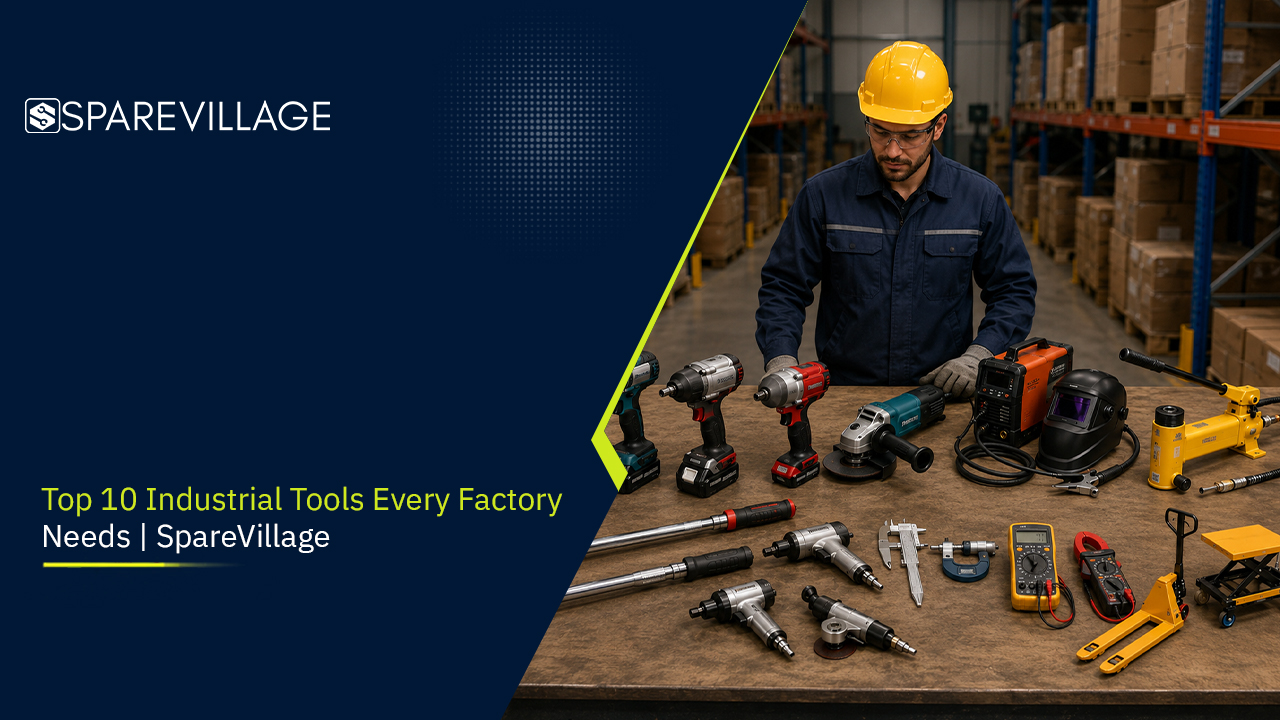
Top 10 Industrial Tools Every Factory Needs | SpareVillage
Industrial tools guide covering the top 10 factory tools, industrial maintenance tools list, heavy duty industrial tools, uses, and buying tips.
Article Content
Introduction: Why the Right Industrial Tools Matter in Modern Manufacturing
Every factory depends on efficiency, consistency, and safety. Whether it is a small manufacturing unit, a fabrication workshop, a warehouse, or a large production facility, the equipment used on the shop floor directly affects productivity. Delays often occur not because of a lack of workforce but because workers do not have access to the right tools when they need them. A well-equipped facility can complete jobs faster, reduce downtime, improve maintenance schedules, and create a safer working environment for employees.
This is where industrial tools play a critical role. From assembly operations and machine maintenance to repair work and material handling, these tools support almost every activity within a manufacturing environment. Selecting the right equipment is not only about improving output. It is also about protecting assets, extending machine life, and maintaining operational standards across departments.
Many businesses focus heavily on machinery investment while overlooking the importance of supporting tools. However, production equipment can only perform effectively when workers have reliable tools available for installation, inspection, troubleshooting, and maintenance tasks. This is why experienced plant managers regularly review their tool inventory and upgrade equipment based on operational requirements.
Today, manufacturing facilities are also moving toward digital procurement. Instead of relying solely on local vendors, businesses prefer sourcing products through trusted platforms that offer multiple brands, transparent pricing, and faster purchasing processes. Companies can now compare products, manage procurement requirements, and purchase quality equipment through a reliable B2B industrial marketplace without disrupting daily operations.
In this guide, we will explore the most important tools that support manufacturing and maintenance teams. We will also discuss how businesses can build a practical toolkit that supports long-term operational efficiency.
Industrial Maintenance Tools List Every Factory Should Have
A factory's success depends not only on production but also on maintenance. Machines operate continuously under demanding conditions. Components experience wear and tear. Fasteners loosen. Bearings require replacement. Electrical connections need inspection. Without a structured industrial maintenance tools list, even minor issues can develop into costly breakdowns.
Maintenance teams require dependable equipment that allows them to inspect, repair, adjust, and service machinery quickly. Every facility should maintain a dedicated collection of hand tools, measuring instruments, fastening equipment, and diagnostic devices. These tools help technicians perform preventive maintenance before problems affect production schedules.
One of the most important categories includes fastening tools. Torque wrenches, socket sets, adjustable spanners, and screwdrivers are frequently used during machine servicing. Accurate fastening prevents vibration-related failures and improves equipment reliability. Measuring instruments such as calipers, micrometers, and digital gauges are equally important because maintenance decisions depend on precise measurements rather than assumptions.
Electrical maintenance also requires specialized equipment. Multimeters, insulation testers, cable tools, and voltage detectors help technicians identify faults safely. Since modern manufacturing relies heavily on automation systems, electrical diagnostics have become an essential part of routine maintenance activities.
Facilities should also include lubrication equipment within their maintenance inventory. Proper lubrication reduces friction, minimizes wear, and extends machine life. Grease guns, oil dispensers, and fluid handling tools help maintenance teams follow scheduled service procedures effectively.
When developing an industrial maintenance tools list, businesses should evaluate their production equipment, maintenance frequency, and operational risks. A maintenance toolkit should support daily inspections, preventive maintenance schedules, emergency repairs, and planned shutdown activities. The goal is to ensure that technicians have immediate access to the equipment required for industrial operations without unnecessary delays.
Many procurement managers now purchase maintenance products through an industrial procurement platform because it simplifies sourcing and allows teams to compare specifications across multiple brands. Access to quality products helps maintenance departments standardize tools across facilities and improve inventory management.
Factories that invest in maintenance tools often experience lower downtime, improved equipment reliability, and better production continuity. More importantly, maintenance teams can resolve issues quickly before they escalate into major operational challenges.
Heavy Duty Industrial Tools for Demanding Factory Operations
Not every task on a factory floor can be handled with standard equipment. Manufacturing plants often operate in demanding environments where tools must withstand continuous usage, high loads, dust, vibration, heat, and challenging working conditions. In such situations, heavy duty industrial tools become essential for maintaining productivity and ensuring operational reliability.
Heavy-duty equipment is designed to perform repetitive tasks without compromising performance. These tools are commonly used in fabrication workshops, automotive manufacturing units, construction material plants, metal processing facilities, warehouses, and engineering industries. Their robust construction allows workers to complete complex tasks with greater precision and reduced effort.
Power drills, impact wrenches, angle grinders, demolition hammers, pneumatic tools, hydraulic equipment, and industrial cutting machines are among the most widely used categories. These tools help technicians perform installation, repair, assembly, fabrication, and maintenance work efficiently. Unlike consumer-grade products, industrial-grade equipment is built for extended operation and can handle higher workloads throughout the day.
Another reason businesses invest in heavy duty industrial tools is worker safety. Tools designed specifically for industrial environments often include advanced safety features, better grip designs, overload protection, and durable components that reduce operational risks. When employees use reliable equipment, they can complete jobs more confidently and with fewer interruptions.
Factories that handle large machinery also depend on lifting and handling equipment. Hydraulic jacks, chain pulley blocks, lifting clamps, and torque multipliers support maintenance teams during equipment installation and servicing. These tools reduce manual effort while improving accuracy and workplace safety.
When evaluating heavy duty industrial tools, businesses should consider factors such as durability, power requirements, maintenance support, spare part availability, and compatibility with existing operations. Purchasing decisions should focus on long-term value rather than initial cost alone. A tool that performs consistently for years often delivers a significantly better return on investment than a lower-priced alternative.
Today, many organizations prefer purchasing through a trusted industrial sourcing platform because it allows procurement teams to compare brands, specifications, and product availability in one place. This approach simplifies purchasing and helps businesses identify equipment that matches operational requirements.
For facilities aiming to improve efficiency, reduce downtime, and support demanding workloads, investing in quality heavy-duty equipment is a practical and necessary decision. These tools form the backbone of reliable industrial operations and support production goals across multiple departments.
Top 10 Industrial Tools for Factories That Support Daily Operations
Every manufacturing facility has unique production requirements, but some tools remain essential across industries. Whether the factory produces automotive components, consumer goods, packaging materials, fabricated structures, or electrical products, workers rely on a common set of equipment to keep operations running smoothly. These are often considered the top industrial tools for factories because they support production, maintenance, inspection, and repair activities throughout the facility.
Below are ten tools that consistently prove valuable in manufacturing environments.
1. Power Drills
Power drills are among the most frequently used tools in industrial settings. They assist with drilling holes, fastening components, equipment installation, and maintenance work. Modern drills offer multiple speed settings and compatibility with various drill bits, making them suitable for different materials including metal, wood, plastic, and composite materials.
Production teams often use power drills during assembly processes, while maintenance teams rely on them during machine servicing and repairs. Their versatility makes them one of the most practical tools found in any manufacturing facility.
2. Impact Wrenches
Factories that work with machinery, vehicles, structural assemblies, or heavy equipment frequently depend on impact wrenches. These tools deliver high torque output and allow workers to tighten or remove fasteners quickly.
Compared with manual methods, impact wrenches significantly reduce effort and improve efficiency. They are commonly used in automotive plants, fabrication units, maintenance departments, and equipment installation projects.
3. Angle Grinders
Angle grinders support a wide range of industrial applications. Workers use them for cutting, grinding, polishing, surface preparation, and finishing operations. Because manufacturing facilities process different materials, angle grinders often become one of the most versatile tools available on the shop floor.
They are widely used in welding shops, fabrication units, construction material manufacturing plants, and repair workshops where precision cutting and finishing are required.
4. Measuring and Inspection Instruments
Accurate measurements play a critical role in quality control and maintenance. Tools such as calipers, micrometers, dial indicators, thickness gauges, and measuring tapes help technicians verify dimensions and maintain production standards.
These instruments are considered part of the essential industrial tools for manufacturing plants because product quality depends on precision. Even small measurement errors can affect performance, safety, and customer satisfaction.
5. Torque Wrenches
Proper fastening is critical in manufacturing. Over-tightening can damage components, while under-tightening can create safety risks and equipment failures. Torque wrenches help workers apply the correct amount of force during assembly and maintenance operations.
Industries such as automotive manufacturing, engineering, aerospace, and heavy machinery production rely heavily on torque-controlled fastening procedures.
6. Pneumatic Tools
Compressed air-powered equipment remains a popular choice in many facilities because of its reliability and performance. Pneumatic drills, impact tools, grinders, and fastening equipment offer consistent operation while reducing operator fatigue.
Many factories include pneumatic equipment within their industrial tools list for factories because these tools are suitable for high-volume production environments where speed and durability are important.
7. Welding Equipment
Welding operations remain essential across multiple sectors. Manufacturing facilities use welding machines for fabrication, repairs, structural assembly, and equipment maintenance. Depending on requirements, businesses may use MIG, TIG, or arc welding systems.
Quality welding equipment helps ensure strong joints, improved durability, and consistent production standards. For metalworking operations, welding tools are often among the industrial equipment every factory needs.
8. Hydraulic Tools
Hydraulic equipment provides controlled force for lifting, pressing, pulling, and positioning heavy components. Hydraulic jacks, presses, pullers, and crimping tools support both maintenance and production activities.
Facilities that handle large machinery often depend on hydraulic solutions because manual methods may be inefficient or unsafe. These tools improve productivity while reducing physical strain on workers.
9. Electrical Testing Equipment
Modern manufacturing increasingly depends on electrical systems, automation controls, sensors, and motor-driven equipment. Maintenance teams require testing devices such as multimeters, clamp meters, voltage detectors, and insulation testers to diagnose problems quickly.
Electrical testing equipment supports preventive maintenance programs and helps reduce unexpected downtime. These devices are considered some of the most important must-have tools for factory maintenance because electrical failures can disrupt entire production lines.
10. Material Handling Equipment
Efficient movement of materials contributes directly to operational performance. Pallet trucks, lifting equipment, trolleys, hoists, and handling accessories help workers transport products safely throughout the facility.
Material handling solutions reduce manual effort, improve workplace safety, and support smoother workflow management. For warehouses and manufacturing facilities alike, these tools play an important role in daily operations.
Building a Practical Tool Strategy for Long-Term Growth
The most successful factories do not simply purchase tools when problems arise. Instead, they develop a structured approach that aligns tool investments with production goals, maintenance schedules, and future growth plans. Businesses that maintain a well-organized inventory can respond faster to equipment issues, reduce downtime, and improve workforce efficiency.
A practical strategy should include equipment for maintenance, assembly, inspection, repair, fabrication, and material handling. It should also account for future operational requirements as production capacity expands. This is why procurement teams regularly review their tool inventory and update purchasing plans based on changing business needs.
Organizations searching for the best industrial tools for production facilities often prioritize reliability, safety, and long-term performance over short-term savings. A dependable tool inventory supports smoother operations and allows workers to perform tasks efficiently across multiple departments.
Whether the objective is production growth, maintenance improvement, or workplace safety, selecting the right tools remains one of the most valuable investments a factory can make.
How Different Industries Use Industrial Tools to Improve Operations
The role of tools extends far beyond production floors. Different industries depend on specialized equipment to maintain efficiency, improve safety, and support daily operations. While the exact requirements vary from one sector to another, the objective remains the same: complete work accurately, safely, and within scheduled timelines. Understanding how various industries use these tools helps businesses make informed purchasing decisions and build a tool inventory that supports long-term operational goals.
Manufacturing Industry
Manufacturing facilities depend on a wide range of equipment for assembly, fabrication, maintenance, inspection, and packaging activities. Production teams use drills, grinders, fastening tools, measuring instruments, and welding equipment to maintain product quality and meet output targets.
Maintenance departments also rely on a structured factory maintenance tools checklist to ensure machines operate efficiently. Regular inspections, preventive maintenance, and quick repairs help manufacturers reduce downtime and avoid costly production interruptions. As factories continue to modernize, procurement teams increasingly look for reliable suppliers that can provide multiple product categories through a single purchasing channel.
Automotive Industry
Automotive manufacturing and repair facilities require precision, consistency, and speed. Technicians regularly use torque wrenches, impact tools, hydraulic equipment, diagnostic devices, and lifting systems to assemble and maintain vehicles.
Because automotive production often involves high-volume operations, equipment reliability becomes extremely important. Even a small delay on an assembly line can affect production schedules. This is why automotive businesses invest in quality industrial power tools for manufacturing and maintenance operations. These tools help technicians achieve accurate results while maintaining productivity across the facility.
Construction and Infrastructure Industry
Construction projects depend heavily on equipment that can perform under demanding site conditions. Contractors use cutting tools, drilling equipment, demolition hammers, measuring instruments, and material handling systems throughout project execution.
In addition to construction work itself, infrastructure projects require ongoing equipment maintenance and repair. Reliable tools help teams complete tasks efficiently while meeting safety requirements. Whether working on commercial buildings, industrial facilities, or infrastructure developments, construction professionals depend on durable equipment that can withstand continuous usage.
Warehousing and Logistics Industry
Warehouses may not operate production lines, but they still require specialized tools to manage inventory, material movement, packaging, and facility maintenance. Pallet trucks, lifting equipment, packaging tools, labeling systems, and maintenance equipment all contribute to operational efficiency.
Warehouse managers understand that delays in material handling can affect the entire supply chain. Having access to the right equipment helps businesses improve storage operations, reduce handling errors, and maintain smooth inventory movement. As logistics networks continue to grow, investing in quality tools becomes increasingly important.
Agriculture and Farming Industry
Modern agriculture relies on equipment for irrigation systems, equipment maintenance, fencing, storage facilities, and machinery repairs. Farmers and agricultural businesses often require durable tools that can perform reliably in outdoor environments.
Maintenance teams regularly service tractors, pumps, harvesting equipment, and storage infrastructure. Access to dependable tools helps reduce equipment downtime during critical farming periods. As agricultural operations become more technology-driven, procurement decisions increasingly focus on reliability and long-term value.
Electrical and Engineering Industry
Electrical contractors and engineering businesses depend on testing equipment, cable tools, diagnostic instruments, fastening tools, and installation equipment. Accuracy and safety are critical because electrical systems require precise work and compliance with industry standards.
Testing devices help technicians identify faults, inspect systems, and perform maintenance safely. Engineering projects also require specialized equipment for installation, fabrication, and commissioning activities. Having access to quality tools improves project efficiency while supporting workplace safety requirements.
Simplifying Industrial Procurement with SpareVillage
Finding reliable suppliers can be challenging for businesses that purchase products from multiple categories. Procurement teams often spend significant time comparing vendors, checking product availability, negotiating pricing, and managing separate purchasing processes.
SpareVillage was created to simplify this experience. As a growing factory tools marketplace, SpareVillage helps businesses discover products across multiple industrial categories through a single platform. Instead of working with numerous suppliers, organizations can explore a broad range of products and compare options more efficiently.
Businesses looking for an industrial tools supplier can explore products that support maintenance teams, production departments, engineering projects, and warehouse operations. The platform is designed to help organizations source products more conveniently while improving procurement efficiency.
Beyond tools, SpareVillage supports various business requirements through categories such as:
- Safety and PPE Supplies
- Industrial Tools and Equipment
- Electrical Tools and Equipment
- Healthcare Medical and Lab Supplies
- Agriculture and Farming Products
- Office Supplies
- Construction Materials
- Packaging and Material Handling Solutions
- Automotive Products
This category coverage allows businesses to manage multiple purchasing requirements from a single source. Whether a company requires safety equipment, maintenance products, packaging materials, or engineering supplies, the platform supports a wide range of industrial procurement needs.
Many businesses today prefer purchasing industrial tools online because it reduces sourcing time and improves visibility into product options. Digital procurement also helps procurement teams compare specifications, manage purchasing decisions, and streamline supplier evaluation processes.
For organizations seeking an industrial equipment supplier India can trust, SpareVillage continues to expand its product offerings while supporting businesses across different industries. The platform aims to simplify procurement by connecting buyers with quality products and trusted suppliers.
Companies interested in expanding their reach can also become sellers through the SpareVillage vendor platform. Businesses can visit vendor.sparevillage.com to register and start showcasing their products to industrial buyers across multiple sectors.
The future of procurement is increasingly digital. Businesses that adopt efficient sourcing methods can improve purchasing efficiency, reduce procurement delays, and access a wider range of products through a modern industrial sourcing platform.
Frequently Asked Questions (FAQs)
1. What industrial tools can I find on SpareVillage?
SpareVillage offers a wide range of industrial tools for manufacturing, maintenance, repair, assembly, and inspection tasks. Businesses can explore products across multiple industrial categories based on their operational requirements.
2. Does SpareVillage provide industrial tools for factories and manufacturing plants?
Yes, SpareVillage provides industrial tools that support factory operations, machine maintenance, fabrication work, production activities, and warehouse management across various industries.
3. Can SpareVillage help businesses create an industrial maintenance tools list?
Yes, SpareVillage offers products commonly included in an industrial maintenance tools list, such as hand tools, measuring instruments, electrical testing equipment, fastening tools, and maintenance accessories.
4. Does SpareVillage offer heavy duty industrial tools for industrial applications?
Yes, SpareVillage provides heavy duty industrial tools suitable for demanding environments, including manufacturing facilities, engineering workshops, construction sites, and maintenance operations.
5. Why should businesses buy industrial tools from SpareVillage?
SpareVillage helps businesses simplify procurement by providing access to multiple industrial product categories, supplier options, and purchasing solutions through a single platform.
6. Can I buy industrial tools online from SpareVillage?
Yes, businesses can buy industrial tools online from SpareVillage and explore products for manufacturing, maintenance, safety, electrical work, material handling, and other industrial applications.
7. What product categories are available on SpareVillage besides industrial tools?
In addition to industrial tools, SpareVillage offers Safety & PPE Supplies, Electrical Tools & Equipment, Healthcare Medical & Lab Supplies, Agriculture & Farming Products, Office Supplies, Construction Materials, Packaging & Material Handling Products, and Automotive Solutions.
8. How does SpareVillage support industrial procurement?
SpareVillage acts as a digital sourcing platform where businesses can discover products, compare options, and manage purchasing requirements more efficiently than traditional procurement methods.
9. Can manufacturers and suppliers sell products through SpareVillage?
Yes, manufacturers, distributors, and suppliers can register on the SpareVillage vendor platform and connect with industrial buyers looking for products across multiple categories.
10. How can I learn more about industrial products from SpareVillage?
Businesses can visit the SpareVillage website and follow the SpareVillage YouTube channel for product information, buying guides, industry insights, procurement tips, and educational content.