Essential Maintenance Tools for Manufacturing Plants | Sparevillage
Maintenance Tools every manufacturing plant needs. Explore essential tools list for factory maintenance, plant operations & equipment reliability.
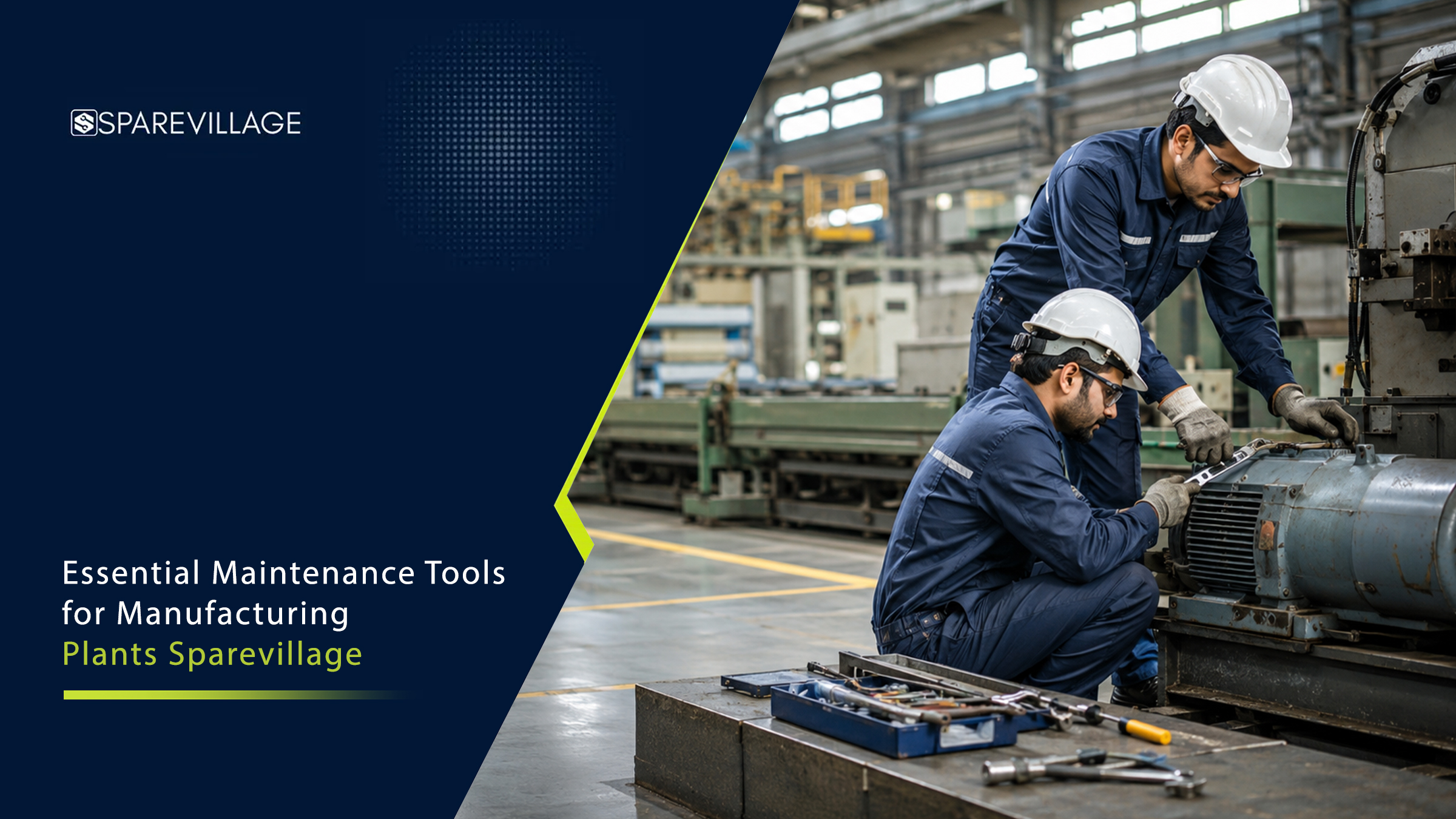
Article Content
Introduction
Running a manufacturing plant is not easy. Every single day, your machines work hard. They run for long hours. They handle heavy loads. And over time, they wear out. That is why having the right maintenance tools in your plant is not optional, it is absolutely necessary.
Whether you own a small production unit or a large industrial facility, your factory's performance depends on how well you maintain your equipment. The right maintenance tools help you catch problems early. They reduce unexpected breakdowns. They keep your production line running without costly interruptions.
Many plant owners and factory managers search for the best maintenance tools to build a reliable maintenance system. But they often feel confused about where to start. Which tools are truly essential? What does a complete maintenance toolkit look like? How do you choose the right equipment for your specific factory needs?
In this blog, we answer all these questions. We cover everything from basic hand tools to advanced diagnostic instruments. We explain what each tool does and why it matters for your factory. By the end of this article, you will have a clear picture of what your plant maintenance team needs. So let us get started.
Why Maintenance Tools Matter in a Manufacturing Plant
Every factory owner knows the pain of unplanned downtime. A single machine failure can stop your entire production line. It can delay deliveries, increase costs, and hurt your business reputation. This is where proper plant maintenance equipment plays a big role.
Good maintenance tools help you in two important ways. First, they support preventive maintenance, which means checking and servicing machines before they break down. Second, they support predictive maintenance, which means using data and instruments to predict when a machine might fail.
Both approaches save you money in the long run. They extend the life of your industrial machinery. They improve machine performance. And they reduce the risk of accidents on the factory floor.
A well-maintained plant is also a safer plant. Worn-out parts, loose connections, or overheated motors can cause serious safety hazards. The right tools help your maintenance team identify these risks early.
When you invest in quality plant maintenance equipment, you are not spending money. You are saving it. You are protecting your machines. You are protecting your workers. And most importantly, you are protecting your production efficiency.
Many experienced plant engineers follow a Total Productive Maintenance (TPM) approach. This strategy involves everyone, from operators to supervisors, in keeping machines in top condition. And it all starts with having the right tools available at the right time.
Essential Maintenance Tools List Every Factory Must Have
Every plant manager should have a clear maintenance tools list before setting up a maintenance program. Without the right tools, even the most skilled technician cannot do a proper job. Let us look at the most important categories.
Hand Tools for Maintenance
Hand tools are the foundation of any maintenance toolkit. These are the tools your team uses every day.
Spanners and wrenches — for tightening and loosening bolts and nuts
Screwdrivers (flat and Phillips) — for panel access and component fitting
Pliers and cutters — for electrical and mechanical work
Hammers and mallets — for assembly and disassembly tasks
Files and chisels — for surface finishing and metal work
Torque wrench — one of the most important tools in mechanical maintenance. It ensures bolts are tightened to the exact specification. Over-tightening or under-tightening can damage machine parts or cause failures.
A good set of hand tools is non-negotiable. Every maintenance technician should have a personal toolkit with these basics.
Power Tools for Maintenance
Power tools speed up maintenance work. They reduce manual effort and improve accuracy.
Electric drills and impact drivers — for fast assembly and disassembly
Angle grinders — for cutting and grinding metal parts
Cordless ratchets — for working in tight spaces
Power saws — for cutting pipes and structural parts during repair work
Power tools help your team complete industrial repair work faster and with less fatigue. This is especially important during breakdown maintenance, when speed matters most.
Measuring Instruments
Accurate measurements are the backbone of good maintenance. Without them, you are just guessing.
Vernier calipers and micrometers — for precise dimensional measurement
Dial gauges — for checking shaft alignment and runout
Pressure gauges — for monitoring hydraulic and pneumatic systems
Thermometers — for checking operating temperatures
These calibration tools ensure that every component is installed and operating within its correct tolerance. They are essential for routine equipment inspection.
Diagnostic and Inspection Tools for Modern Factories
Modern factories need more than basic hand tools. They need smart diagnostic tools that can detect hidden problems before they become serious failures. This section covers the most important inspection and diagnostic equipment for industrial maintenance.
Multimeter
A multimeter is one of the most used electrical maintenance tools in any factory. It measures voltage, current, and resistance. Your electricians use it to check motor windings, control panels, and wiring systems. Without a good multimeter, electrical troubleshooting becomes guesswork.
Infrared Thermometer
An infrared thermometer helps your team detect heat-related problems without touching the equipment. Overheating is one of the leading causes of motor failures, bearing damage, and electrical faults. By scanning machines regularly with an infrared thermometer, your team can spot hot spots early. This is a key part of any condition monitoring program.
Vibration Analyzer
A vibration analyzer is used for machine health monitoring. Abnormal vibration is often the first sign that something is wrong inside a machine, like a worn bearing, misalignment, or imbalance. Using a vibration analyzer regularly gives your team early warning of developing faults. This makes it one of the most valuable predictive maintenance tools available today.
Bearing Puller
A bearing puller is used to safely remove bearings from shafts and housings without damaging the parts. Bearing replacement is one of the most common tasks in factory maintenance. A proper bearing puller makes this job clean, safe, and efficient. Using the wrong method can damage the shaft or the housing, leading to costly repairs.
Borescope / Inspection Camera
An inspection camera allows your technicians to look inside machines, pipes, and enclosed spaces without disassembly. This saves time and reduces the risk of unnecessary teardowns.
These diagnostic tools are not luxury items. They are essential for any plant that wants to move from reactive maintenance to a proactive maintenance planning approach.
Lubrication Tools and Their Role in Equipment Reliability
One of the most overlooked areas of factory maintenance is lubrication. Improper lubrication is responsible for nearly 50% of all bearing failures in industrial machinery. Having the right lubrication tools is critical for equipment reliability.
Grease Guns
A good grease gun helps your team apply the right amount of grease to bearings, joints, and other moving parts. Manual grease guns are common. But pneumatic grease guns are faster and better for high-volume lubrication tasks.
Oil Dispensers and Funnels
Clean oil dispensers help prevent contamination during oil top-ups. Contaminated oil is one of the leading causes of gear and bearing wear in factory equipment.
Lubrication Charts and Schedules
While not a physical tool, a proper lubrication schedule is part of your maintenance toolkit. It tells your team which machine needs lubrication, how much, and how often.
Grease Fittings and Zerks
These small but important fittings allow your team to grease bearings without disassembly. Having the right fittings on all your machines makes lubrication faster and more consistent.
Lubrication is a simple task. But doing it correctly and consistently makes a massive difference in machine servicing outcomes. It directly impacts equipment downtime and machine performance across your entire production line.
Proper lubrication practices also extend the equipment lifecycle significantly. This is why asset maintenance programs always include a strong lubrication component.
Electrical Maintenance Tools for Safe and Efficient Operations
Electrical systems are the backbone of any factory. Motors, control panels, drives, and wiring must all be maintained carefully. The right electrical maintenance tools help your team do this safely and effectively.
Clamp Meter
A clamp meter measures current without breaking the circuit. It is safer and faster than using a standard multimeter for current measurements. Your electricians will use this daily.
Insulation Resistance Tester (Megger)
This tool tests the insulation of motors, cables, and wiring. Poor insulation leads to electrical leakage, short circuits, and motor burnout. Regular insulation testing is part of a good preventive maintenance program.
Phase Sequence Tester
This small but important tool checks the phase sequence of three-phase motors. An incorrect phase sequence causes motors to run in reverse, which can damage equipment and create safety hazards.
Electrical Panel Inspection Tools
For electrical panel inspection, your team needs a combination of tools, multimeter, thermal camera, insulation tester, and proper PPE (personal protective equipment). Never skip PPE during any electrical maintenance task. Industrial safety equipment is just as important as diagnostic tools.
Cable Tester
A cable tester helps identify faulty cables, open circuits, and short circuits. This speeds up equipment troubleshooting significantly.
Maintaining electrical systems is one of the most important aspects of plant operations. Poor electrical maintenance leads to equipment failures, production stoppages, and in worst cases, fires or accidents. Always follow proper maintenance safety procedures during electrical work.
Building a Maintenance Tool Kit: Practical Tips for Plant Owners
Now that you know what tools you need, let us talk about how to build a proper maintenance tool kit for your factory. A random collection of tools is not enough. You need a structured approach.
Step 1 — Assess Your Plant Needs
Start by listing all the machines in your factory. Understand what type of maintenance each machine requires. This helps you identify which tools are most critical for your specific operations.
Step 2 — Prioritize by Maintenance Type
Organize your toolkit based on maintenance types:
Basic hand tools — for daily and routine maintenance tasks
Electrical tools — for motor and panel maintenance
Diagnostic tools — for predictive and condition-based maintenance
Lubrication tools — for all rotating equipment
Step 3 — Invest in Quality
Do not buy cheap tools to save money. Poor quality tools break easily. They give inaccurate readings. They can even cause accidents. Invest in certified, quality-tested industrial equipment maintenance tools.
Step 4 — Create a Tool Management System
Label all tools. Keep them organized in a dedicated tool room or toolbox. Train your team on proper tool usage and storage. A good maintenance management system includes proper tool tracking.
Step 5 — Review and Update Regularly
Your factory will grow. New machines will arrive. Your tool needs will change. Review your maintenance tools list every 6 to 12 months. Add new tools as your plant evolves.
Step 6 — Train Your Maintenance Team
Tools are only as effective as the people using them. Invest in regular training for your maintenance team. Teach them how to use diagnostic tools, how to read measurements, and how to follow maintenance scheduling correctly.
Building a complete maintenance tool kit takes time and planning. But it is one of the best investments you can make for your factory's long-term performance and operational efficiency.
SpareVillage — Your Trusted Source for Industrial Maintenance Tools
When you are looking for reliable equipment tools for your manufacturing plant, you need a supplier you can trust. That is where SpareVillage comes in.
SpareVillage is one of India's growing industrial procurement platforms. It connects factory owners, plant engineers, MSMEs, and maintenance teams with verified suppliers of quality industrial tools and equipment. Whether you need basic hand tools, advanced diagnostic equipment, or specialized factory maintenance tools, SpareVillage has a wide range to explore.
Here is why plant owners and maintenance managers trust SpareVillage:
Wide Product Range — From torque wrenches to vibration analyzers, from lubrication tools to electrical testing equipment, SpareVillage offers a comprehensive catalog of industrial maintenance equipment.
Verified Suppliers — Every supplier on the platform is vetted. You get genuine, quality-certified products.
Competitive Pricing — As a B2B platform, SpareVillage offers factory-friendly pricing that works for both small units and large manufacturers.
Easy Online Ordering — Browse, compare, and order industrial tools from the comfort of your office. No need to visit multiple markets.
Pan-India Delivery — SpareVillage delivers across India, making it easy for factories in smaller cities and industrial zones to access quality tools.
Expert Support — The SpareVillage team understands industrial needs. They can help you find the right equipment tools for your specific application.
Whether you are building a new maintenance toolkit from scratch or upgrading your existing set of equipment tools, SpareVillage makes the process simple, reliable, and cost-effective.
We also encourage you to explore their collections across different industries. SpareVillage covers tools for CNC machine maintenance, conveyor system maintenance, pump maintenance, compressor maintenance, hydraulic system maintenance, and much more.
Visit SpareVillage today and explore their extensive catalog of industrial maintenance tools. Finding the right tools for your factory has never been easier.
Also Read These Helpful Blogs from SpareVillage
If you found this article useful, you will love these other in-depth blogs from SpareVillage. They are written specifically for factory owners, plant engineers, and industrial buyers like you.
📖 Benefits of Buying Industrial Products Online in India — Learn why more plant owners are switching to online procurement and how it saves time and money.
📖 SpareVillage: Your Trusted Partner for Industrial Procurement Platform — Discover how SpareVillage is changing the way India buys industrial products.
📖 How SpareVillage Connects MSMEs with Industrial Suppliers — A must-read for small and medium manufacturers looking for reliable supplier networks.
📖 Top 10 Industrial Tools Every Factory Needs | SpareVillage — A quick and practical guide to the most important tools for any factory floor.
📖 How SpareVillage Connects Buyers with Verified Industrial Material Suppliers — Understand how the platform ensures quality and trust in every transaction.
Conclusion
Maintaining a manufacturing plant is a serious responsibility. Your machines, your workers, and your business all depend on how well you manage maintenance. And good maintenance starts with having the right tools.
From basic hand tools and torque wrenches to advanced instruments like vibration analyzers and infrared thermometers, every tool on your maintenance toolkit plays a role. They help you prevent breakdowns. They help you detect problems early. They help you keep your production line running efficiently.
Start by making a proper maintenance tools list for your factory. Understand what each machine needs. Build your toolkit step by step. Train your team. And always invest in quality tools from trusted suppliers.
If you are ready to equip your factory with the best industrial maintenance tools, start your journey at SpareVillage. Explore their wide collection of factory maintenance tools, diagnostic equipment, lubrication tools, and more. Choose the tools that match your factory's needs and take your plant maintenance program to the next level.
Your machines work hard for you. Give them the care they deserve. Visit SpareVillage today.
Have questions about which tools are right for your plant? Explore the SpareVillage catalog or reach out to their industrial procurement experts for guidance.
FAQs
FAQ 1: What are the most essential maintenance tools every manufacturing plant must have?
Every plant needs a mix of basic and advanced tools. Start with hand tools, spanners, screwdrivers, pliers, and a torque wrench. Add measuring instruments like vernier calipers and pressure gauges. Then include diagnostic tools like a multimeter, infrared thermometer, and vibration analyzer. These cover most of your daily and preventive maintenance needs. Without these, your team cannot do proper maintenance work.
FAQ 2: My machines break down frequently. Can the right tools actually reduce this problem?
Yes, absolutely. Most unexpected breakdowns happen because problems go undetected for too long. The right diagnostic tools, like a vibration analyzer and infrared thermometer, help you spot issues early. You fix small problems before they become big failures. This is called predictive maintenance. It directly reduces machine downtime and saves repair costs.
FAQ 3: What is the difference between preventive maintenance and predictive maintenance tools?
Preventive maintenance tools are used on a fixed schedule. You service the machine regularly, whether it shows a problem or not. Tools like grease guns, torque wrenches, and insulation testers are used here. Predictive maintenance tools monitor machine condition in real time. Vibration analyzers, infrared thermometers, and condition monitoring instruments fall in this category. They tell you when a machine actually needs attention, not just when the calendar says so.
FAQ 4: We are a small manufacturing unit. Do we really need expensive diagnostic tools?
Yes, even small units need them. You do not have to buy everything at once. Start with the basics. A good multimeter, an infrared thermometer, and a vibration analyzer are not luxury items. They are investments. One avoided breakdown will save you more than what these tools cost. As your plant grows, you can expand your toolkit step by step.
FAQ 5: Why is lubrication so important, and what lubrication tools do we need?
Improper lubrication causes nearly 50% of all bearing failures in factories. That is a huge number. It means many breakdowns are completely preventable. You need a good grease gun, manual or pneumatic. You also need clean oil dispensers to avoid contamination. A proper lubrication schedule is equally important. Without it, your team may miss machines or apply the wrong amount of grease. Consistent lubrication directly improves equipment reliability and machine life.
FAQ 6: Is a torque wrench really necessary, or can we just use a regular spanner?
A torque wrench is necessary. A regular spanner gives you no control over tightening force. Over-tightening can crack or strip bolts. Under-tightening can cause parts to come loose during operation. Both situations lead to machine damage or safety risks. A torque wrench lets you tighten bolts to the exact specification every time. It is one of the most important tools for mechanical maintenance in any factory.
FAQ 7: What electrical maintenance tools should every factory have for motor and panel maintenance?
Your team needs at least four tools for electrical maintenance. First, a multimeter, for checking voltage, current, and resistance. Second, a clamp meter, for safe current measurement without breaking the circuit. Third, an insulation resistance tester (megger), for checking motor and cable insulation. Fourth, a phase sequence tester, to ensure three-phase motors are connected correctly. Always pair these with proper safety equipment like insulated gloves and PPE. Never skip safety during electrical work.
FAQ 8: How often should we review and update our maintenance tool kit?
Review your maintenance tools list at least every 6 to 12 months. Your factory changes over time. New machines arrive. Old equipment gets retired. Your tool needs will change with it. Also check existing tools for wear and damage. A damaged tool gives wrong readings or can cause accidents. Replace worn-out tools immediately. Regular reviews keep your maintenance team ready and your plant safe.
FAQ 9: Where can we buy genuine and quality industrial maintenance tools in India?
SpareVillage is a reliable option for industrial buyers in India. It is an online B2B procurement platform that connects factory owners and plant engineers with verified industrial suppliers. You can find everything from basic hand tools to advanced diagnostic equipment on one platform. Suppliers are vetted, so you get genuine and quality-certified products. They also offer pan-India delivery, which is great for factories in smaller cities and industrial zones. Visit SpareVillage and explore their industrial maintenance tools catalog.
FAQ 10: How do we train our maintenance team to use these tools correctly?
Training is as important as the tools themselves. A good tool in the wrong hands gives wrong results. Start with basic tool safety training for all technicians. Then give hands-on training on diagnostic tools, especially vibration analyzers and insulation testers. These require proper technique to give accurate readings. Create standard operating procedures (SOPs) for using each tool. Review these SOPs regularly. Also encourage your team to follow a maintenance schedule, so tools are used at the right time, on the right machines, in the right way.