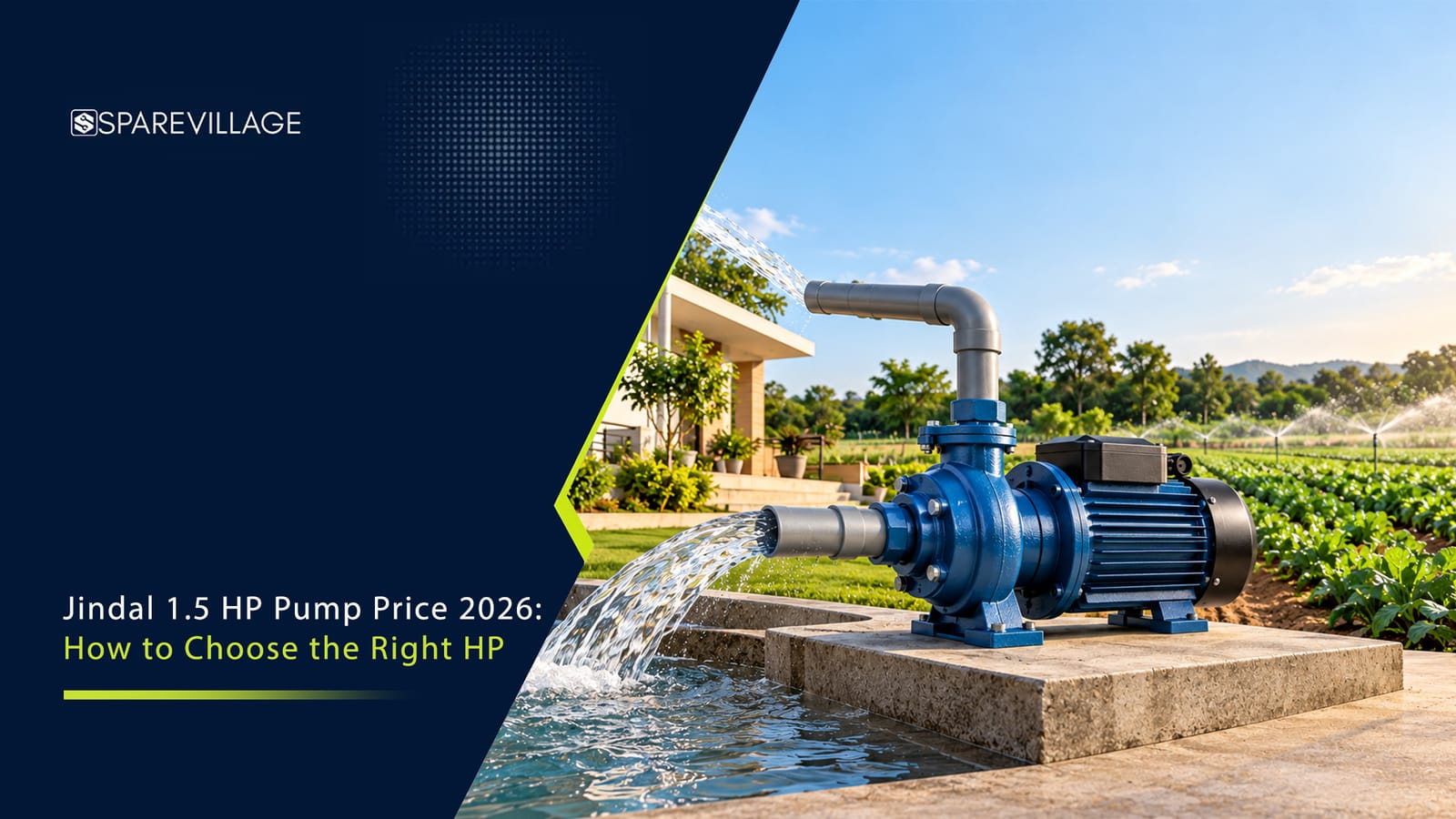
Jindal 1.5 HP Pump Price 2026: How to Choose the Right HP
Looking for the Jindal 1.5 HP submersible pump price? See how 1 HP, 1.5 HP, 2 HP and 3 HP pumps compare, and find out which HP suits your borewell.
Article Content
Intro : Choosing a submersible pump involves more than comparing prices. You also need to consider your borewell's water level, required water flow, delivery height and daily water demand. If you are looking for the Jindal submersible pump 1.5 HP price, this guide will help you compare available models, understand approximate online prices and choose a suitable horsepower for your requirements. Jindal Submersible Pump 1.5 HP Price in 2026 The Jindal submersible pump 1.5 HP price varies by model, stage count, motor construction, cooling type, included accessories and warranty. On SpareVillage, listed 1.5 HP models fall into different price ranges. Check the exact product specifications and current listing before placing an order. Based on the Jindal 1.5 HP products listed on SpareVillage, the approximate online price range is ₹6,500–₹9,500. This is an indicative range covering different models and packages, not a fixed price for every 1.5 HP pump. For example, the available listings include a 12-stage oil-filled model with a control panel, a water-filled model sold without a control panel, and water-filled models supplied with a control panel or submersible cable. These packages have different prices because their specifications and included parts are not the same. You can review these examples on SpareVillage: Prices can change with listing updates, seller offers and availability. Offline sellers may also quote different prices. Treat the range as a guide and check the live listing for the current online price. Two pumps with the same horsepower may have different prices because they can use different designs and come with different accessories. Check these details before comparing models: Number of stages: Compare the stage count and the model's head and flow specifications. Motor cooling: Confirm whether the motor is oil-filled or water-filled. Motor winding: Check the listed winding material. Power supply: Confirm whether the model matches your available electrical supply. Included accessories: Check whether the package includes a control panel, submersible cable or safety wire. Warranty: Read the coverage period and conditions for the specific model. Total purchase cost: Check applicable taxes, delivery charges and installation expenses. For example, a pump supplied with a control panel and cable may cost more than a pump-only model. Compare the complete package before deciding which option offers better value. SpareVillage is a B2B marketplace where buyers can explore products for business and other practical requirements. You can visit the Submersible Pumps category to review available models and compare their specifications. You can also explore the wider Water Pumps category or browse Pumps and Motors for other equipment options. Before buying, confirm the current price, availability, delivery details and warranty for your selected model. Jindal submersible pump prices vary by horsepower, model design, stage count and included accessories. The table below gives indicative online prices for selected models listed on SpareVillage. It does not represent a fixed price list for every Jindal pump. Approximate Jindal submersible pump prices Important: These are rounded, indicative online prices based on the available SpareVillage listings checked for this article. They are not guaranteed selling prices. Offline prices may differ, and current prices can change. The 1 HP price has been left unconfirmed rather than estimated without sufficient listing evidence. The 3 HP range is based on a more limited price sample than the 1.5 HP and 2 HP ranges. Check the current listing before relying on it. Jindal motor 2 HP price The Jindal motor 2 HP price depends on the exact pump set and the accessories supplied with it. The selected 2 HP listings on SpareVillage fall within an approximate online range of ₹8,800–₹11,800. For example, one listed model is a 15-stage, single-phase, pure copper, oil-filled borewell pump set. Its package includes a control panel, safety wire and submersible cable. Other models may have different specifications or included parts. You can compare these listings: The prices displayed on these pages may change. Check the current listing and compare the package contents before ordering. Horsepower alone does not tell you how much water a pump can deliver at a particular height. The pump's head and flow characteristics are important, along with its motor design and installation requirements. Accessories also affect the total cost. A package that includes a control panel, cable and safety wire should not be compared directly with a pump-only package without accounting for those parts. The same applies to warranty terms. Different models can have different coverage periods and conditions. Read the warranty details for the exact product instead of assuming all models offer the same coverage. For a fair comparison, first identify the flow and head you need. Then compare the models that can meet those requirements and review their current online prices. The right horsepower depends on the required water flow, total pumping head and the borewell's water supply. A 1 HP, 1.5 HP, 2 HP or 3 HP pump may suit different installations, but you should select a model only after checking its performance at your required operating conditions. When should you consider a 1 HP pump? A 1 HP pump may suit a lower-demand application if its performance specifications meet the required flow and head. For example, a small water-storage system may need less water per minute than a farm irrigation system. A suitable 1 HP model may be enough when the water level, delivery height and required flow fall within its operating range. However, a lower price or a shallow borewell does not automatically make a 1 HP pump the right choice. Check the pumping water level, pipe losses and required discharge before buying. The exact 1 HP model matters as much as its motor rating. Compare its performance specifications with the actual site requirements. When should you consider a 1.5 HP pump? A 1.5 HP pump may be suitable when its performance range meets your required flow and pumping head. If you are comparing the Jindal submersible pump 1.5 HP price, check the model's stage count, head range, discharge information, motor cooling type and included accessories. A 1.5 HP rating does not guarantee that a pump will suit every borewell. Models with the same motor power can have different operating ranges. Before selecting one, identify the required water flow and total dynamic head. Then check whether the selected model can deliver the required flow at that head. When should you consider a 2 HP pump? A 2 HP pump may be worth considering when your required flow or pumping head exceeds what a suitable lower-powered model can provide. For agricultural use, consider the water demand of your irrigation system, the number of outlets operating at the same time and the available irrigation hours. For tank filling, consider the tank capacity and the time available to fill it. A higher-powered pump is not automatically better. If it draws water faster than the borewell can replenish it, the pumping water level may fall during operation. Check the borewell's sustainable water yield and the selected pump's performance before moving to a higher horsepower. When should you consider a 3 HP pump? A 3 HP pump may suit an installation with higher flow or head requirements if the selected model can meet the required operating conditions. Before buying, confirm the borewell diameter, pumping water level, delivery pipe, required flow and available electrical supply. A higher-power motor also requires a suitable electrical installation and correctly selected protection equipment. Do not choose 3 HP simply because you want to lift water from a greater depth. Compare the performance curves of the available models and select one that meets the required duty point. Does higher HP always mean more water? No. Higher horsepower does not guarantee a higher water discharge in every installation. A pump's discharge depends on its design and the head against which it operates. Its maximum discharge may be stated at a low head, while its maximum head may be stated at little or no discharge. For this reason, compare the flow rate at your required total dynamic head instead of relying only on horsepower or a maximum head figure. Which HP Submersible Pump Is Suitable for a 200-Foot Borewell? There is no single horsepower rating that suits every 200-foot borewell. The correct pump depends on the pumping water level, required flow, delivery height, pipe losses, borewell yield and the selected model's performance curve. Why is borewell depth not enough? The total borewell depth and the depth from which the pump must lift water are not necessarily the same. A borewell may be drilled to 200 feet, but its water level may stand much closer to the surface. The water level can also fall when the pump starts operating. These terms help explain the difference: Total borewell depth: The full depth of the drilled borewell. Static water level: The water level when the pump is not operating and the well has recovered. Pumping water level: The water level while the pump is running. Total dynamic head: The combined head needed to lift and deliver water, including the effect of outlet pressure and pipe losses. The pumping water level is especially important when selecting a pump. The pump must also deliver water to the required outlet or tank at the flow rate you need. How do you estimate the required pumping head? Total dynamic head includes the vertical lift from the pumping water level, the required outlet pressure and friction losses through the delivery pipe and fittings. For example, if the pumping water level is below the ground and water must be delivered to an elevated tank, the required head includes both the lift from the pumping water level and the tank's height above ground. Pipe friction and any required outlet pressure must also be considered. This is an illustration of the calculation method, not a recommendation for a specific Jindal model. The actual values must come from the borewell measurements and installation plan. Once you estimate the total dynamic head, compare it with the pump's performance curve. Check how much water the model can deliver at that head. Which HP should you choose for a 200-foot borewell? Do not assume that a 200-foot borewell always requires a 1.5 HP or 2 HP pump. The right model depends on the actual water level, the required discharge and the delivery conditions. Use these steps to narrow down your options: Measure or confirm the static and pumping water levels. Check the borewell's inside diameter and sustainable water yield. Work out the required flow in litres per minute or cubic metres per hour. Estimate total dynamic head, including the outlet height, pressure and pipe losses. Compare the performance curves of suitable 1 HP, 1.5 HP, 2 HP and 3 HP models. Confirm the power supply, installation requirements and motor protection. A low-yield borewell may not support the discharge of a larger pump. A pump that draws water faster than the well can recover may cause the water level to fall and increase the risk of dry running. Ask the supplier or installer to confirm the duty point before buying. This is more reliable than choosing a pump based only on borewell depth. How should you plan for Rabi-season irrigation? If the pump is intended for Rabi-season irrigation, consider the crop's water requirement, the irrigation method and the number of hours available for watering. Estimate the required water flow and check whether the borewell can maintain that supply. Also allow time to confirm the pump model, electrical installation, delivery and installation arrangements before the pump is needed. The season itself does not determine the required horsepower. The borewell's conditions and the irrigation system's water demand remain the main factors. How to Choose the Right Jindal Submersible Pump Before Buying To choose a suitable Jindal submersible pump, confirm the required flow, total dynamic head, borewell diameter, electrical supply and included accessories. These checks help you compare models based on your needs instead of choosing only by horsepower or price. Check the required flow rate Flow rate tells you how much water a pump can deliver over a given period. It is commonly expressed in litres per minute or cubic metres per hour. For a storage tank, estimate the volume of water required and the time available to fill it. For irrigation, calculate the combined water demand of the outlets operating at the same time. The required flow must also be considered alongside the pressure needed by the irrigation equipment. Do not select a pump using only its maximum discharge figure. Check the flow rate at the required head. Check the head and number of stages Head describes the energy needed to move water against gravity and system resistance. The number of stages is one factor that affects a multistage pump's performance. A 12-stage pump and a 15-stage pump should not be treated as interchangeable just because their motor power is similar. Their actual performance depends on the complete pump design. Check the head and discharge specifications for the exact model you intend to buy. Make sure the data matches your installation requirements. Confirm the borewell diameter The pump must fit inside the borewell casing with enough clearance for installation and operation. Check the pump's outside diameter against the usable inside diameter of the borewell. Also follow the manufacturer's instructions for installation position and minimum submergence. Placing a pump too close to the bottom may increase the risk of drawing sand or sediment. If the water level falls below the required limit, the pump may also be at risk of dry running. Consult a qualified installer if you are unsure about the suitable installation position. Check the electrical supply and protection Confirm whether your site has the required single-phase or three-phase supply and whether the voltage matches the pump's specifications. The installation should have suitable motor protection. Depending on the system, this may include overload, low-voltage and dry-run protection. A control panel included in a product package does not automatically mean that every site-specific protection requirement is covered. Check the panel specifications and confirm whether additional components are needed. Electrical installation should be handled by a qualified professional. Review the warranty and included parts Read the warranty terms for the exact product. Check the coverage period, exclusions and conditions for service or replacement. Also confirm whether the package includes a control panel, submersible cable, safety wire and other required parts. The necessary cable length and delivery pipe should be checked against the installation plan. These details affect the total purchase cost. They also help prevent ordering a package that does not meet your needs. Compare products on SpareVillage SpareVillage provides a marketplace where buyers can explore pumps and other electrical equipment. You can start with the Submersible Pumps collection to review available listings. For a wider selection, visit Water Pumps or browse the Pumps and Motors category. Compare the exact model specifications, current displayed price, included accessories, warranty and availability. If you are buying for a farm, business or other planned requirement, confirm that the pump meets the actual operating conditions before placing your order. Final Buying Checklist: Price, HP and Borewell Requirements The best Jindal submersible pump is the model that meets your water requirement at the required head and fits your borewell and electrical setup. Before buying, compare the exact product specifications, current price, installation needs and warranty rather than choosing by horsepower alone. Use this checklist before making a purchase: Purpose: Is the pump for household water supply, tank filling, livestock or irrigation? Borewell depth: What is the total depth of the borewell? Water level: What are the static and pumping water levels? Water yield: How much water can the borewell supply sustainably? Required flow: How much water do you need per minute or hour? Total dynamic head: What are the vertical lift, outlet pressure and pipe losses? Pump size: Does the pump fit the borewell casing? Horsepower: Can the selected model deliver the required flow at the calculated head? Power supply: Does the motor match the available voltage and phase? Accessories: Are the control panel, cable and other required parts included? Price: Is the current displayed price within your budget, and are applicable taxes and delivery charges clear? Warranty: What is covered, and what conditions or exclusions apply? Installation: Has a qualified installer confirmed that the model suits the site? Make the final decision using the full specifications If you are comparing the Jindal submersible pump 1.5 HP price with a 2 HP model, first check whether both pumps can meet the same flow and head requirement. If a suitable lower-powered model meets the required duty point, a higher horsepower may not be necessary. If it cannot provide the required flow, another model may be more suitable. For a 200-foot borewell, do not select a pump based on total depth alone. Use the pumping water level, required flow and total dynamic head to identify suitable models. Price is another part of the decision. The approximate online price range for Jindal 1.5 HP pumps listed on SpareVillage is ₹6,500–₹9,500, while selected 2 HP listings fall around ₹8,800–₹11,800. These ranges can change and do not guarantee the price of every model. Check the current product listing before ordering. SpareVillage helps buyers explore pump listings and compare product details in one marketplace. Review the exact model, current price, included accessories and warranty before purchasing. If the specifications do not clearly match your borewell conditions, confirm the required duty point with a qualified pump supplier or installer. A careful comparison helps you select a pump based on your actual water needs, avoid unsupported assumptions about horsepower and plan your purchase with greater confidence. FAQs : 1. What Is the Jindal 1.5 HP Pump Price? The price of a Jindal 1.5 HP submersible pump depends on its model, number of stages, motor type and included accessories. For example, a pump supplied with a control panel and cable may cost more than a pump sold without them. Online listings also show different prices for different configurations. Before purchasing, check the current product listing, included accessories, warranty and delivery charges. Compare products with matching specifications rather than choosing only by price. 2. What Is the Jindal Motor 1.5 HP Price? The Jindal motor 1.5 HP price depends on the exact motor or pump set you need. A standalone motor and a complete submersible pump set are not necessarily the same product. The final price can also depend on motor construction, electrical specifications, included parts and warranty. Before comparing prices, confirm whether the listing includes the pump, motor, control panel, cable and safety wire. This helps you compare the actual cost of the products you are considering. 3. What Is the Jindal Motor 2 HP Price? The Jindal motor 2 HP price varies by model and configuration. A 2 HP motor supplied as part of a complete borewell pump set may have a different price from a motor sold separately. The number of stages, motor type, electrical requirements and included accessories can also affect the total cost. Check the product specifications and current selling price before ordering. If you are replacing an existing motor, confirm that the new motor is compatible with your pump and electrical setup. 4. What Is the Jindal 1 HP Pump Price? The price of a Jindal 1 HP submersible pump depends on the specific model and what comes with it. Some products may include a control panel, cable and safety wire, while others may have a different package. These differences can make two pumps with the same HP rating cost different amounts. Check the current listing for the complete product details and warranty. Also, make sure a 1 HP model can deliver the water flow you need at your borewell's actual pumping head. 5. What Is the Jindal 2 HP Pump Price? The Jindal 2 HP submersible pump price depends on the model, stage count, motor construction and included accessories. A 2 HP rating alone does not identify a complete pump specification, so there is no single price that applies to every model. Before buying, check the pump's head and discharge details, power requirements, warranty and package contents. Compare current listings with the same specifications. This gives you a more useful price comparison than comparing two products only because both are rated at 2 HP. 6. What Is the Jindal 3 HP Pump Price? The price of a Jindal 3 HP submersible pump varies according to its model, number of stages, construction and supplied accessories. A pump designed for a different pumping head may have a different price even when the motor rating is the same. Check the manufacturer's performance information and the seller's current listing before making a decision. Confirm the included control panel, cable, safety wire and warranty. Choose a 3 HP model only when its performance matches your water requirement and installation conditions. 7. Why Do Jindal Pump Prices Vary Online? Jindal pump prices vary online because listings may describe different models, stage counts, motor types and accessory packages. Some products include a control panel, cable and safety wire, while others may not. Seller offers, stock availability and delivery charges can also affect the amount payable. For example, current marketplace listings show different prices for Jindal 1.5 HP pumps with different specifications. 8. Is the Online Pump Price the Same as Offline? No, an online pump price is not guaranteed to match the price offered by a local dealer. The final amount may differ because of seller offers, stock, transportation, included accessories and local installation arrangements. An online listing may also show a promotional price that changes later. Ask the seller for the complete product details and final payable amount before ordering. If comparing online and offline offers, make sure both include the same pump model, accessories, warranty and applicable delivery or installation costs. 9. Which HP Pump Is Best for a Borewell? The best HP rating depends on how much water you need and the total head the pump must overcome. HP alone cannot tell you whether a pump will work for your borewell. You should consider the pumping water level, required flow, delivery height, pipe losses and borewell diameter. Then compare these requirements with the pump's performance chart. Two pumps with the same HP can deliver different amounts of water at the same head. A suitable pump is one that meets your actual requirements. 10. Which HP Pump Is Suitable for 200 Feet? There is no single HP rating that is suitable for every 200-foot borewell. The total drilled depth does not always equal the height through which the pump must lift water. The pumping water level, height of the outlet, pipe losses and required water flow all affect the selection. Start by collecting these details and checking the performance chart of the proposed pump. A qualified pump supplier or installer can use this information to identify a model that meets your water demand. 11. Is a 1.5 HP Pump Enough for 200 Feet? A 1.5 HP submersible pump may be suitable for some borewells around 200 feet deep, but the depth alone cannot confirm that it will work. Its ability to supply water depends on the exact model, pumping water level, required flow and total head. Check the manufacturer's performance chart to see how much water the pump can deliver under your conditions. If the pump cannot meet the required flow at that head, a different model may be necessary, even if its HP rating is similar. 12. Is a 2 HP Pump Suitable for 200 Feet? A 2 HP pump can be suitable for certain 200-foot borewell installations, but it is not automatically the right choice. The result depends on the pumping water level, water demand, delivery height, pipe size and the pump's performance at the required head. A model designed for a high head may deliver a different flow from another 2 HP model. Before purchasing, share the borewell and water-use details with the supplier and confirm that the selected model meets the required flow. 13. Is a 3 HP Pump Suitable for 200 Feet? A 3 HP pump may suit a 200-foot borewell when the required flow and total head match the pump's performance. However, choosing a higher HP rating does not automatically improve water supply. The borewell must also be capable of providing the required quantity of water. Check the pumping water level, required discharge, delivery height, pipe losses and borewell yield before selecting the model. A pump that is too powerful for the source or system may be an unsuitable choice and can increase running costs. 14. Is a 1 HP Pump Enough for a Borewell? A 1 HP submersible pump may be enough for a borewell with a suitable pumping head and a modest water requirement. However, the answer depends on the pump model and the conditions at the site. A 1 HP pump designed for a lower head may not provide enough water when the pumping level is much deeper or the delivery point is higher. Check the model's performance chart, borewell water level and required flow before buying. Do not select the pump using HP alone. 15. Does Higher HP Mean More Water? No, a higher HP rating does not always mean that a pump will deliver more water in your installation. Water discharge depends on the pump's design and the head against which it operates. A high-head model may deliver less water than another model with a lower HP rating under particular conditions. Compare the performance charts at your required head and flow. Also check whether the borewell can supply enough water. The right pump should meet your demand without exceeding the source's sustainable yield. 16. How Do I Choose a Pump for Borewell Depth? Choose a borewell pump by considering the pumping water level, required water flow, delivery height, pipe losses and borewell diameter. The total drilled depth is useful information, but it does not tell you the pump's complete operating requirement. Water levels can also change while pumping, so the dynamic water level matters. Once you have these details, compare the required flow and total head with the pump's performance chart. This gives a more reliable basis for selecting the HP rating and stage count. 17. How Many Stages Are Needed for a Borewell Pump? The required number of stages depends on the pump's design, the total head and the water flow you need. Stages are the repeated hydraulic sections inside a multistage pump that help it build pressure. More stages can support a higher head in a suitable design, but stage count alone does not confirm the pump's performance. Check the manufacturer's head and discharge chart for the exact model. Before buying, make sure the pump can provide your required water flow at the expected pumping head. 18. What Is the Difference Between HP and Head? HP describes the motor's power rating, while head describes the height or pressure requirement that the pump must overcome. These are related but different measurements. A pump's ability to deliver water depends on its design and operating conditions, not only on the motor's HP. For example, two pumps with the same HP may have different flow rates at the same head. When choosing a submersible pump, check both the motor rating and the manufacturer's performance chart to confirm that the model suits your installation. 19. What Is the Difference Between Head and Discharge? Head describes the energy the pump provides to move water through the system, commonly expressed as a height of water. Discharge describes how much water the pump delivers over a period, such as litres per minute or litres per hour. A pump may deliver different amounts of water at different heads. As the operating head changes, its discharge can change too. When comparing borewell pumps, check the head and discharge together instead of relying on the maximum head or maximum flow figure alone. 20. How Much Water Can a 1.5 HP Pump Deliver? There is no single water-flow figure for every 1.5 HP submersible pump. Actual discharge depends on the pump model, stage count and the total head under which it operates. The same pump may deliver a different amount of water when the pumping water level, delivery height or pipe resistance changes. Check the manufacturer's performance chart for the specific model and your required head. If the seller lists a maximum flow rate, do not assume the pump will provide that rate at every pumping depth. 21. What Does a 12-Stage Pump Mean? A 12-stage submersible pump has 12 hydraulic stages in its pumping assembly. These stages work together to provide the pressure needed to move water through the system. However, the number of stages does not tell you the exact water flow or pumping head by itself. Performance also depends on the pump's design, impeller details and operating conditions. Before buying a 12-stage model, check its specified head and discharge at your expected operating point. Do not assume every 12-stage pump performs the same way. 22. What Is the Difference Between Oil- and Water-Filled Pumps? Oil-filled and water-filled submersible pumps use different motor arrangements and cooling designs. The right option depends on the manufacturer's construction, operating requirements and installation conditions. Buyers should not assume that one type is always better or more durable than the other. Check the product specifications, installation instructions, maintenance requirements and warranty for the exact model. Also confirm that the pump is suitable for the intended water source and application. Compare the complete specifications rather than selecting a pump only because it is oil-filled or water-filled. 23. Does a Submersible Pump Need a Control Panel? A submersible pump's motor needs suitable electrical control and protection, but the exact arrangement depends on the motor and pump model. Some products are sold with a control panel, while other listings may require a separate purchase. Check the manufacturer's instructions to confirm the required starter, overload protection and other electrical components. Also verify the supply voltage and phase requirements before installation. A qualified electrician or pump installer should confirm the electrical setup so the motor is protected and the system operates according to the manufacturer's specifications. 24. What Should I Check Before Buying a Borewell Pump? Before buying a borewell pump, check the borewell diameter, pumping water level, required water flow, total head, electrical supply and pump specifications. Confirm whether the product includes a control panel, cable and safety wire, and read the warranty terms. You should also consider the borewell's water yield and the pump's suitability for the water conditions. Ask the seller for the exact model details and performance chart. These checks help you avoid buying a pump that fits your budget but does not meet your actual water requirement. 25. Which Submersible Pump Is Best for Irrigation? The best submersible pump for irrigation depends on the crop's water demand, irrigation method, available water supply and required pressure. A drip irrigation system and a sprinkler system may need different flow and pressure conditions. The pump must also handle the total head created by the pumping water level, delivery height and pipe losses. Estimate the required flow and operating hours, then compare pump performance charts. Before selecting a model, confirm that the borewell can sustainably supply the amount of water required for irrigation. 26. How Do I Calculate Pump Flow for Irrigation? Calculate the required pump flow by estimating how much water your irrigation system needs during its operating period. For drip irrigation, consider the number of emitters and their rated flow. For sprinklers, consider the number of sprinklers operating together and their specified water demand. The pump must supply that flow at the required total head. Also check the borewell's sustainable yield, because a pump should not draw water faster than the source can reliably provide it. A pump supplier can help match these figures to a suitable model. 27. Can a High-HP Pump Damage a Borewell? A high-HP pump does not automatically damage a borewell, but pumping more water than the source can sustainably provide may cause problems. Excessive pumping can lower the water level during operation and increase the risk of the pump running dry if suitable protection is absent. The correct pump should match the borewell's yield and the water demand. Before choosing a higher HP rating, assess the borewell's recovery rate and pumping water level. A qualified installer can help determine a suitable discharge rate and protection system. 28. How Do I Know If My Borewell Has Enough Water? A borewell's available water supply can be assessed through a pumping or yield test that measures how the water level changes during pumping and how quickly it recovers afterward. The total drilled depth alone does not show how much water the borewell can supply continuously. Seasonal changes and local groundwater conditions can also affect availability. Ask a qualified borewell professional to assess the source and its sustainable yield. Use that information when selecting a pump so its discharge does not exceed the available water supply. 29. Which Pump Is Best for Filling an Overhead Tank? The best pump for filling an overhead tank is one that can deliver the required water flow at the total head of your installation. This includes the pumping water level, the height of the tank above the delivery point and losses in the pipes and fittings. Work out how much water the tank holds and how quickly you want to fill it. Then compare that requirement with the pump's performance chart. Check the power supply, pipe size and suitable tank-level controls before finalising the model. 30. How Can I Reduce Borewell Pump Running Costs? To reduce borewell pump running costs, select a model that meets your required flow and head without being unnecessarily oversized. Check the pump's efficiency information and ensure the pipework is suitable for the intended discharge. Correct installation, appropriate electrical protection and regular maintenance can help prevent avoidable problems. You should also monitor changes in water level, discharge and running time, as these can indicate a developing issue. The lowest purchase price is not always the lowest long-term cost, so compare performance and maintenance needs too.What is the approximate price of a Jindal 1.5 HP submersible pump?
Why do Jindal 1.5 HP pump prices differ?
Where can you compare Jindal submersible pumps?
Jindal Submersible Pump Price List: 1 HP, 1.5 HP, 2 HP and 3 HP
Why should you compare the full price and specifications?
Which HP Submersible Pump Is Right for Your Borewell?