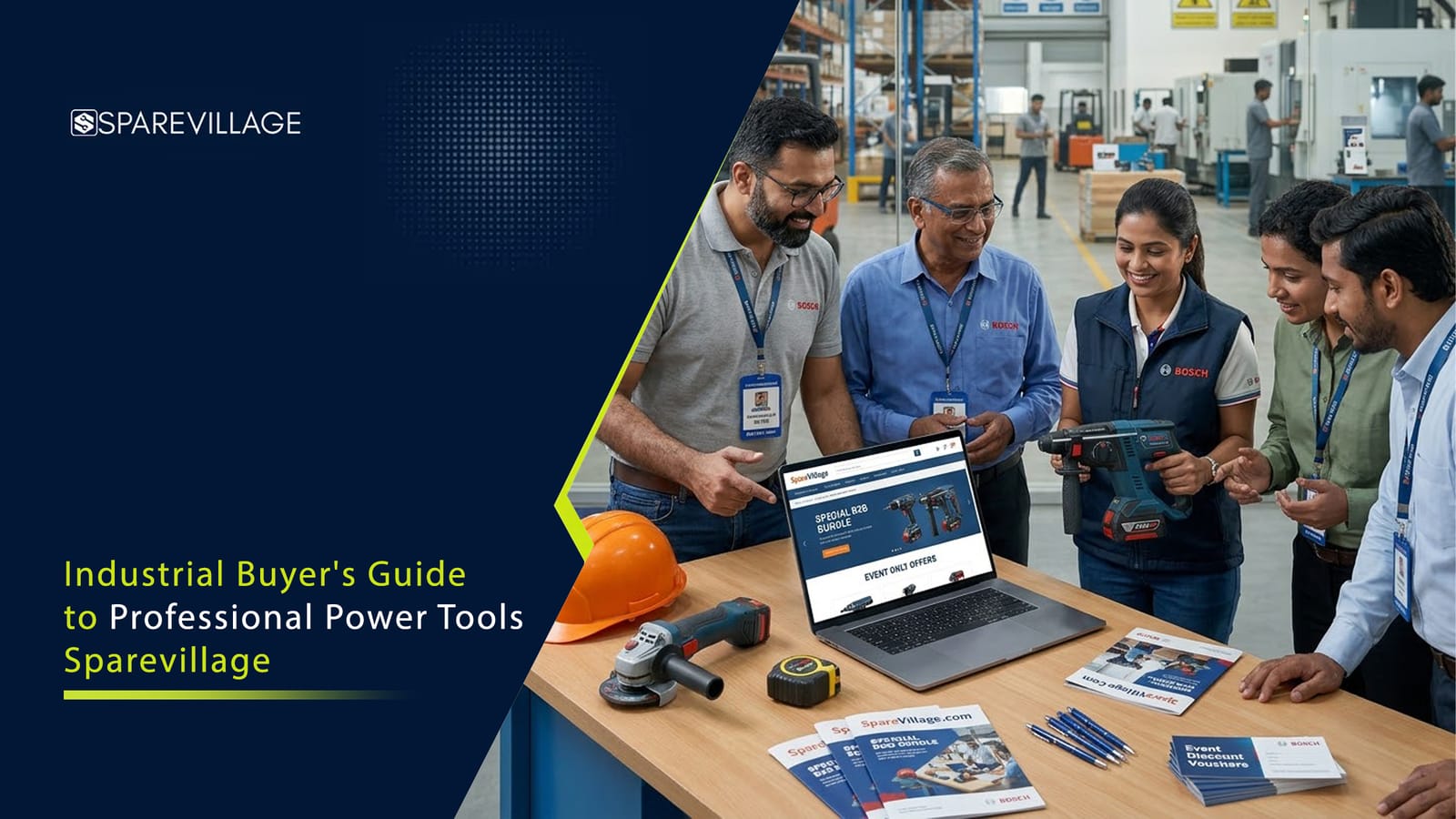
Industrial Buyer's Guide to Professional Power Tools | Sparevillage
Professional power tools built for industrial use. Explore types, buying tips, and where to source trusted brands with SpareVillage.
Article Content
Intro:
Professional power tools are the backbone of every serious industrial operation. Whether you run a fabrication workshop, manage a factory floor, or lead a maintenance team, the tools in your hands decide how fast work gets done and how well that work holds up under real pressure.
This blog is written for buyers who want honest, usable information, not marketing fluff. In the sections ahead, we will walk through:
What separates professional-grade equipment from ordinary tools
The different types of industrial power tools used across sectors
Where these tools actually get used on the ground
What to check before you spend your budget
You will also learn:
The difference between cordless and corded power equipment
Why industrial warranty and durability matter more than price alone
How buying industrial power tools online has changed for B2B teams across India
By the end of this guide, you will know exactly what to look for in industrial-grade power tools, how to match equipment to your application, and where to source it without wasting time on unreliable suppliers.
SpareVillage put this guide together because we talk to maintenance engineers, workshop owners, and procurement teams every single day, and the same practical questions keep coming up. People want tools that last, suppliers they can trust, and a buying process that does not eat their entire week.
That is exactly what this article covers, point by point, with real detail instead of vague claims. Read it fully if you are planning a purchase this quarter, and bookmark it as a reference for the next time your team needs to restock the toolroom.
What Are Professional Power Tools, Really?
Professional power tools are built for a different job than the tools sold at a general hardware counter. They are made to run for longer hours, handle tougher materials, and survive rough daily use on a shop floor or construction site.
The motor is stronger, the housing is tougher, and the internal components are chosen to resist heat, dust, and vibration over years, not months. This is where the line between a hobby tool and professional electric tools becomes obvious.
A hobbyist might use a drill for an hour on a weekend. A maintenance technician might run the same type of drill for eight hours a day, five days a week, on steel, concrete, or hardened alloys. Industrial power equipment is engineered for that second scenario. It has to.
Downtime on a production line or a fabrication job costs real money, and a tool that fails halfway through a task is not a bargain, no matter what it cost upfront. That is why industrial buyers look past the sticker price and ask about motor life, duty cycle, and build quality.
These industrial-grade power tools are also designed with the operator in mind. Better grip design, lower vibration, and safer switch mechanisms reduce fatigue and injury risk during long shifts.
When you are choosing equipment for a team, not just for yourself, this matters even more, because the tool needs to perform consistently in the hands of different operators, day after day.
Types of Industrial Power Tools Every Workshop Needs
Industrial work covers a huge range of tasks, so no single tool does everything. A well-stocked workshop usually carries a mix of cutting, drilling, grinding, and finishing tools, each suited to a specific job.
An angle grinder handles cutting, grinding, and polishing on metal and masonry, and it is one of the most used tools on any shop floor.
A rotary hammer or demolition hammer is built for breaking concrete and drilling into hard masonry, jobs a regular drill simply cannot handle.
For fastening work, an impact wrench and impact driver deliver high torque in short bursts, which is exactly what heavy bolting and assembly work demands.
An electric drill, cordless drill, and hammer drill cover general drilling needs, from soft materials to brick and stone.
A bench grinder stays fixed in the workshop for sharpening and shaping metal parts, while an orbital sander and belt sander handle surface finishing on wood and metal.
A circular saw, jigsaw, and reciprocating saw give you flexibility for straight cuts, curved cuts, and demolition-style cutting.
Heat guns and blowers support surface prep and cleanup, a polisher finishes metal and painted surfaces to a professional shine, and a router shapes edges and grooves with precision.
Add an oscillating tool for detail work and a die grinder for fine metalwork, and you have a toolkit that can handle almost anything an industrial job throws at it.
Where Industrial Power Tools Get Used
Industrial power tools show up in far more places than most people realise.
In metal fabrication, they cut, shape, grind, and finish raw material into finished parts, often multiple times a day.
The manufacturing industry depends on them for factory maintenance and machine maintenance, keeping production equipment running instead of sitting idle.
On construction projects, these tools handle everything from drilling and cutting to fastening and demolition, often in tough outdoor conditions.
Industrial repair work, whether on machinery or structures, relies on tools that can be trusted under pressure, because a repair job rarely allows for a second attempt on the same day.
Heavy engineering firms use them across production line maintenance, where even a short unplanned stop can affect an entire shift's output.
A welding workshop and a fabrication workshop both lean heavily on grinding and cutting tools as part of daily operations, not occasional use.
Automotive workshops use power tools for everything from panel work to engine bay repairs, where torque and precision both matter.
Plant maintenance teams and MRO operations, short for maintenance, repair, and operations, use power tools constantly for preventive maintenance, catching small issues before they become expensive breakdowns.
Across all of these settings, the common thread is simple: the tool has to work every time, because the operation depends on it. This is why industrial buyers rarely compromise on build quality once they have felt the difference a proper tool makes on a demanding job.
What to Check Before You Buy Industrial-Grade Power Tools
Buying industrial-grade power tools is not just about picking a brand you recognise. A few technical details decide whether a tool actually fits your work.
Motor power tells you how much raw output the tool can deliver, while RPM, or rotations per minute, tells you how fast it spins for cutting, grinding, or drilling tasks.
Torque matters more for fastening and drilling into hard material, since it decides how much resistance the tool can push through without stalling.
Voltage affects both power and runtime for cordless tools, and checking the battery platform matters if you already own tools from the same brand, since a shared platform saves money on batteries and chargers over time.
The cordless vs corded decision depends on your workspace. Cordless tools give freedom of movement, which matters on large sites, while corded tools give unlimited runtime, which suits fixed workstations.
A brushless motor is worth paying attention to, since it runs cooler, lasts longer, and needs less maintenance than older brushed designs.
Ergonomics and safety features are not extras, they directly affect operator fatigue and injury risk over a full shift.
Tool durability and industrial warranty terms tell you how the manufacturer stands behind their own product, which is a strong signal of build confidence.
Finally, look at operating efficiency, expected productivity gains, ongoing maintenance cost, and overall tool lifespan. These five factors together decide the real cost of a tool, not just what you pay on day one.
Cordless vs Corded: Choosing the Right Power Equipment
This is one of the most common questions industrial buyers ask, and the honest answer is that it depends on the job.
Professional cordless power tools have improved massively in the last few years. Better batteries mean longer runtime, and brushless motors mean less power loss compared to older cordless designs.
For field technicians, site work, and jobs where you move between locations, cordless tools remove the hassle of cables, extension leads, and fixed power points. This flexibility can genuinely speed up work on large sites or scattered maintenance rounds.
Corded tools still hold their ground for heavy, continuous use. A bench grinder or a large angle grinder used for hours at a stretch often performs more consistently when corded, since there is no battery to monitor or swap mid-task.
Corded tools also tend to deliver slightly higher sustained power for the toughest jobs, like continuous demolition or heavy-duty cutting.
Many workshops now run a mixed fleet, keeping cordless tools for mobility and light-to-medium tasks, and corded tools for fixed stations and heavy-duty work.
The smartest approach is to match the tool to the task instead of picking one format for everything. If your team moves constantly between job sites, lean cordless. If your equipment mostly stays in one place doing repetitive heavy work, corded equipment often makes more financial and practical sense over its working life.
Why Industrial Warranty and Durability Matter More Than Price
It is tempting to compare tools purely on price, especially when budgets are tight. But industrial buyers who have been burned by a cheap tool failing mid-project know better.
A tool that costs less upfront but fails after a few months ends up costing more once you factor in downtime, replacement cost, and lost productivity.
This is where industrial warranty terms become a real decision factor, not just fine print. A manufacturer that offers a strong warranty is telling you something important about how long they expect the tool to last under real conditions.
Tool durability is closely tied to the quality of internal components, the materials used in the housing, and how well the tool is sealed against dust and moisture, which matter enormously in factory and construction environments.
Maintenance cost is another piece buyers often overlook. A tool that needs frequent servicing or replacement parts adds hidden cost over its lifetime, even if the purchase price looked attractive.
Equipment reliability directly affects production efficiency, because every unplanned stoppage ripples through a schedule.
When you calculate the true cost of a tool, factor in expected lifespan, servicing needs, and how the warranty protects you if something goes wrong early. This full picture, not just the price tag, is what separates a smart industrial purchase from a short-term saving that costs more later.
Buying Industrial Power Tools Online: What Changes for B2B Buyers
Sourcing industrial power tools used to mean relying on a handful of local suppliers, waiting on quotations, and hoping stock was actually available when you needed it. That has changed.
Buying industrial power tools online now gives procurement teams access to a much wider range of trusted industrial brands, clearer pricing, and faster comparison between models.
For a maintenance engineer trying to find the right rotary hammer or the right impact wrench, being able to compare specifications side by side saves real time compared to calling multiple vendors.
An industrial tools marketplace also solves a problem many buyers face: consistency. When you order from a marketplace built for industrial procurement, you are not stuck hoping a small local shop has stock.
You get a wider catalogue, verified sellers, and a smoother repeat-ordering process for recurring needs like consumables and spares. This matters even more for businesses managing multiple sites, where procurement teams need one reliable source instead of juggling different local suppliers for every location.
SpareVillage was built around exactly this need. As an industrial power tools supplier and marketplace, it brings together trusted brands, clear specifications, and a straightforward buying process, so procurement teams spend less time chasing quotations and more time getting equipment into the hands of the people who need it.
How SpareVillage Helps You Source the Right Power Tools
SpareVillage exists to make industrial buying simpler, not more complicated. As a B2B marketplace built specifically for industrial, automotive, medical, and commercial buyers, SpareVillage brings verified suppliers and established brands together in one place, so procurement teams are not stuck comparing scattered vendors one by one.
Whether you need a single tool for a maintenance team or a full toolkit for a new production line, SpareVillage gives you clear specifications, transparent listings, and a buying process built for repeat, high-volume industrial purchasing, not one-off retail shopping.
This matters for teams that order regularly, since consistency and reliable stock availability often matter as much as the tool itself.
If your team is exploring options right now, it is worth taking a look at the Power Tools collection on SpareVillage, where you will find a wide range of professional power tools from trusted brands, organised by category and application.
If your sourcing needs go beyond power tools, the broader Industrial Tools and Equipment category covers everything from cutting and drilling equipment to workshop essentials, all in one place.
Procurement teams that switch to a single trusted marketplace for industrial sourcing often find that it saves time, reduces sourcing errors, and simplifies repeat ordering across departments and sites.
Conclusion: What We Covered and What to Do Next
This guide walked through what actually makes professional power tools different from ordinary equipment, the range of tool types every industrial workshop should know, where these tools get used day to day, and the technical details worth checking before you buy.
We also looked at cordless versus corded equipment, why warranty and durability outweigh price alone, and how sourcing industrial power tools online has changed for B2B buyers.
The core takeaway is simple: the right tool, bought from a trustworthy source, pays for itself through reliability, safety, and fewer unplanned stoppages. Cheap, short-lived equipment almost always costs more in the long run.
If you are ready to upgrade your toolkit or restock your workshop, explore the Power Tools collection on SpareVillage and compare industrial-grade options from trusted brands.
For a wider look at sourcing strategy, our earlier guide, The Complete Buyer's Guide to Industrial Power Tools, goes deeper into selection criteria across categories.
You can also check Why Businesses Are Switching to SpareVillage for Industrial Sourcing to understand how procurement teams are simplifying their buying process.
Whatever your industry, the right equipment, sourced the right way, makes daily work faster, safer, and more predictable.
FAQ Section
1. What makes professional power tools different from regular power tools?
Professional power tools are built for longer duty cycles, tougher materials, and daily heavy use. They use stronger motors, better-sealed housings, and more durable internal parts than tools made for occasional home use. SpareVillage stocks equipment specifically rated for this kind of continuous industrial demand.
2. Which power tools are essential for a fabrication workshop?
An angle grinder, welding-adjacent grinding tools, a bench grinder, and a die grinder cover most fabrication needs. Add a rotary hammer and impact wrench for assembly and structural work. SpareVillage's Power Tools collection groups these by application, making it easier to build a complete workshop kit.
3. Should I choose cordless or corded power tools for my workshop?
It depends on how your team works. Cordless suits mobile tasks and field technicians who move between locations. Corded suits fixed workstations doing heavy, continuous work. Many industrial buyers on SpareVillage run a mixed fleet of both formats.
4. How important is warranty when buying industrial power tools?
Very important. A strong industrial warranty signals that the manufacturer trusts the tool's build quality. It also protects your business from early failure costs. SpareVillage lists warranty terms clearly on product pages so buyers can compare before purchasing.
5. What is a brushless motor, and why does it matter?
A brushless motor runs cooler, lasts longer, and needs less maintenance than a traditional brushed motor. It is a strong indicator of a higher-quality, longer-lasting tool, which is why many industrial-grade power tools now use this design.
6. Can I buy industrial power tools online reliably in India?
Yes. Platforms like SpareVillage now make it possible to compare specifications, check stock, and order industrial power tools online from verified sellers, removing much of the uncertainty of relying on scattered local suppliers.
7. What should maintenance engineers prioritise when choosing power tools?
Durability, torque, and ergonomics matter most for maintenance work, since tasks vary daily and shifts are often long. Look for tools with proven reliability and a solid warranty, both of which are highlighted across SpareVillage's industrial tool listings.
8. How do I know what motor power or RPM I actually need?
Match the tool to the material and task. Harder materials and heavier cutting need higher motor power and torque. Lighter finishing work needs speed control more than raw power. Product pages on SpareVillage list these specifications clearly for comparison.
9. Are cordless power tools powerful enough for industrial use?
Modern professional cordless power tools, especially brushless models, now handle most industrial tasks well. Battery platforms have improved runtime significantly, making cordless a practical choice for many field and workshop applications today.
10. What industries rely most on industrial power tools?
Metal fabrication, manufacturing, construction, automotive workshops, and plant maintenance all depend heavily on power tools daily. Preventive maintenance and MRO operations in particular use them constantly to avoid unplanned equipment downtime.
11. How often should industrial power tools be serviced?
This varies by tool and usage intensity, but regular inspection prevents small issues from becoming costly failures. Following the manufacturer's maintenance schedule, along with proper storage, extends tool lifespan significantly.
12. What is the real cost difference between cheap and industrial-grade tools?
Cheap tools often fail sooner, need more frequent repairs, and cause downtime. Industrial-grade power tools cost more upfront but typically deliver lower total cost over their working life through better reliability and stronger warranty coverage.
13. Does SpareVillage sell tools for automotive workshops too?
Yes. SpareVillage serves industrial, automotive, medical, and commercial buyers, so automotive workshops can source power tools alongside other automotive parts and supplies from the same marketplace.
14. Can I buy power tools in bulk for my business through SpareVillage?
Yes. SpareVillage is built for B2B procurement, including repeat and bulk ordering across departments or multiple business locations, making it suited for businesses restocking toolrooms regularly.
15. Where can I explore the full range of professional power tools on SpareVillage?
You can browse the complete Power Tools collection on SpareVillage, or explore the wider Industrial Tools and Equipment category for related industrial equipment and accessories.