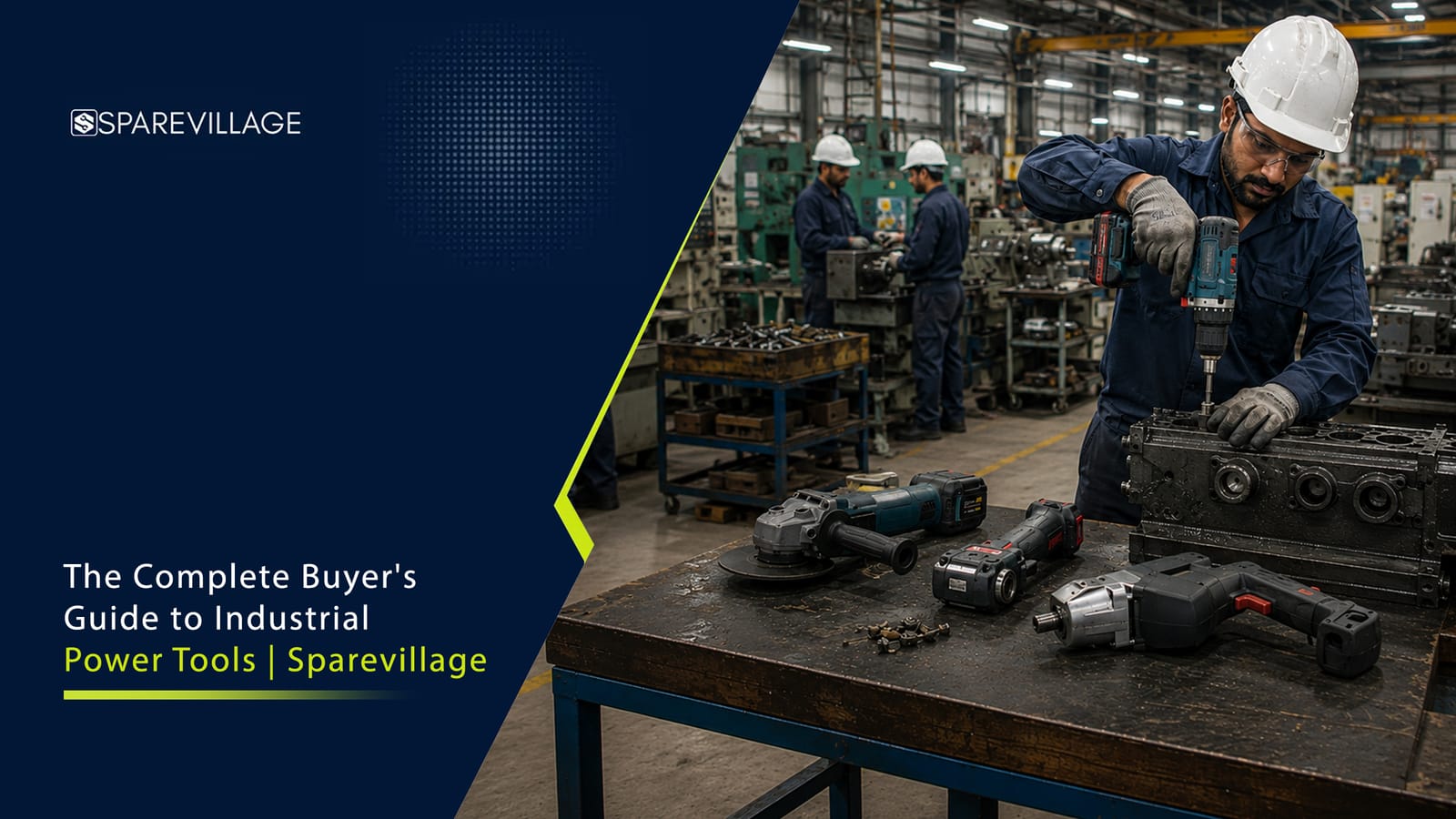
The Complete Buyer's Guide to Industrial Power Tools | Sparevillage
Industrial power tools buying guide to help professionals choose the right tools for construction, fabrication, maintenance, and manufacturing work.
Article Content
Introduction
Every workshop, factory floor, and construction site runs on the strength of its tools. When machines pause and hands take over, it is the power tool that gets the real work done. Industrial Power Tools are no longer a convenience for engineers, contractors, and maintenance teams, they have become the backbone of daily operations across manufacturing, fabrication, and repair work. From tightening a single bolt on a production line to cutting through steel on a construction site, these tools decide how fast and how well a job gets finished.
If you have ever tried finishing a task with an underpowered drill or a grinder that overheats within minutes, you already know why choosing the right equipment matters. Industrial Power Tools are built differently from the ones sold for occasional home use. They carry stronger motors, tougher housings, and internal components designed to survive continuous use, dust, vibration, and heat, day after day, shift after shift.
This guide walks you through everything a buyer needs before adding Industrial Power Tools to their procurement list, from understanding tool types and power sources to matching the right accessory with the right job. Whether you run a fabrication unit, manage a construction site, or handle maintenance for a manufacturing plant, this buying guide is built around real working conditions, not just specification sheets pulled from a catalogue.
We will also show you where to find genuine, warranty-backed power tools without wasting hours comparing multiple sellers one by one. SpareVillage brings professional and industrial-grade equipment together under one B2B marketplace, so procurement teams do not have to chase different vendors for every single category.
By the end of this guide, you will know exactly which tool suits your application, what specifications actually matter, and how to buy with confidence instead of guesswork.
Understanding the Role of Power Tools in Industrial and Professional Work
Power tools sit at the centre of almost every industrial process. A maintenance technician tightening a flange, a fabricator grinding a weld seam, or an electrician drilling through a concrete wall, all of them depend on tools that will not let them down mid-task. This is exactly where Professional Power Tools separate themselves from consumer-grade equipment. They are engineered for repeated, heavy-duty use rather than the occasional weekend project.
Industrial machinery and workshop equipment are only as reliable as the tools used to install, repair, and maintain them. A weak motor or a poorly sealed housing can mean lost production hours, rework, and in some cases, safety risks on the shop floor. That is why factories, engineering workshops, and MRO teams treat Heavy Duty Power Tools as an investment rather than a one-time purchase.
There is also a practical, day-to-day reason this category matters so much. Industrial environments are unforgiving, dust, moisture, metal shavings, and constant vibration wear down ordinary equipment fast. Tools built for professional use come with reinforced gearboxes, better heat dissipation, and components rated for extended duty cycles. This is the difference between a tool that lasts one project and one that lasts several years of daily operation.
For businesses handling manufacturing, construction, automotive repair, or engineering workshops, the right power tool is not just about getting the job done. It is about consistency, worker safety, and reducing downtime. A dependable set of industrial equipment keeps production schedules on track and prevents small delays from turning into costly ones. This is why procurement teams increasingly look for suppliers who understand both the technical specifications and the real working conditions these tools face every single day.
Types of Industrial Power Tools Every Professional Should Know
Before buying, it helps to understand the categories available and where each one fits into your workflow. Here are the tool types that most industrial and professional setups rely on:
Drill Machines – used for drilling holes in metal, wood, and concrete, ranging from compact impact drills to heavy rotary and magnetic drills. You can explore the full range of Drill Machines for every application.
Angle Grinders and Bench Grinders – essential for cutting, grinding, and polishing metal surfaces on fabrication lines.
Rotary Hammers and Demolition Hammers – built for concrete drilling and breaking work on construction sites, available under Electric Hammers.
Circular Saws, Jigsaws, and Reciprocating Saws – used for precision cutting in wood, metal, and mixed-material jobs.
Impact Wrenches and Impact Drivers – deliver high torque for fastening and loosening bolts quickly, common in automotive and heavy machinery work.
Heat Guns and Blowers – used for shrink wrapping, paint removal, and clearing debris, browse these under Blowers & Heat Guns.
Die Grinders and Cut-Off Machines – suited for fine metal work and material separation on workshop floors.
Electric Screwdrivers – ideal for repetitive fastening tasks on assembly lines.
Each of these belongs to the broader Industrial Power Tools ecosystem, and choosing between them depends entirely on the application. A construction crew will lean heavily on demolition hammers and circular saws, while an automotive workshop will use impact wrenches and die grinders far more often. Understanding this mapping between tool type and task saves both money and time, because you end up buying equipment that actually gets used rather than sitting idle in a storeroom.
Cordless vs Electric Power Tools: Which One Fits Your Application
One of the first decisions every buyer faces is choosing between Cordless Power Tools and Electric Power Tools. Both have a place in industrial settings, and the right choice depends on where and how the tool will be used.
Electric Power Tools, the corded variety, are known for consistent, uninterrupted power. They do not lose performance as a battery drains, which makes them a strong choice for long grinding sessions, continuous drilling, or heavy-duty cutting where power dips are not an option. Fixed workstations, bench-mounted equipment, and production-line setups often rely on corded tools simply because they are always plugged into a stable power source.
Cordless Power Tools, on the other hand, bring freedom of movement. With advances in brushless motor technology and lithium-ion battery packs, today's cordless equipment delivers power output that comes close to matching corded alternatives, while offering the flexibility to work on scaffolding, remote sites, or areas without easy access to power outlets. Variable speed control and battery indicators have also made cordless tools far more precise and predictable than earlier generations.
There is also a third category worth knowing, pneumatic power tools, which run on compressed air and are common in large manufacturing plants with an existing air supply infrastructure. These are typically chosen for high-frequency, high-torque tasks like assembly line fastening.
For most professional buyers, the decision comes down to mobility versus runtime. If your team moves across a large site or works in areas without fixed power points, Cordless Power Tools are worth the investment. If the work happens at a fixed station with access to power, Electric Power Tools often deliver better value for the same budget. Many industrial buyers end up keeping both types on hand, assigning each to the tasks it handles best.
Key Features to Check Before You Buy Power Tools
Not every power tool labelled "industrial" actually performs like one. Before you buy power tools for your team, check these specifications closely, because they directly affect performance, safety, and how long the tool will last on the job.
Motor type and torque – A brushless motor runs cooler, lasts longer, and delivers more consistent power than a standard brushed motor. High torque motor output matters most for drilling, grinding, and fastening applications.
Battery and runtime – For cordless tools, check the lithium-ion battery capacity and charging time. A higher amp-hour rating means fewer interruptions during a shift.
Build quality – Look for heavy-duty construction, reinforced housings, and dust or water resistance ratings if the tool will be used outdoors or in dusty environments.
Ergonomic grip – A comfortable, well-balanced grip reduces fatigue and improves control during long working hours, which also lowers the risk of accidents.
Variable speed control – Useful for switching between delicate and heavy-duty tasks without changing tools.
Warranty and after-sales support – Genuine Power Tools from authorised sellers come with manufacturer warranties, which protects your investment if something goes wrong.
It also helps to compare Industrial Power Tools Price across a few trusted sellers before finalising an order, especially for bulk or wholesale purchases. A slightly higher upfront cost on a well-built tool usually works out cheaper over time, since it means fewer replacements and less downtime. When you are working with a Trusted Power Tool Supplier, you also get clarity on specifications, genuine parts, and support if repairs are ever needed. This is particularly important for industrial buyers who cannot afford unplanned equipment failure during an active production run.
Power Tools by Application: Construction, Fabrication, Woodworking and Automotive
Different industries lean on different tool categories, and matching the equipment to the application is where most buying decisions go wrong. Here is how power tools typically map across sectors:
Construction sites depend heavily on concrete drilling equipment, demolition hammers, and cut-off machines for breaking, drilling, and cutting through masonry and concrete. Circular saws and reciprocating saws are also common for cutting through mixed materials on-site.
Metal fabrication workshops rely on angle grinders, die grinders, and cutting tools for precision cutting, deburring, and finishing metal components. Grinding applications and polishing applications are a daily requirement here, which makes bench grinders and cut-off machines essential shop-floor equipment. You can browse Cutters suited for stone, metal, and sheet material cutting tasks.
Woodworking operations need a different set of tools altogether, routers, planers, and sanders for shaping and finishing wood surfaces. Precision matters more here than raw power, since surface finish quality directly affects the final product.
Automotive workshops use impact wrenches and impact drivers extensively for wheel and engine work, along with die grinders for bodywork and rust removal. Speed and torque control matter more in this setting than in most other applications.
Industrial maintenance and manufacturing teams need a mix of everything, drills, grinders, saws, and screwdrivers, since maintenance work can involve metal, wood, or composite materials on any given day. This is usually where a broader Industrial Power Equipment inventory pays off, because the range of daily tasks is simply too varied for a single tool type.
Knowing which category your business falls into makes procurement far more efficient. Instead of stocking every available tool type, you can prioritise the ones your team actually uses and reserve budget for building depth in that category, such as spare batteries, extra accessories, or backup units.
Power Tool Accessories and Attachments You Should Not Ignore
A power tool is only as good as the accessory fitted to it. Many buyers focus entirely on the tool itself and treat accessories as an afterthought, which often leads to poor results and shorter tool life.
Drill bit sets, SDS bits and chisels, hole saws, and circular saw blades all need to match both the material being worked on and the tool's specifications. Using the wrong blade or bit not only gives a poor finish but can also strain the motor and shorten the tool's lifespan. Similarly, wheel brushes, flexible shafts, and power tool stands help extend what a single tool can do, turning one grinder or drill into a more versatile piece of equipment.
For cutting applications, matching the right circular saw blade or bandsaw blade to the material, wood, metal, or composite, makes a measurable difference in both speed and finish quality. Precision cutting jobs, in particular, demand accessories rated for the exact material and thickness involved.
Keeping a stock of Power Tool Accessories on hand also reduces downtime significantly. Instead of pausing a job because a drill bit snapped or a blade dulled, teams with a well-stocked accessory inventory can swap parts and continue working within minutes. This is especially important for industrial and manufacturing settings where every stopped minute has a direct cost attached to it.
You can explore the complete range of Power Tool Accessories to build a well-rounded inventory alongside your core tools, rather than sourcing accessories separately every time a job comes up.
Why Buy Industrial Power Tools Online from a Trusted B2B Supplier
Once you know what to buy, the next question is where to buy it from. Sourcing power tools through scattered, unverified sellers is one of the most common mistakes industrial buyers make, and it usually shows up later as counterfeit parts, missing warranties, or inconsistent quality between orders.
Buying Power Tools Online through a dedicated B2B marketplace solves most of these problems in one step. A platform built for industrial procurement gives you access to genuine, brand-authorised equipment, transparent pricing, and bulk ordering options, all without needing to negotiate separately with multiple vendors. This matters even more for businesses managing wholesale or repeat orders, where consistency across shipments is critical.
SpareVillage works exactly this way. As a B2B marketplace built for industrial and MRO procurement, it brings together trusted brands like Bosch, Makita, DeWALT, Milwaukee, Hikoki, Ingco, Stanley, and Total under one roof, so you are not left guessing about authenticity. Whether you need a single Cordless Drill Driver for a maintenance team or a Bulk Power Tools order for a new facility, the process stays simple, transparent, and backed by proper documentation.
You can explore Cordless Power Tools for mobile, on-site work, browse Power Tools Combo Kits if you are setting up a new workshop from scratch, or check Sanders & Polishers for finishing-stage equipment. Every category is organised so procurement teams can compare specifications and place orders without back-and-forth emails or phone calls.
For businesses that want to go beyond a single purchase, it is worth exploring SpareVillage as a broader Industrial Tool Marketplace, covering everything from power tools to spares, safety equipment, and maintenance supplies. Buying from one trusted source, instead of piecing orders together from different sellers, saves time and builds a more reliable, repeatable procurement process over the long run.
Conclusion
Choosing the right Industrial Power Tools comes down to understanding your application, checking the specifications that actually matter, and buying from a supplier you can trust. Whether your team needs cordless flexibility for on-site work, corded reliability for a fixed workstation, or a complete accessory inventory to keep downtime low, the right combination makes a measurable difference to daily productivity.
SpareVillage brings genuine, warranty-backed power tools and accessories together on one B2B marketplace, making it easier for procurement teams to source everything they need without compromising on quality or authenticity. Explore Industrial Tools and Equipment on SpareVillage and build a toolkit that keeps your operations running without interruption.
If you found this guide useful, you may also want to read our other blogs : Benefits of Buying Industrial Products Online in India, SpareVillage: Your Trusted Partner for Industrial Procurement Platform, and Top 10 Industrial Tools Every Factory Needs | SpareVillage, for more insights on smarter industrial procurement.
Frequently Asked Questions
1. What are Industrial Power Tools used for?
Industrial Power Tools are used for drilling, cutting, grinding, fastening, and finishing tasks across construction, manufacturing, and maintenance work. They are built for continuous, heavy-duty use, unlike standard tools made for occasional home tasks.
2. What is the difference between cordless and electric power tools?
Electric power tools run on a continuous power supply and offer steady output, while cordless power tools use rechargeable batteries for mobility. Cordless models suit on-site or remote work, while electric tools work best at fixed workstations.
3. Which brand of power tools is best for industrial use?
Trusted brands like Bosch, Makita, DeWALT, Milwaukee, and Hikoki are widely used in industrial settings for their durability and consistent performance. The right brand depends on your application, budget, and required torque or power output.
4. How do I choose the right power tool for my workshop?
Match the tool to your primary application — drilling, cutting, grinding, or fastening — and check motor power, build quality, and accessory compatibility. Buying based on actual daily tasks avoids unnecessary spending on unused features.
5. Are cordless power tools powerful enough for industrial work?
Modern cordless power tools with brushless motors and lithium-ion batteries now match much of the performance of corded tools. For continuous, heavy-duty tasks, electric tools may still offer more consistent output.
6. What should I check before buying power tools online?
Check the seller's authenticity, warranty terms, product specifications, and return policy before ordering. Buying from a verified B2B marketplace like SpareVillage reduces the risk of counterfeit or poor-quality tools.
7. Can I buy power tools in bulk for my factory?
Yes, most B2B suppliers, including SpareVillage, offer bulk and wholesale ordering options for factories and businesses. Bulk buying often comes with better pricing and consistent stock availability.
8. What accessories do I need along with a power tool?
Accessories depend on the tool and task — drill bits, saw blades, grinding wheels, and SDS bits are common essentials. Keeping a stocked accessory inventory reduces downtime during active work.
9. How long do industrial power tools typically last?
With proper maintenance, industrial-grade power tools can last several years, even under daily heavy use. Lifespan depends on build quality, usage intensity, and how well accessories are matched to the tool.
10. Is it better to buy power tools online or from a local store?
Buying online often gives access to a wider range, transparent pricing, and genuine products with proper warranty documentation. Local stores may offer immediate availability but often have limited stock and brand options.
11. What power tools are essential for a metal fabrication workshop?
Angle grinders, die grinders, cut-off machines, and drill machines are core essentials for metal fabrication work. These handle cutting, grinding, and finishing tasks that fabrication shops need daily.
12. Do industrial power tools come with a warranty?
Genuine industrial power tools purchased from authorised sellers typically come with manufacturer warranties. Always confirm warranty terms and documentation before completing a purchase, especially for bulk orders.
13. What is the price range for industrial power tools?
Industrial power tools price varies widely based on brand, power source, and application, ranging from budget-friendly to premium heavy-duty models. Comparing specifications alongside price helps identify the best value for your needs.
14. Are pneumatic power tools better than electric ones?
Pneumatic tools work well in facilities with existing compressed air infrastructure and are known for high torque output. For most standalone workshops, electric or cordless power tools are more practical and easier to maintain.
15. Where can I buy genuine industrial power tools online in India?
SpareVillage is a trusted B2B marketplace offering genuine, warranty-backed industrial power tools from leading brands. It supports both single-unit and bulk orders for procurement teams across industries.