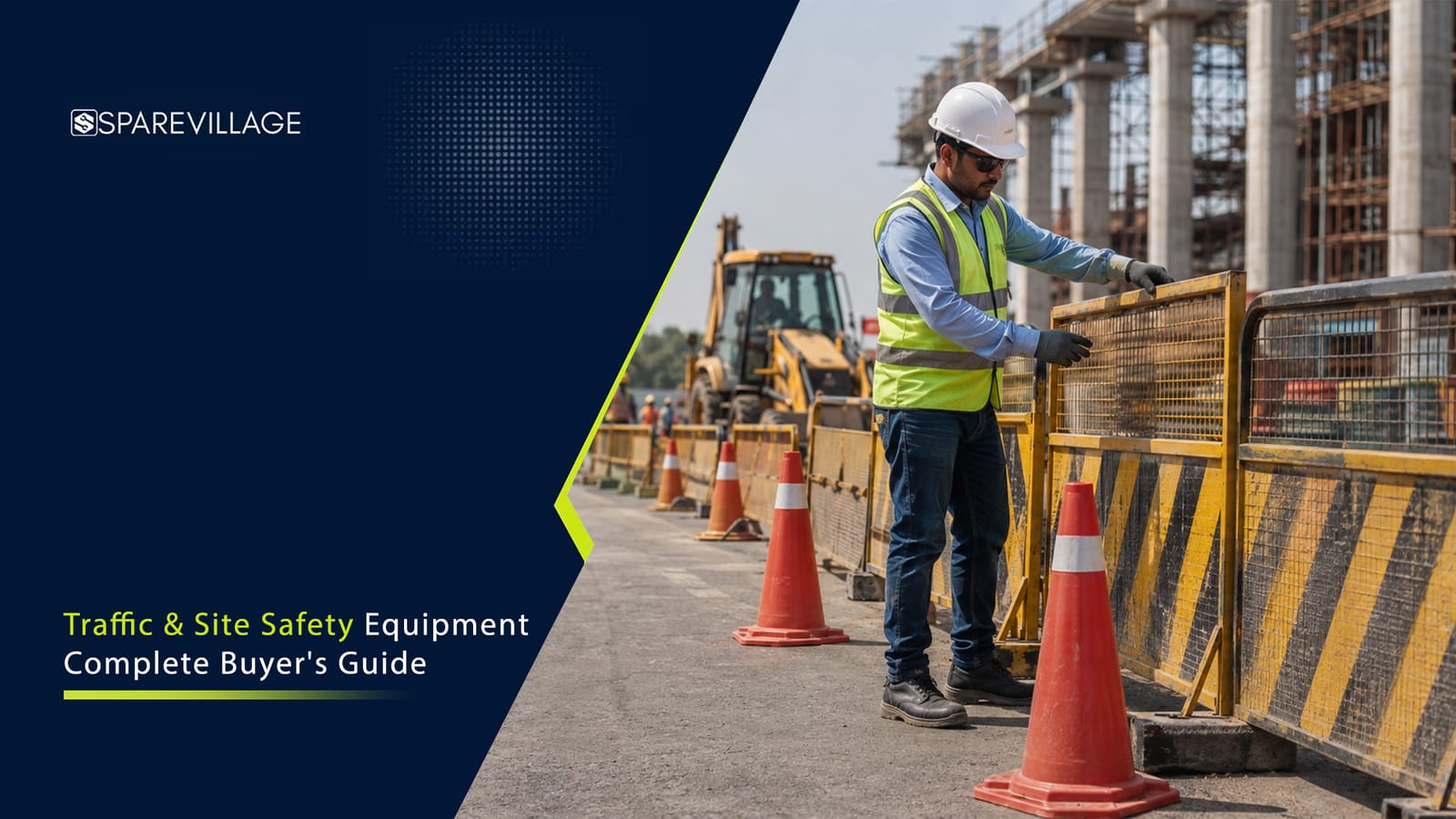
Traffic & Site Safety Equipment: Complete Buyer’s Guide
Learn how to choose traffic and site safety equipment, including cones, barriers, signs, bollards, mirrors and reflective products for your site.
Article Content
Intro :
Traffic and site safety equipment is used to control movement, separate people from vehicles, identify hazards, and protect temporary or permanent work areas. The right equipment helps businesses manage vehicle routes, pedestrian movement, restricted zones, loading areas, construction sites, warehouses, parking areas, and other locations where people and vehicles operate together.
Buying these products is not simply a matter of choosing cones, barriers, or signs. Each product should match the site layout, traffic pattern, hazard level, visibility requirements, working conditions, and expected duration of use.
This buyer’s guide explains how to select traffic and site safety equipment based on actual site requirements, what specifications matter during purchasing, and how to build a practical safety setup without buying unnecessary products.
What Is Traffic & Site Safety Equipment?
Traffic and site safety equipment includes physical products used to direct, restrict, warn, separate, or control movement within workplaces and public or semi-public areas.
The equipment generally falls into several functional groups:
Traffic cones: Used to mark temporary hazards, divert movement, identify work zones, and create visual separation.
Safety barriers: Used where a stronger physical boundary is required between people, vehicles, equipment, and hazardous areas.
Delineators and posts: Used to clearly define routes, corners, restricted areas, and temporary traffic paths.
Warning and safety signs: Used to communicate speed limits, restricted access, directions, hazards, and mandatory actions.
Wheel stops and parking barriers: Used to control vehicle positioning in parking and loading areas.
Convex mirrors: Used to improve visibility at blind corners, warehouse intersections, gates, and vehicle movement points.
Reflective products: Used to improve visibility in low-light or poorly illuminated areas.
Barricade tapes and chains: Used for temporary restriction of access where a rigid barrier is not necessary.
Speed control equipment: Includes products such as speed breakers and related traffic-control systems used to reduce vehicle speed in designated areas.
Road and floor marking products: Used to establish clear pedestrian routes, vehicle lanes, parking positions, and restricted zones.
The correct combination depends on the risk being controlled. A cone may be suitable for a short-term maintenance activity, while a warehouse vehicle route may require permanent barriers, floor markings, warning signs, and mirrors.
Why Traffic Control Equipment Should Be Selected as a System
A common purchasing mistake is treating every safety product as an independent item. Effective site control usually requires several products working together.
For example, placing a warning sign at a warehouse intersection may communicate the hazard, but it does not physically separate pedestrians from forklifts. A better setup may combine:
Floor markings to define the pedestrian route.
Barriers to create physical separation.
Warning signs to communicate the traffic rule.
Convex mirrors to improve visibility at blind points.
Reflective elements where visibility is reduced.
This approach addresses the hazard from different angles instead of depending on one product.
Start With the Hazard, Not the Product
Before purchasing equipment, identify what needs to be controlled.
Ask these questions:
Where do vehicles and pedestrians interact?
Which areas have restricted visibility?
Where do vehicles need to slow down?
Which locations require restricted access?
Which hazards are temporary?
Which hazards are permanent?
Does the equipment need to withstand outdoor weather?
Will forklifts, trucks, cars, or heavy equipment operate near the safety products?
Is the area used during night shifts or low-light conditions?
Does the site require temporary or permanent traffic control?
The answers determine the type, quantity, material, visibility, and installation method required.
How to Choose Traffic & Site Safety Equipment
1. Assess the Site Layout The physical layout should be the first consideration when purchasing traffic-control products. Map the areas where people, vehicles, machinery, and materials move. Identify entrances, exits, loading bays, intersections, blind corners, pedestrian crossings, parking areas, storage zones, and emergency access routes. A simple site map can help determine where equipment is actually required. Identify High-Interaction Areas High-interaction areas are locations where different types of movement overlap. Typical examples include: Forklift and pedestrian crossings. Warehouse intersections. Loading and unloading zones. Factory entrances. Parking exits. Construction-site access points. Material handling areas. Delivery vehicle routes. Blind corners. Temporary maintenance zones. These locations generally require more deliberate traffic-control measures than low-traffic areas. 2. Select the Right Barrier Type Barriers are appropriate when visual warnings alone are not enough. The required barrier depends on what needs to be separated and how much physical impact it may experience. Plastic and Water-Fill Barriers Plastic barriers are commonly used for temporary traffic control, construction zones, event areas, roadwork, and site separation. Water-fill designs can provide additional stability without requiring a permanently heavy structure. Consider: Barrier length. Base stability. Visibility. Reflective panels. Interlocking capability. Portability. Outdoor durability. Ease of storage. Safety Bollards and Posts Bollards and posts are useful for protecting fixed areas such as entrances, machinery, walls, pedestrian routes, and building edges. Fixed bollards are suitable where permanent protection is required. Removable or flexible posts can be more appropriate for temporary or changing layouts. The key buying decision is whether the product needs to guide movement or physically resist vehicle access. 3. Choose Traffic Cones Based on Application Traffic cones are simple products, but their specifications directly affect their usefulness. Important factors include: Height. Base size. Stability. Material flexibility. Reflective bands. Visibility. Indoor or outdoor use. Resistance to weather conditions. For high-traffic areas, a stable base is important because lightweight cones can be displaced by wind, vehicle movement, or accidental contact. Reflective bands are particularly useful where the cones need to remain visible during low-light conditions. When to Use Cones Cones are best suited to situations where the hazard or work area is temporary. Examples include: Floor cleaning. Maintenance work. Temporary repairs. Vehicle diversion. Short-term obstruction. Loading-area changes. Temporary restricted zones. Cones should not automatically be treated as a substitute for a physical barrier where people or vehicles require stronger separation. 4. Select Safety Signs According to the Required Action A safety sign should communicate a specific instruction, warning, restriction, or direction. The buyer should first determine what action the sign needs to communicate. Examples include: Stop: Requires the movement to stop. No Entry: Restricts access. Speed Limit: Controls vehicle speed. Pedestrian Crossing: Identifies a designated crossing. Forklift Area: Warns people about vehicle movement. Authorized Personnel Only: Restricts access to a controlled area. Warning: Draws attention to a specific hazard. The sign should be positioned where the user can see and understand it before reaching the hazard or decision point. Consider Sign Material and Placement Indoor signs may have different material requirements from outdoor signs. For outdoor use, consider: Weather resistance. UV exposure. Mounting method. Surface durability. Visibility from the required distance. Reflective properties where necessary. A technically correct sign becomes ineffective if it is hidden behind equipment, placed too close to the hazard, or positioned where approaching traffic cannot see it in time. Reflective Traffic & Visibility Equipment Visibility becomes more important when a site operates during night shifts, early mornings, poor weather, or areas with inadequate lighting. Reflective strips, reflective tapes, high-visibility markers, and reflective signs can make traffic-control products easier to identify. Where Reflective Equipment Is Most Useful Consider reflective equipment for: Outdoor warehouses. Construction sites. Parking areas. Factory entrances. Loading bays. Temporary road diversions. Vehicle routes. Emergency access paths. Areas with changing light conditions. Reflective material should complement site lighting rather than replace adequate lighting. Convex Mirrors for Blind Areas Convex safety mirrors provide a wider field of view than a standard flat mirror. They are useful at locations where walls, racks, machinery, or building structures obstruct visibility. Typical applications include: Warehouse intersections. Factory corners. Parking exits. Narrow vehicle routes. Loading areas. Gate entrances. Forklift movement points. The important buying factors include mirror diameter, viewing distance, mounting method, indoor or outdoor suitability, and resistance to environmental conditions. A mirror should be positioned to improve visibility at the actual conflict point. Installing it without considering the approaching driver's or operator's line of sight can reduce its practical value. Speed Control Equipment for Industrial Sites Vehicle speed is an important consideration in warehouses, factories, parking areas, campuses, and other sites where vehicles share space with people. Speed-control products can be used where site traffic needs to slow before reaching a crossing, entrance, intersection, or pedestrian area. Choosing a Speed Breaker Consider: Vehicle type. Expected vehicle speed. Load carried by vehicles. Road or floor surface. Installation location. Product height. Width and modular design. Reflective visibility. Outdoor durability. A speed-control product should not be selected only by price. Its dimensions and construction need to be appropriate for the vehicles using the route. Pedestrian and Vehicle Route Separation One of the most important site-safety purchasing decisions is separating pedestrian movement from vehicle movement wherever practical. A clearly defined pedestrian route reduces uncertainty for both workers and vehicle operators. A practical separation system may include: Floor markings to identify walking routes. Barriers or guardrails where physical separation is necessary. Pedestrian signs at crossings and entry points. Warning signs near vehicle interaction zones. Convex mirrors at blind intersections. Reflective markings in low-light areas. The equipment should support the site's actual movement pattern rather than simply filling available space with safety products. Temporary vs Permanent Site Safety Equipment The duration of the hazard should influence the buying decision. Temporary Safety Requirements Temporary work areas often require portable products that can be installed, moved, and stored easily. Suitable products may include: Traffic cones. Portable barriers. Barricade tape. Safety chains. Temporary signs. Portable delineators. Warning boards. These products are useful for maintenance, repairs, construction activities, cleaning operations, and temporary changes to traffic routes. Permanent Safety Requirements Permanent hazards require equipment designed for continuous use. Examples include: Fixed bollards. Guardrails. Permanent signs. Floor markings. Fixed convex mirrors. Vehicle protection barriers. Permanent speed-control systems. The purchasing objective should be long-term reliability rather than simply the lowest initial price. Material and Durability: What Buyers Should Check Material selection affects service life, maintenance, and performance. Common materials include plastic, rubber, metal, PVC, reflective films, and composite materials. For Outdoor Applications Prioritize: Weather resistance. UV resistance. Corrosion resistance where applicable. Stable construction. Water resistance. Temperature tolerance. Visibility after prolonged exposure. For Industrial Indoor Applications Prioritize: Impact resistance. Easy cleaning. Compatibility with the floor surface. Resistance to frequent handling. Visibility around machinery and storage racks. Suitable mounting systems. The environment should determine the specification. A product designed for occasional indoor use may not be suitable for continuous outdoor exposure. How to Buy Traffic & Site Safety Equipment in Bulk Businesses purchasing for factories, warehouses, construction projects, offices, commercial facilities, or multiple locations should plan the complete requirement before placing an order. Create a requirement list based on location rather than buying products individually. For example: This approach makes quantity planning easier and reduces the risk of purchasing incompatible products. Check Product Specifications Before Ordering Do not purchase only from the product name. Check: Dimensions. Material. Weight. Reflective properties. Installation requirements. Load or impact suitability where applicable. Indoor/outdoor suitability. Quantity per pack. Mounting accessories. Warranty or manufacturer information where provided. For larger projects, confirm product dimensions and installation requirements before ordering the complete quantity. How to Build a Practical Site Safety Setup A good site setup starts with identifying the movement problem and then selecting the equipment required to control it. Step 1: Map the Movement Identify pedestrian routes, vehicle routes, crossings, loading areas, entrances, exits, and blind spots. Step 2: Identify Conflict Points Mark every location where pedestrians and vehicles can come into contact or where visibility is restricted. Step 3: Decide the Required Control Determine whether the location needs: A visual warning. Directional guidance. Restricted access. Physical separation. Speed reduction. Improved visibility. Step 4: Select the Equipment Match the control requirement to the appropriate product rather than selecting products based only on availability or price. Step 5: Check the Installation Confirm that signs, mirrors, barriers, and other fixed products can be installed at suitable locations. Step 6: Review the Setup After installation, observe actual movement through the area. If workers or drivers continue to cross the intended route, the control system may need adjustment. Related Industrial Safety Buying Guides Traffic and site safety equipment is one part of a broader industrial safety program. Buyers planning PPE and workplace protection requirements can also read [Industrial Safety & PPE Supplies: The Complete Buyer’s Guide for 2026] to understand how to plan wider workplace safety purchases. For companies purchasing protective clothing and safety footwear, read [Industrial Workwear & Safety Footwear: Complete Buyer’s Guide] for guidance on selecting products according to workplace conditions and job requirements. For personal protective equipment covering the head, hands, respiratory system, and eyes, read [Head, Hand & Respiratory PPE: Gloves, Helmets, Masks & Eye Protection Guide]. For work-at-height requirements, read [Fall Protection Equipment: A Complete Guide for Working at Height] before selecting harnesses, lanyards, and related equipment. For fire-risk protection, read [Fire Safety Equipment for Industrial & Commercial Premises] to understand how to plan fire-safety equipment for commercial and industrial locations. For maintenance and hazardous-energy control, read [Lockout Tagout (LOTO): Complete Industrial Safety Guide]. Explore Safety Equipment and Supplies Businesses can explore the Safety Equipment & Supplies collection on SpareVillage to compare different workplace safety products and identify equipment according to their operational requirements. The collection is designed for businesses looking for industrial safety products across different applications rather than relying on a single product category. Explore the SpareVillage B2B Marketplace For businesses managing recurring industrial procurement, the SpareVillage B2B marketplace provides a broader way to explore industrial products and sourcing requirements. It can be useful for organizations purchasing safety products along with tools, maintenance supplies, equipment, and other industrial requirements. Watch SpareVillage Safety & Industrial Videos Product specifications are important, but visual demonstrations can make it easier to understand how equipment is designed and where it can be used. Watch SpareVillage videos on YouTube for product reviews, demonstrations, industrial product explainers, and practical information before making purchasing decisions. Conclusion Traffic and site safety equipment should be purchased according to the specific movement, visibility, access, and separation requirements of a site. Traffic cones are useful for temporary marking. Barriers provide stronger separation. Signs communicate rules and hazards. Convex mirrors improve visibility at blind points. Reflective products improve identification in low-light conditions. Bollards and permanent barriers provide long-term protection around defined areas. The most effective setup is rarely a single product. A well-planned system combines the right equipment at the right locations based on how people, vehicles, and materials actually move through the site. Before placing an order, assess the site layout, identify conflict points, define the required control, check product specifications, and select equipment that matches the working environment. For businesses looking to source industrial safety products, SpareVillage provides a marketplace for exploring safety equipment, industrial tools, maintenance products, and other workplace requirements in one place. FAQs : Traffic & Site Safety Equipment 1. What are the main types of traffic and site safety equipment? The main types include traffic cones, delineators, barricades, barriers, safety signs, bollards, speed breakers, convex mirrors, reflective products, wheel stops, and floor-marking products. Each serves a different purpose. Cones and delineators guide movement, barriers provide physical separation, signs communicate instructions, and mirrors improve visibility at blind locations. 2. How do I choose the right traffic safety equipment for my site? Choose equipment according to the site layout, vehicle movement, pedestrian traffic, hazard location, visibility, traffic speed, and whether the requirement is temporary or permanent. Start by identifying the specific risk you need to control, then select products that provide warning, direction, separation, visibility, or speed control for that situation. 3. What is the difference between traffic cones, delineators, and barriers? Traffic cones and delineators primarily guide or channel people and vehicles around a hazard. Barriers provide stronger physical separation and can prevent vehicles from entering restricted areas. Use cones or delineators when visual guidance is sufficient. Use barriers when the situation requires a physical boundary between traffic, workers, equipment, or hazardous areas. 4. What should I consider when buying traffic cones? Check the cone height, base stability, material, reflective bands, visibility, and intended application. Higher-speed or low-light areas generally require products that provide greater visibility and stability. For industrial sites, also consider whether cones will be exposed to outdoor conditions, frequent handling, vehicle movement, or repeated deployment and storage. 5. When should I use barriers instead of traffic cones? Use barriers when visual marking alone cannot provide adequate separation. Barriers are appropriate around work zones, restricted areas, vehicle routes, loading areas, machinery, and locations where accidental vehicle entry could create a serious hazard. Cones are better suited to temporary marking and channeling where physical impact protection is not the primary requirement. 6. Why are reflective materials important in traffic safety equipment? Reflective materials improve the visibility of signs, cones, barriers, and delineators when headlights or other light sources illuminate them. They are particularly useful for night work, outdoor vehicle routes, parking areas, construction zones, and locations with changing light conditions. Reflective elements should support, rather than replace, adequate site lighting. 7. What traffic safety equipment is suitable for warehouses and industrial sites? Industrial sites commonly require barriers, traffic cones, bollards, safety signs, convex mirrors, floor markings, wheel stops, and speed-control products. The combination depends on forklift movement, pedestrian routes, loading areas, blind corners, and vehicle access points. Equipment should be selected to separate movement paths and clearly communicate site-specific traffic rules. 8. How do I select traffic safety equipment for temporary work zones? For temporary work zones, prioritize equipment that is portable, visible, stable, and easy to reposition. Common choices include cones, delineators, portable barriers, barricades, warning signs, and reflective products. The exact combination should reflect traffic conditions, work-zone layout, visibility requirements, project duration, and applicable local requirements. 9. What should I check before buying traffic and site safety equipment in bulk? Before placing a bulk order, verify the product dimensions, material, quantity, reflective properties, installation method, environmental suitability, and intended application. Also confirm applicable specifications or standards for the project location. For B2B purchasing, provide the supplier with the application, required quantity, product specifications, delivery location, and project requirements. 10. How can I create an effective traffic safety setup for a worksite? Start by mapping vehicle and pedestrian routes and identifying intersections, blind spots, entrances, loading areas, and restricted zones. Then combine suitable signs, markings, cones, barriers, mirrors, and speed-control products according to each risk. The objective is to create clear movement paths and appropriate separation rather than simply adding more safety equipment.