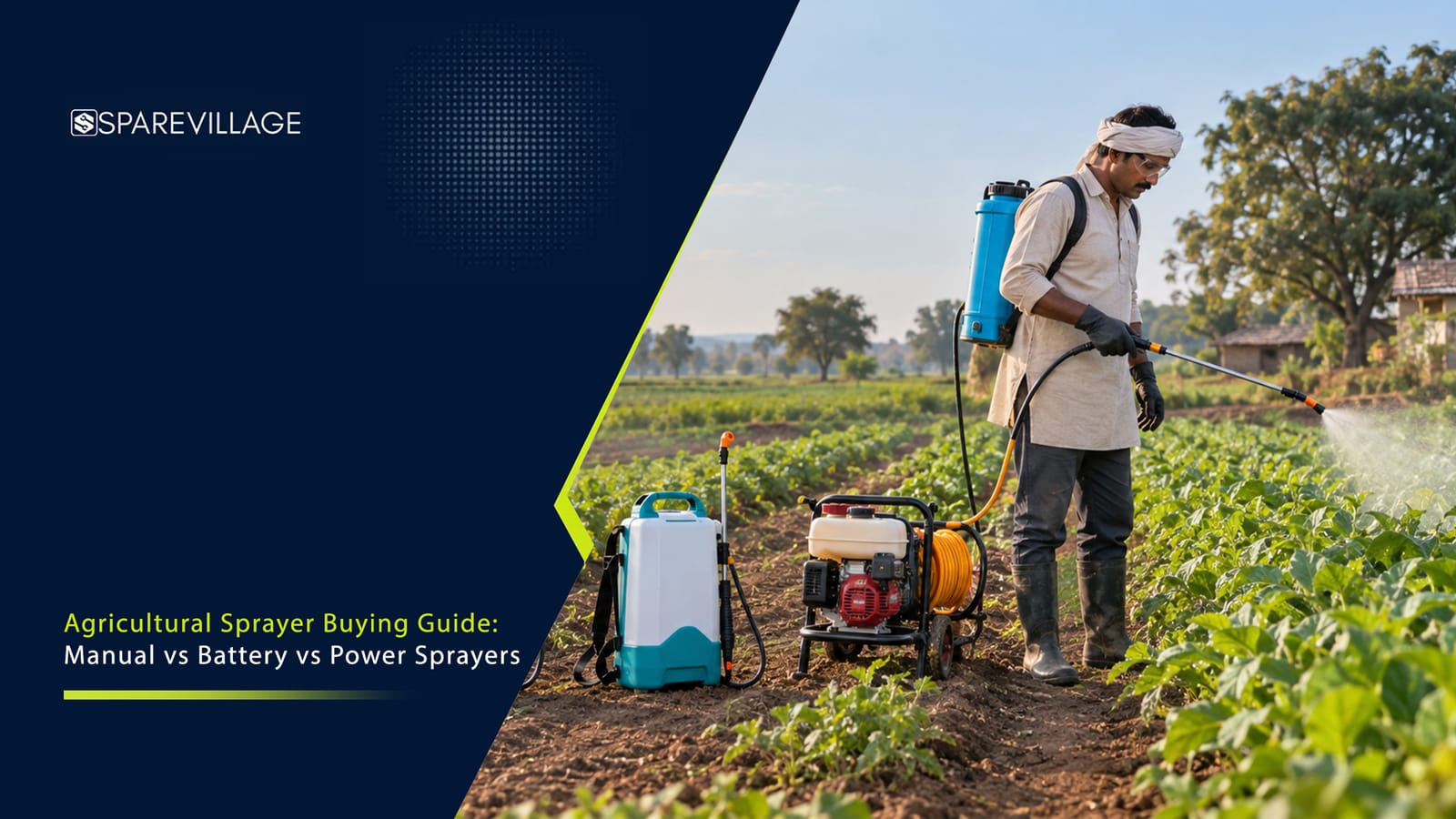
Agricultural Sprayer Buying Guide: Manual vs Battery vs Power Sprayers
Compare manual, battery & power agricultural sprayers. Pick the right one for your farm size, budget & crop with verified B2B suppliers. visit sparevillage now
Article Content
Intro:
A farmer spraying two acres does not need the same machine as a contractor covering fifty. Yet most buying guides treat every sprayer the same way. That gap is exactly where buyers lose money, either overpaying for power they never use or underbuying and losing hours to manual pumping every season.
This guide breaks the decision into three real categories: manual, battery, and power sprayers. Each one solves a different problem on the farm. By the end, you will know which one fits your land size, your crop cycle, and your budget, without guessing.
If you are exploring the wider category, our Agriculture & Farming collection lists every machine used across sowing, protection, and harvest stages on Indian farms.
Manual Sprayers: The Entry Point for Small Farms and Spot Treatment
A manual sprayer is the simplest tool in crop protection. It has a tank, a hand pump, a pressure chamber, and a nozzle. You fill the tank, pump the handle to build pressure, and release liquid through the wand. No battery, no engine, no charging cycle.
Most manual knapsack sprayers sold in India follow the IS 3906 specification set by the Bureau of Indian Standards. This standard defines tank material, working pressure (usually around 300 kPa), and build quality for piston-type units. When you buy a BIS-marked sprayer, you are buying against a tested benchmark, not a random import.
Manual sprayers make sense in a few clear situations:
Kitchen gardens, nurseries, and plots under one acre
Spot treatment for a patch of infected plants rather than a full field
Farms with irregular spraying needs, maybe once or twice a season
Buyers who want the lowest upfront cost and near-zero maintenance
The trade-off is physical effort. Every liter you spray needs a pump stroke. On a half-acre plot this is manageable. On five acres, your arm gives up long before the tank runs dry. Manual units also have fewer moving parts, so repairs are cheap and parts are easy to source through Sprayer Accessories listings.
If your operation is small, seasonal, or budget-first, a manual sprayer from our Sprayers range is a sound starting point.
Battery Sprayers: Built for Farmers Who Spray Often But Don't Want Fuel
A battery sprayer replaces the hand pump with a rechargeable motor. You press a switch, the motor builds pressure, and you focus entirely on aim and coverage. There is no pumping rhythm to maintain, which matters once you are spraying for more than twenty minutes at a stretch.
Most battery-powered knapsack units in the Indian market run on 12V lithium-ion packs rated between 8Ah and 12Ah. A full charge typically delivers four to eight hours of spraying time, depending on nozzle pressure and terrain. That is enough for a working farmer to finish a two to four acre plot without stopping mid-row to recharge.
Battery sprayers earn their place in these conditions:
Medium-size farms, roughly one to five acres, sprayed on a regular cycle
Operators dealing with wrist, shoulder, or back strain from manual pumping
Fields where noise matters, since battery motors run near silent compared to petrol engines
Buyers who want consistent pressure so chemical coverage does not vary row to row
They cost more than manual sprayers upfront, but the time saved per session adds up fast across a full growing season. Battery models are also widely used outside pure farmland. Nurseries, poly-houses, and landscaped estates lean on them for routine plant care, which is why our Gardening & Landscaping category carries several compact battery sprayer options built for that lighter, frequent-use pattern.
One practical note: always disconnect and store the battery separately after use. Leaving it attached to a damp tank shortens its life faster than the spraying itself.
Power Sprayers, Knapsack Power Sprayers, and HTP Sprayers for Large-Scale Fields
Once a farm crosses five to ten acres, or the crop is orchard, plantation, or high-density vegetable, manual pumping and even battery motors start to run out of capacity. This is where power sprayers take over.
A power sprayer uses a petrol or diesel engine, or in some setups a heavier electric motor, to generate continuous high pressure. Unlike battery units that taper off as charge drops, an engine-driven sprayer holds steady pressure for hours, which matters when you need uniform droplet size across a large field.
Within this category, two formats matter for B2B buyers:
Knapsack power sprayers keep the backpack format but add an engine or a stronger battery-motor combination to the same tank. They still travel with the operator, which suits row crops, vineyards, and mixed terrain where a mounted machine cannot maneuver.
HTP sprayers (High Pressure/High Volume, often written as High Throw Pressure sprayers) are built for a different job entirely. These are typically mounted on a trolley, tractor, or stationary frame and connected to a long hose reel. They throw spray fifteen to twenty meters or more, which is exactly what tall orchard trees, sugarcane, or large plantation blocks need. One operator with a hose can cover ground that would take three or four knapsack operators the same amount of time.
Power sprayers, including HTP units, fit these use cases:
Farms above five acres, or any orchard and plantation operation
Contract sprayers and custom hiring centers serving multiple farms
Crops needing frequent, scheduled spraying cycles through the season
Buyers prioritizing speed and labor reduction over upfront machine cost
The higher price tag is offset by lower labor cost per acre and faster turnaround during pest outbreaks, when timing decides whether the crop survives. Browse the full range of engine and high-pressure units under Power Sprayers and Knapsack Power Sprayers.
Matching Sprayer Type to Farm Size, Budget, and Spray Frequency
Buyers rarely fail because they picked a "bad" sprayer. They fail because they picked the wrong sprayer for their actual pattern of use. Use these four questions to narrow the decision before you check a single price tag.
How much land are you actually covering? Under one acre points to manual. One to five acres points to battery. Above five acres, or orchard and plantation land, points to power or HTP.
How often do you spray in a season? Occasional or seasonal use does not justify the cost of an engine sprayer. Weekly or biweekly cycles do, because labor hours saved compound fast.
Who is operating the machine? A single farmer working alone benefits from reduced physical strain, which favors battery or power over manual. A hired crew spread across a large field benefits from the reach of an HTP sprayer.
What is your realistic budget, including running cost? Manual sprayers need almost no ongoing spend beyond seals and nozzles. Battery sprayers add charging and battery replacement every few seasons. Power and HTP sprayers add fuel or higher electricity draw plus engine servicing.
There is no universally "best" sprayer. There is only the right sprayer for the acreage, crop, and labor situation in front of you. Buyers scaling up from manual equipment often follow a similar sizing logic to what we covered in our guide on Power Weeder: How to Choose the Right Farm Machine, where land size and crop type again decide the category, not brand preference.
Choosing the Right Sprayer for Insecticides, Pesticides, Herbicides, and Fungicides
The sprayer you choose also depends on what you are spraying, not just how much land you cover. Different chemical categories place different demands on tank material, nozzle type, and cleaning routine.
Insecticides and pesticides typically need fine droplet nozzles for even leaf coverage, since pests hide on the underside of foliage. Battery and power sprayers with adjustable nozzle heads handle this better than a basic manual nozzle, because pressure stays constant through the pass. Browse compatible chemical stock under Insecticides & Pesticides.
Herbicides demand a dedicated tank wherever possible. Herbicide residue left in a tank later used for insecticide or fungicide application can damage a healthy crop through cross-contamination. If budget allows only one sprayer, a thorough triple-rinse protocol between chemical types is non-negotiable. Explore herbicide options under Herbicides.
Fungicides often need to reach deep into plant canopies, which is where HTP sprayers with long-reach lances outperform smaller units, especially for orchard and vineyard fungal control during humid months. Check compatible products under Fungicides.
A quick rule that saves both crop and money: match nozzle fineness to pest biology, and match tank capacity to field size, but never mix chemical categories in the same tank without a full clean between uses.
About SpareVillage
SpareVillage is a verified B2B industrial marketplace built for buyers who need equipment they can trust without chasing ten different local dealers. On the agriculture side, that means manual, battery, and power sprayers from checked suppliers, listed with real specifications instead of vague descriptions.
For procurement teams, workshop owners, and farm equipment dealers, SpareVillage removes the usual sourcing friction. Every listed supplier goes through a verification process before their products go live, so bulk buyers are not gambling on an unknown vendor for a season-critical purchase. Pricing, specifications, and availability sit in one place instead of scattered across calls and catalogs.
This approach extends across every category on the platform, not just sprayers. If you want to understand how that verification and sourcing model works in more depth, read How Sparevillage Connects Buyers with Verified Industrial Material Suppliers and Why Businesses Are Switching to SpareVillage for Industrial Sourcing. For a broader view of the platform's role in procurement, see Sparevillage: Your Trusted Partner for Industrial Procurement Platform.
Which Sprayer Should You Buy?
Choose a manual sprayer for plots under one acre or occasional spot treatment. Choose a battery sprayer for one to five acres with regular spraying and no tolerance for pumping fatigue. Choose a power sprayer, or specifically an HTP sprayer, for farms above five acres, orchards, plantations, or contract spraying operations where speed and continuous pressure decide the outcome. Match your final pick to the chemical type you spray most, since insecticides, herbicides, and fungicides each place different demands on nozzle and tank design.
Conclusion
The manual vs battery vs power sprayer decision comes down to three things: how much land you cover, how often you spray, and who is doing the spraying. A manual sprayer keeps cost near zero for small, occasional jobs. A battery sprayer removes pumping fatigue for farmers spraying regularly across a few acres. A power or HTP sprayer earns its price on larger farms, orchards, and contract operations where speed and steady pressure protect the crop when timing matters most.
Get this choice right and the sprayer stops being a chore. It becomes one less thing to think about every spraying season, freeing up hours that go back into the actual farming. Buy for the acreage and crop cycle in front of you, not for the biggest machine on the page, and the sprayer will pay for itself well before the season ends.
People Also Ask :
1. Which sprayer is best for a small farm under one acre?
A manual sprayer is the right fit for plots under one acre. It costs less, needs almost no maintenance, and covers small or scattered patches well. You won't need continuous pressure or long spray sessions on that scale, so paying for a battery or engine unit adds cost without adding real benefit.
2. How long does a battery sprayer run on a single charge?
Most agricultural-grade battery sprayers with a 12V, 8-12Ah lithium pack run for four to eight hours on a full charge. Actual runtime depends on nozzle pressure setting and terrain. That range is usually enough to finish two to four acres in one session without stopping to recharge midway.
3. What is the difference between a knapsack power sprayer and an HTP sprayer?
A knapsack power sprayer keeps the backpack format with an added engine or stronger motor, so the operator still carries it. An HTP sprayer is mounted on a trolley, tractor, or stationary frame, connected to a long hose, and throws spray fifteen to twenty meters, built for tall orchards and large plantation blocks.
4. Can I use the same sprayer for insecticide and herbicide?
Only if you triple-rinse the tank thoroughly between uses. Herbicide residue left in a tank later used for insecticide can damage a healthy crop through cross-contamination. A dedicated tank for herbicides is the safer choice if your budget allows a second unit.
5. Which sprayer type needs the least maintenance?
Manual sprayers need the least maintenance since they have no motor, battery, or engine. The only regular upkeep is checking seals, nozzles, and the pump gasket. Battery and power sprayers add motor servicing, battery health checks, and, for engine units, fuel system upkeep on top of the basic wear parts.
6. Is a battery sprayer worth it over a manual one?
It depends on how often you spray. For regular use across one to five acres, yes, since it removes pumping fatigue and keeps pressure consistent through the whole tank. For occasional spot treatment on a small plot, a manual sprayer does the job at a fraction of the cost.
7. Why does my manual sprayer lose pressure while spraying?
Pressure drops naturally as you spray, since each pump stroke only builds a temporary reserve. It falls further if the pump seal is worn, the pressure chamber has a leak, or the nozzle is partially clogged. Regular seal checks and nozzle cleaning keep pressure more consistent between pump strokes.
8. How many hours can a battery-powered sprayer run before it needs recharging?
Compact garden-grade battery sprayers with smaller 2000-2400mAh batteries typically run two to three hours per charge. Larger agricultural units with 8-12Ah packs run four to eight hours. Runtime always drops with higher pressure settings, so match battery capacity to your actual field size before buying.
9. Do battery sprayers spray evenly compared to manual pumps?
Yes, more evenly. A battery-powered motor holds steady pressure through the spray cycle, so droplet size and coverage stay consistent row to row. Manual pumps lose pressure between strokes, which creates uneven application, especially noticeable toward the end of a long spraying session.
10. Are power sprayers overkill for a home garden?
Generally yes. Power sprayers are built for farms above five acres, orchards, or contract spraying, where speed and continuous pressure matter. A home garden or small backyard plot is better served by a manual or compact battery sprayer, since a power sprayer's engine and cost add no real advantage there.
11. What should I check before buying an agricultural sprayer online?
Check tank capacity, pressure rating, nozzle type, and whether the unit carries a BIS mark like IS 3906 for manual sprayers. For battery and power units, confirm battery capacity or engine specification, plus warranty terms and spare parts availability before ordering, especially for bulk or dealership purchases.
12. Are BIS-certified sprayers better than uncertified ones?
BIS-certified sprayers are tested against defined standards for tank material, build quality, and working pressure, so they carry a verified quality benchmark. Uncertified units can still work fine, but there's no independent check behind the claims, which adds risk for buyers purchasing in bulk for commercial use.
13. Can I buy sprayer accessories separately from the main unit?
Yes. Nozzles, hoses, pressure chambers, seals, and wands are commonly sold as standalone parts. This matters for repair and upkeep, since replacing a worn nozzle or seal is far cheaper than replacing the whole sprayer, and keeps an existing unit running for several more seasons.
14. What tank capacity is standard for commercial farm sprayers?
Sixteen to twenty liters is the standard tank size for knapsack manual and battery sprayers used commercially in India. Power sprayers and HTP units mounted on trolleys or tractors carry much larger tanks, often 100 liters or more, built for continuous spraying across bigger fields without frequent refilling.
15. Is it better to buy sprayers in bulk for a dealership or retail outlet?
For dealerships and retail outlets, bulk buying from verified suppliers usually works out cheaper per unit and ensures consistent stock across manual, battery, and power categories. It also simplifies after-sales support, since parts and warranty claims route through one confirmed source instead of multiple scattered vendors.