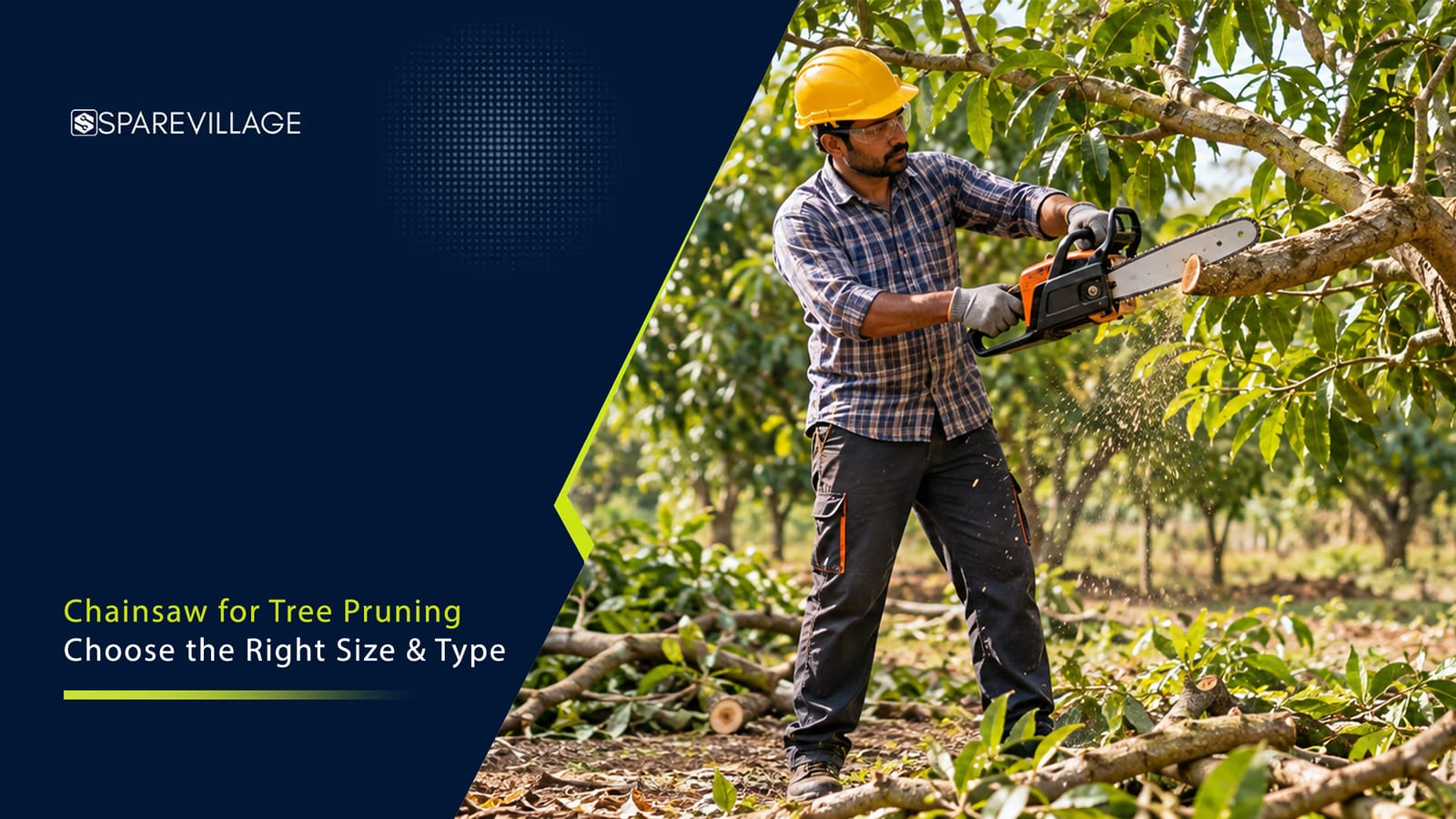
Chainsaw for Tree Pruning: Choose the Right Size & Type | Sparevillage
Chainsaw for tree pruning? Learn how to choose the right size, type, bar length and chain, plus what to check before buying the right pruning chainsaw.
Article Content
Intro: Tree pruning looks simple until you have to cut a thick branch, work around a fence, or reach a branch that is higher than expected. This is where choosing the right chainsaw becomes important. A chainsaw that is too large can become difficult to control during pruning. A saw that is too small may struggle with thicker wood and put unnecessary strain on the machine. Guide bar length, engine or motor power, chain type, weight, balance and the type of pruning work all matter. This guide explains how to choose a chainsaw for tree pruning, what size makes sense for different jobs, when a pruning chainsaw is useful, what to check before buying, and which other tree pruning tools may be more suitable for smaller branches. The aim is simple. By the end, you should be able to look at a chainsaw specification and understand whether it actually matches your work. If you are comparing agricultural equipment and other farm-use tools, you can also explore Agriculture & Farming for related equipment and supplies. A chainsaw for tree pruning is a chainsaw selected for cutting and removing branches rather than only for heavy tree felling. The important word here is selected. There is no single chainsaw that is automatically correct for every pruning job. A small branch near ground level, a thick orchard branch and professional tree-care work have very different requirements. Manufacturers commonly separate chainsaws by intended use, including occasional use, part-time use, professional use and dedicated tree-care or pruning applications. Husqvarna, for example, describes dedicated tree-care chainsaws as compact machines designed for trained professionals working in trees. For ordinary pruning, the right choice depends on the branch size, wood type, access, working position and experience of the operator. That is why buying the biggest chainsaw is not automatically a better decision. For pruning, control can be just as important as raw cutting power. Is a Chainsaw Good for Tree Pruning? Yes, a chainsaw can be useful for tree pruning when branches are too thick for hand pruning tools and the operator is trained and equipped for chainsaw work. A chainsaw can remove larger branches much faster than a manual pruning saw. It can also handle wood that would take considerable effort to cut by hand. But not every branch needs a chainsaw. Small branches may be easier to handle with a Pruning Secateur, Anvil Loppers or pruning saw. A chainsaw becomes more relevant as branch diameter increases and manual cutting becomes inefficient. The decision should therefore start with the branch, not the machine. If a lighter pruning tool can safely complete the job, using a chainsaw simply because it is available does not necessarily make sense. For larger branches, however, the correct chainsaw can save considerable time and effort. The right chainsaw size depends mainly on the work being done, the size of the wood and the operator's experience. Chainsaw size is not determined by guide bar length alone. Engine displacement and power are also important on petrol models, while motor output and battery platform matter on battery-powered models. Husqvarna recommends considering both the user's experience and the size and type of wood when choosing chainsaw size. It also notes that a smaller saw is generally easier to manoeuvre, while larger saws are intended for larger trees and heavier cutting. For pruning, this distinction matters. A saw that feels manageable on the ground may feel very different when the operator is working in a restricted position. Weight and balance become more noticeable as the job continues. Does a Longer Bar Mean a Better Chainsaw? No. A longer guide bar gives the machine more cutting reach, but it also adds weight and can affect manoeuvrability. For limbing and pruning, a shorter guide bar can be easier to control. Husqvarna specifically notes that shorter bars weigh less and are easier to manoeuvre for limbing work, while longer bars are useful for larger tree sizes. This is why guide bar length should be matched to the work rather than selected simply because a longer bar looks more powerful. If most of your work involves pruning branches rather than cutting large trunks, excessive bar length may provide little practical benefit. There is no universal bar length that is correct for every pruning job. The correct length depends on the diameter of the branches you regularly cut, the saw's specifications and your experience. A shorter bar can make a compact chainsaw easier to handle during smaller pruning work. Larger cutting jobs may require a longer bar and a machine with enough power to operate it effectively. The important point is that the bar should be compatible with the chainsaw and chain system. Do not assume that any chain or bar will fit any chain saw machine. Pruning Chainsaw vs Regular Chainsaw A pruning chainsaw is generally designed around manoeuvrability and tree-care applications. Dedicated tree-care chainsaws can have compact designs and, in professional models, top-handle configurations intended for trained arborists. Husqvarna describes its tree-care range as equipment for trained professionals working in trees or off the ground. A conventional chainsaw is more commonly used for ground-based cutting, including pruning, limbing, cutting firewood and other agricultural or property-maintenance work. For most buyers, the key question is not whether a machine is labelled “pruning” or “regular”. The better question is: Where will you use it, what will you cut, and from what working position? If you are doing ground-based pruning on farms, orchards or properties, a suitable conventional chainsaw may be sufficient. If the work involves climbing or working above ground, equipment selection becomes much more specialised. Dedicated tree-care chainsaws should only be used by appropriately trained professionals. Petrol or Battery Chainsaw for Pruning? Both petrol and battery-powered chainsaws can be suitable for pruning. The better option depends on how and where the machine will be used. A petrol chainsaw can make sense when the work is frequent, demanding and away from convenient charging facilities. A battery chainsaw can be attractive for users who value lower maintenance, easier starting and reduced dependence on fuel. Current chainsaw ranges include both battery and gasoline options for pruning and tree maintenance. The decision should therefore consider working time, cutting requirements, battery availability, maintenance and access to power. For occasional property or garden maintenance, a compact battery chainsaw may be sufficient. For repeated agricultural work involving larger quantities of wood, the overall workload should be considered before choosing the power source. Buying a chainsaw should not be based on price or engine power alone. If the machine is mainly for pruning, check its weight, balance, guide bar compatibility, chain system, power and intended application. Check Weight and Balance A chainsaw needs to feel manageable in the hands. Husqvarna recommends checking balance and ergonomics when buying a chainsaw because the machine should remain controlled when the operator changes grip or position. This becomes particularly important during pruning because the saw may be moved repeatedly between branches. A machine that is powerful but tiring to handle may not be the right machine for your actual workload. Check Guide Bar Compatibility Check the recommended guide bar length before buying. Also check whether replacement bars are readily available for the model. A chainsaw is not only the main machine. The bar and chain are working parts that eventually require maintenance or replacement. Check the Chain The chain directly affects cutting performance. When replacing a chain, you need the correct specifications. Chain compatibility is not determined by bar length alone. Pitch, gauge and drive-link count all matter. Recent chainsaw discussions from users also highlight how easily buyers can select the wrong chain when they rely only on the bar's inch measurement. This makes Chainsaw Spare Parts an important part of the buying decision. Before buying a machine, check whether compatible chains, guide bars and other replacement parts are available. A low purchase price is less attractive if maintaining the machine becomes difficult later. Check Safety Features Look for a chainsaw with appropriate safety features and read the manufacturer's operating instructions before use. Kickback is one of the major hazards associated with chainsaws. Other risks include moving branches, falling wood, chain contact and unexpected movement of material. The machine should also be inspected before use. A damaged chain, incorrect tension or poor maintenance can affect safe operation. Husqvarna recommends correct working techniques, suitable protective equipment and functioning safety features when operating a chainsaw. A chainsaw is not always the first tool you should reach for. The correct tool depends on branch size, height, accessibility and the type of cut required. For small branches, a pruning secateur can be practical. For thicker branches that are still manageable by hand, loppers or pruning saws may be more suitable. For larger branches, a chainsaw may become the more practical option. For branches beyond safe ground-level reach, a pole saw or professional tree-care service may be more appropriate than trying to improvise with a conventional chainsaw. This is an important distinction because many pruning problems are actually tool-selection problems. Chainsaw or Hedge Trimmer? A hedge trimmer is designed for shaping and maintaining hedges and similar vegetation. It is not a replacement for a chainsaw when the job involves cutting substantial woody branches. If your work involves maintaining hedges, read our guide on Hedge Trimmers before choosing equipment. Chainsaw or Hedge Shears? Hedge shears are manual tools intended for trimming and shaping suitable hedge growth. They are useful when precision and control matter more than cutting through thick wood. For thicker tree branches, a chainsaw is a different class of cutting tool. Chainsaw or Anvil Loppers? Anvil loppers are useful for branches that are within the tool's cutting capacity and can be reached safely from the ground. They are also easier to carry and maintain than a powered chainsaw. For smaller pruning work, they may be the more practical option. For larger branches, a suitable chainsaw can reduce manual effort considerably. What About High Tree Branches? High branches require extra caution. A common mistake is to treat a high branch like a normal ground-level branch and simply use a ladder with a chainsaw. That can create a difficult working position and increase the consequences of a loss of control. Professional tree-care chainsaws are designed for specialised work, including climbing and pruning, but manufacturers clearly state that such equipment is intended for trained arborists. If the branch is high, close to electrical lines, above a building, unstable or under tension, professional tree-care assistance should be considered instead of treating it as a normal DIY pruning job. Recent arborist discussions also show that inexperienced users frequently underestimate the additional risks involved with elevated branches and difficult tree positions. How Do You Choose a Chainsaw for Farm Use? For farms and agricultural properties, the right chainsaw should match the range of work rather than one isolated task. You may need to prune fruit trees, remove damaged branches, cut fallen wood or maintain trees around the property. In this situation, consider how frequently the chainsaw will be used, the typical branch diameter, the type of wood and the distance from your workshop or power source. A machine that is easy to maintain can also be valuable when it is used regularly. If your agricultural work includes other vegetation management tasks, you may also want to read Brush Cutter vs Grass Trimmer: Which Is Better for Thick Grass? That guide covers a different type of cutting requirement and can help separate grass and vegetation clearing from tree pruning. When Should You Buy a Chainsaw? Buying makes more sense when chainsaw work is a recurring requirement. If you regularly maintain farmland, orchards, gardens, plantations or large properties, owning the right machine can make repeated pruning work more convenient. But occasional users should still consider whether they actually need to own one. One recent Reddit discussion involved an inexperienced user considering buying a chainsaw for tree removal. Other users strongly advised against attempting difficult tree work without the necessary experience and equipment. The lesson is simple. Buy a chainsaw because it matches a genuine recurring requirement, not because the machine appears useful for every cutting job. What Chainsaw Spare Parts Should You Check? A chainsaw purchase should also include a maintenance plan. Chains eventually become dull. Guide bars can wear. Other machine-specific parts may also require replacement over time. Before buying a chainsaw, check the availability of compatible: Chains Guide bars Chain tensioning components Air filters Spark plugs for petrol models Other model-specific service parts The exact parts depend on the chainsaw model. Manufacturer guidance also highlights the importance of filing equipment, spare cutting equipment and other maintenance accessories for chainsaw users. This is one reason a reliable source for Chainsaw Spare Parts matters almost as much as the initial machine purchase. How to Buy a Chainsaw Without Choosing the Wrong One? Start by writing down the work you actually do. If most of your work is light pruning, you may not need a large machine. If you regularly cut thicker branches, look for enough power and an appropriate bar and chain combination. If the work is professional tree care, look specifically at equipment designed for that application and ensure that the operator has the required training. Then compare machines on weight, balance, power source, guide bar specification, chain compatibility, serviceability and spare-parts availability. This approach is more useful than choosing a machine simply because it has the largest engine or longest bar. The best chainsaw for pruning is therefore not a universal model. It is the machine whose specifications match the wood, workload and working conditions you actually face. Why Buying From a Trusted Marketplace Matters The machine itself is only one part of the purchase. When buying a chainsaw, you also need accurate specifications, compatible accessories and access to replacement parts. This is where the buying source matters. At SpareVillage, the objective is to make business and agricultural sourcing easier by bringing products and suppliers into one marketplace. Instead of choosing a machine from a single listing based only on price, buyers can use product information and specifications to compare what actually matches their requirement. For agricultural users, workshops, businesses and other professional buyers, this matters because equipment purchases are rarely one-time decisions. The machine needs to fit the work. The replacement chain needs to fit the machine. The accessories need to be compatible. And the supplier needs to be reachable when something needs clarification. That is the type of buying decision SpareVillage is built to support. If you are also comparing equipment for other agricultural tasks, you can read How to Choose the Right Milking Machine for Dairy Farming?, Agricultural Sprayer Buying Guide: Manual vs Battery vs Power Sprayers, and Power Weeder: How to Choose the Right Farm Machine. Each one focuses on a different equipment decision rather than treating every agricultural machine as a simple price comparison. Final Checklist Before Buying Before selecting a chainsaw for tree pruning, check these questions. What type of branches will you cut most often? What is the approximate size of those branches? Will you work mainly from the ground? How frequently will the machine be used? Is the saw comfortable and balanced for the intended work? Is the guide bar suitable for the job? Are the chain specifications easy to identify? Are replacement chains and bars available? Is the power source suitable for your working location? Does the machine have the required safety features? Do you have the training and protective equipment required for the work? If you cannot answer these questions, do not choose a chainsaw only by looking at its price or power rating. Conclusion Choosing a chainsaw for tree pruning is mainly about matching the machine to the work. A compact chainsaw can be easier to manoeuvre for pruning and limbing. A larger machine may be more appropriate for heavier cutting. Guide bar length should match the work rather than being selected simply because a longer bar appears more powerful. The same applies to the chain. The correct pitch, gauge and drive-link specification are essential when buying replacement chains. Spare parts availability should therefore be considered before purchasing the machine, not after something wears out. For smaller branches, manual pruning tools may be enough. For thicker branches, a suitable chainsaw can make the job considerably more efficient. For high, unstable or technically difficult tree work, professional equipment and trained operators become much more important. The right buying decision is not about finding the biggest chainsaw. It is about finding the chainsaw that fits your actual work. Before buying, compare the machine's power, weight, balance, guide bar, chain compatibility, maintenance requirements and spare-parts availability. Then choose according to the job you expect the machine to perform. For more equipment guides and product information, explore SpareVillage and follow @sparevillage on Instagram for product updates and practical equipment content. You can also subscribe to the SpareVillage YouTube channel for product reviews, tool explainers and equipment-focused videos. Read the specifications. Match the tool to the job. Then buy with confidence. FAQs : 1. What size chainsaw is best for tree pruning? For tree pruning, a smaller and lighter chainsaw is generally easier to control than a large saw. The required size depends on branch diameter, wood type and working position. A shorter guide bar can also improve manoeuvrability during limbing and pruning. Always match the saw to the actual cutting job. 2. What size chainsaw do I need for cutting tree branches? The required chainsaw size depends on the thickness of the branches you regularly cut. Smaller limbs can be handled with compact saws, while thicker branches require more cutting capacity. The guide bar should be appropriate for the material being cut. Avoid choosing a larger saw simply because it appears more powerful. 3. What bar length is good for pruning? A shorter guide bar is generally easier to manoeuvre during pruning and limbing. Some buying guides recommend approximately 6–12 inch bars for different pruning tasks, depending on branch size and saw design. The correct length should always match the manufacturer's specifications and the diameter of wood you intend to cut. 4. Is a longer chainsaw bar better for pruning? Not necessarily. A longer bar can provide greater cutting reach, but it also adds weight and can make the saw harder to manoeuvre. For pruning and limbing, a shorter bar can be easier to control. Choose bar length according to branch size and the chainsaw's recommended specifications rather than choosing the longest available option. 5. Is a chainsaw good for tree pruning? A chainsaw can be useful for removing branches that are too thick for manual pruning tools. It is particularly useful when repeated cuts would make manual tools inefficient. However, small branches may be better handled with secateurs or loppers. The correct tool depends on branch size, access, working position and operator experience. 6. What is a pruning chainsaw? A pruning chainsaw is a chainsaw intended or selected for cutting branches and performing tree-care work. Some dedicated tree-care models are compact and designed for specialised professional use. They should not automatically be considered suitable for every user. Ground-based pruning and professional in-tree pruning can require different equipment. 7. What is the difference between a pruning chainsaw and a regular chainsaw? The main difference is the intended application and design. Dedicated tree-care chainsaws can be compact and may use specialised configurations for trained arborists. Conventional chainsaws are commonly used for ground-based cutting, including pruning, limbing and other property or agricultural work. The right choice depends on where and how the saw will be operated. 8. Is a battery chainsaw good for tree pruning? A battery chainsaw can be suitable for pruning when the cutting workload matches its power and battery capacity. It can be convenient for users who want easier starting and no fuel mixing. Before buying, check battery runtime, charging arrangements, weight, bar length and the manufacturer's recommended applications for the specific model. 9. Is a petrol chainsaw better for tree pruning? A petrol chainsaw can be useful when pruning involves frequent or demanding cutting and charging facilities are limited. However, petrol models can be heavier and require fuel, engine maintenance and other servicing. The choice should depend on workload, cutting location, required power, maintenance preferences and the specific chainsaw model. 10. How do I choose a chainsaw for orchard pruning? Start by considering the typical branch diameter, tree type, frequency of pruning and working position. Orchard pruning often involves repeated branch cutting, so weight and manoeuvrability matter. A compact saw may be easier for suitable ground-based work. Smaller branches may still be better handled with secateurs, loppers or pruning saws. 11. Can a chainsaw cut thick tree branches? Yes, a suitable chainsaw can cut thick branches, but the machine must have enough cutting capacity for the wood. Branch diameter, wood hardness, guide bar length and saw power all matter. Large or difficult branches can also create additional safety risks, especially when they are under tension or positioned above people or structures. 12. How do I choose a chainsaw for thick branches? Choose according to the diameter and type of wood you expect to cut rather than simply selecting the largest chainsaw. A suitable guide bar and sufficient power are important. The machine should also remain manageable for the operator. If branches are unusually large, unstable or difficult to access, professional tree-care equipment may be required. 13. What should I check before buying a chainsaw? Check the chainsaw's weight, balance, power source, guide bar specification, chain compatibility, safety features and intended application. Also check whether replacement chains, guide bars and other service parts are available. These factors can affect the machine's usefulness long after the initial purchase, particularly when the chainsaw is used regularly. 14. Does chainsaw weight matter for pruning? Yes. Weight matters because pruning can involve repeated movement and changes in cutting position. A heavier chainsaw can increase fatigue and become harder to manoeuvre. Husqvarna specifically notes that a smaller saw can be easier to manoeuvre and that excessive weight can contribute to arm and hand fatigue. 15. How important is chainsaw balance? Balance is important because it affects how easily the operator can control and reposition the machine. Husqvarna recommends checking how the chainsaw sits in the hand and whether changing grip affects balance. For pruning, where the saw may be moved repeatedly between branches, poor balance can make the work more tiring. 16. What chainsaw chain size do I need? You need to match the replacement chain to the chainsaw's specifications. Important measurements include chain pitch, gauge and the number of drive links. Bar length alone is not enough to identify the correct chain. Check the manufacturer's specifications or the existing chain information before ordering replacement chains. 17. When should a chainsaw chain be replaced? A chain should be replaced when it is damaged or can no longer be maintained to the required condition. Excessive wear, damaged components or incorrect cutting performance can indicate that replacement is needed. Do not continue using a chain simply because it technically fits the bar. Correct chain condition is important for safe operation. 18. Are chainsaw spare parts important when buying a machine? Yes. Chainsaws contain wear parts that eventually need maintenance or replacement. Before buying, check whether compatible chains, guide bars, filters and other model-specific parts are available. Easy access to compatible Chainsaw Spare Parts can make long-term ownership more practical, especially for businesses, farms and users who operate the machine regularly. 19. Can I use any chain on a chainsaw? No. Chains are not universally interchangeable. The replacement chain must match the chainsaw and guide bar specifications, including pitch, gauge and drive-link count. Using the wrong chain can create compatibility and operating problems. Always verify the required chain specification from the manufacturer's documentation before purchasing a replacement. 20. Is a chainsaw safe for an inexperienced user? A chainsaw requires proper training and safe operating practices. An inexperienced person should not assume that a small machine eliminates the risks associated with cutting wood. Kickback, falling branches, moving wood and incorrect chain tension are among the hazards that require attention. Difficult tree work should be handled by appropriately trained professionals. 21. Can I use a chainsaw from a ladder for pruning? Using a chainsaw while working from a ladder can create serious control and positioning problems. High branches can also move unexpectedly as they are cut. If pruning requires elevated access, especially near buildings, electrical lines or unstable branches, it is safer to use appropriate professional equipment and trained tree-care personnel rather than improvising. 22. What tools are better than a chainsaw for small branches? For smaller branches, manual tools can often be more practical. Pruning secateurs are suitable for smaller cuts within their rated capacity, while Anvil Loppers can handle larger branches that remain within their cutting range. A pruning saw can also be useful. The appropriate tool depends on branch thickness and accessibility. 23. Chainsaw or hedge trimmer for tree branches? A chainsaw is designed for cutting wood and suitable tree branches, while a hedge trimmer is primarily designed for trimming and shaping hedges and similar vegetation. A hedge trimmer should not be treated as a replacement for a chainsaw when the job involves substantial woody branches. Choose according to the material being cut. 24. Chainsaw or hedge shears for pruning? Hedge shears are designed mainly for trimming and shaping suitable hedge growth. They are not intended to replace a chainsaw for thick tree branches. For light vegetation and hedge maintenance, manual shears may be appropriate. For larger woody branches, use a suitable pruning tool based on branch diameter and the manufacturer's cutting limits. 25. Chainsaw or anvil loppers for pruning? Anvil loppers are useful when branches are within their rated cutting capacity and can be reached safely from the ground. They are lighter and simpler than powered equipment. A chainsaw becomes more useful when branch thickness or the number of cuts makes manual pruning inefficient. Choosing between them should start with the actual branch size. 26. What is the best chainsaw for pruning? There is no single chainsaw that is best for every pruning situation. The appropriate model depends on branch size, wood type, frequency of use, power source, guide bar, weight and operator experience. A compact machine may suit light ground-based pruning, while demanding work can require a more powerful model. 27. What chainsaw is good for farm use? For farm use, choose a chainsaw based on the work it will regularly perform. Consider pruning, fallen branches, firewood, tree maintenance and the typical wood diameter. Weight, power, bar length, fuel or battery requirements and spare-parts availability also matter. A machine should be selected for the farm's actual workload rather than its maximum specification. 28. How do I know if a chainsaw is too big? A chainsaw may be unnecessarily large if its weight, bar length or power exceeds what your regular work requires. A larger saw can be harder to manoeuvre and more tiring to operate. If most of your work involves pruning smaller branches, a more compact model may provide better control and easier handling. 29. How do I know if a chainsaw is too small? A chainsaw may be too small when the cutting job consistently exceeds its intended capacity. Forcing an undersized machine through larger or harder wood can place unnecessary strain on the saw and increase wear. Choose a machine with sufficient power and an appropriate cutting setup for the wood you regularly expect to cut. 30. Does a bigger chainsaw cut faster? A larger chainsaw can provide more cutting capacity, but bigger does not automatically mean faster for every pruning task. Additional weight can make repeated branch cutting more tiring. Cutting speed also depends on chain condition, wood type, saw power, operator technique and the suitability of the bar and chain combination. 31. What safety features should a chainsaw have? Look for appropriate safety features specified by the manufacturer, including a functioning chain brake and suitable controls and guards. The machine should also be maintained correctly, with the chain properly tensioned and sharpened. Protective equipment and safe operating technique are equally important because safety does not depend on the machine alone. 32. Why does chain sharpness matter when pruning? A sharp, correctly maintained chain cuts more effectively than a dull chain. A dull chain can make cutting slower and increase the effort required from the operator. Regular inspection and correct sharpening are therefore important parts of chainsaw maintenance. If the chain is damaged or excessively worn, replacement may be necessary. 33. Should I buy a chainsaw online? You can buy a chainsaw online, but specifications should be checked carefully before ordering. Confirm the intended application, power source, bar length, chain specification, weight, warranty and availability of replacement parts. A reliable marketplace should provide enough product information for comparison instead of asking buyers to choose only from price or appearance. 34. How can I choose the right chainsaw online? Start by defining the job, then compare products using specifications that matter for that job. Check power source, bar length, weight, chain compatibility, intended application and available spare parts. Do not rely only on product photographs. Clear specifications and supplier information make online equipment sourcing easier to evaluate before placing an order. 35. Can I trust a chainsaw seller online? Trust should be based on information that can be checked. Look for clear product specifications, supplier details, compatible accessories, replacement-part availability and transparent purchasing information. For a business purchase, it is also useful to have a clear channel for product queries. Avoid relying only on ratings, discounts or claims that cannot be verified. 36. What should I check about a seller before buying a chainsaw? Check whether the seller provides complete product specifications, manufacturer or brand information, applicable warranty details and relevant replacement parts. Also check whether you can contact the seller for clarification before ordering. For equipment purchases, supplier transparency matters because the machine may require compatible chains, bars and service parts later. 37. Can SpareVillage help me compare chainsaw options? SpareVillage is a marketplace where buyers can explore products and suppliers for business and professional requirements. When comparing chainsaws, buyers should still evaluate each product based on its specifications, intended application, compatibility and supplier information. The marketplace can support product discovery and comparison, but the final selection should match the actual work requirement. 38. Can I find chainsaw spare parts on SpareVillage? SpareVillage provides a marketplace for sourcing business and professional products, including product categories where replacement and maintenance requirements may apply. Before purchasing any Chainsaw Spare Parts, verify the exact chainsaw model and required specifications. Parts should be selected for compatibility rather than simply choosing a product that appears similar. 39. Why should I compare chainsaw specifications before buying? Two chainsaws can look similar while having different power, weight, guide bar compatibility and intended applications. Comparing specifications helps you identify whether the machine actually matches your work. It also reduces the chance of choosing a model that is unnecessarily large, unsuitable for the material or difficult to maintain later. 40. What should I buy with a chainsaw? The exact accessories depend on the chainsaw model and intended work. Common requirements can include compatible replacement chains, guide bars, chain maintenance or sharpening equipment and appropriate protective equipment. Check the manufacturer's recommendations before buying accessories. For regular users, planning for maintenance at the time of purchase can prevent avoidable downtime later. 41. Is a chainsaw enough for complete tree maintenance? No. A chainsaw is only one tool used for tree maintenance. Smaller branches may require secateurs or loppers, hedge maintenance may require hedge trimmers or shears, and specialised high-tree work may require professional climbing equipment. The right tool depends on the branch size, tree position and type of maintenance required. 42. What should I use for high tree pruning? High tree pruning requires more than simply selecting a longer chainsaw. The working position, branch stability, nearby structures and electrical hazards all matter. Dedicated tree-care chainsaws exist for professional arborists, but manufacturers specify that these machines are intended for trained users. Difficult elevated work should be handled by qualified professionals. 43. Is a top-handle chainsaw suitable for everyone? No. Top-handle chainsaws are associated with specialised tree-care work and are designed for trained professionals working in trees. They should not be treated as an easier version of a conventional chainsaw. For normal ground-based pruning, a suitable rear-handle chainsaw may be more appropriate depending on the job and manufacturer recommendations. 44. What should I do if I have never used a chainsaw? Start with the manufacturer's operating instructions and appropriate training rather than learning through trial and error. Understand chain tension, chain brake operation, cutting techniques and kickback risks before using the machine. Avoid difficult tree work until you have the necessary practical experience. Professional training is particularly important for specialised tree-care work. 45. How do I choose a chainsaw for regular pruning work? For regular pruning, focus on a combination of manageable weight, suitable power, appropriate bar length and easy maintenance. The saw should match the typical branch diameter rather than the largest possible branch. Also check replacement-chain availability and other spare parts because frequent use increases the importance of maintenance and serviceability. 46. What is more important: chainsaw power or bar length? Neither should be considered separately. Power must be sufficient for the cutting work and compatible with the selected bar and chain setup. A longer bar does not automatically make a chainsaw more suitable for pruning. The correct combination depends on wood diameter, machine design, intended application and operator experience. 47. How can I avoid buying the wrong chainsaw? Define your typical cutting jobs before comparing models. Note the branch diameter, wood type, frequency of use and whether you will work from the ground. Then compare weight, power, bar length, chain specification, safety features and spare-parts availability. This prevents the purchase from being driven only by price or maximum power. 48. Where can I compare chainsaws and related tools? You can compare chainsaws based on their specifications, intended applications and supplier information before making a purchase. SpareVillage is designed as a marketplace for business and professional sourcing, so buyers can explore relevant products and categories in one place. Always verify compatibility and product specifications before ordering equipment or replacement parts.What Is a Chainsaw for Tree Pruning?
What Chainsaw Size Is Right for Tree Pruning?
What Chainsaw Bar Length Should You Choose?
What to Check Before Buying a Chainsaw?
Start with the job.
Which Tool Should You Use for Tree Pruning?