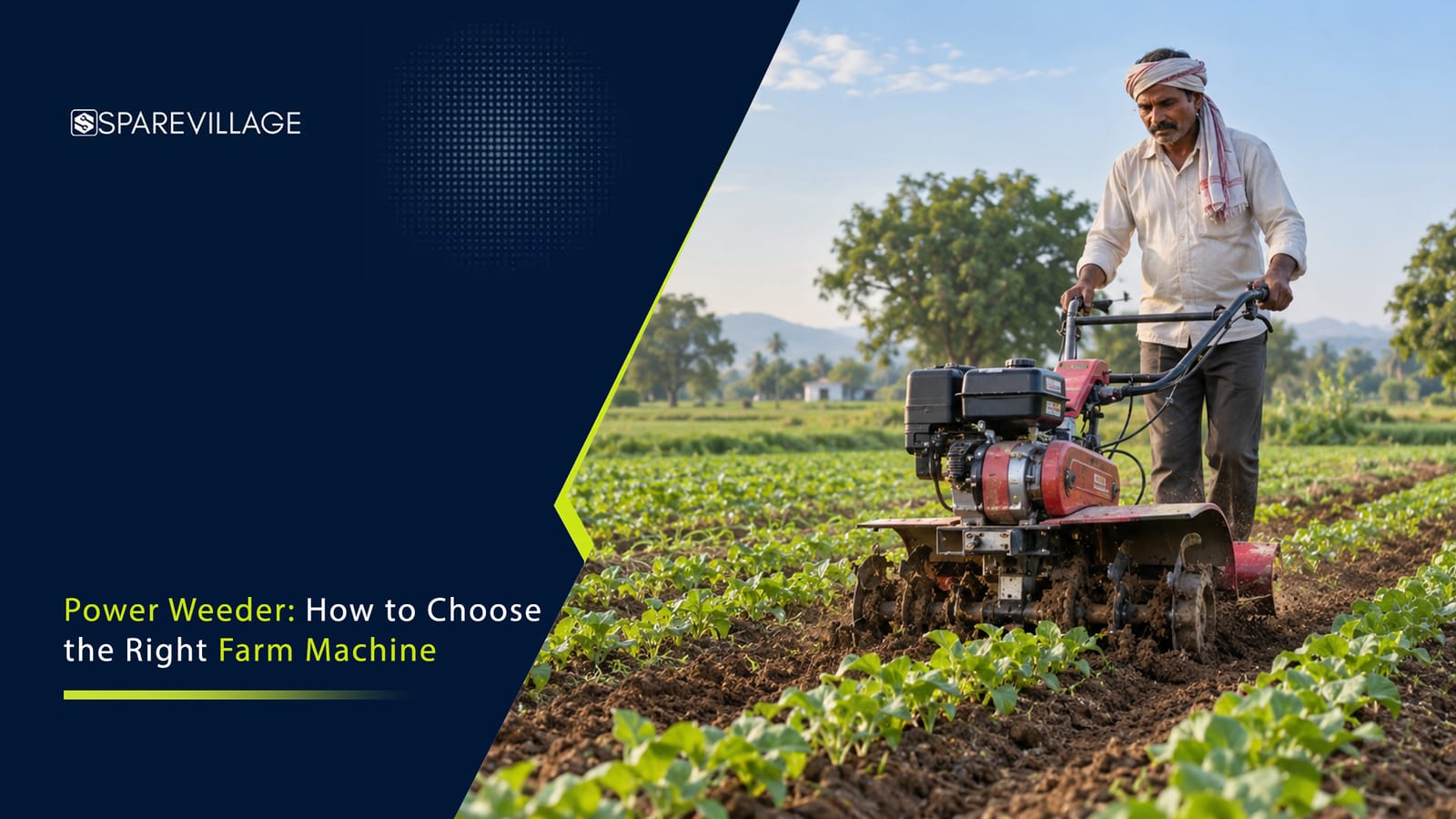
Power Weeder: How to Choose the Right Farm Machine
Power weeder buying guide for small & medium farms: compare types, HP, uses & price to choose the right farming tools and equipment for your land.
Article Content
Intro :
Weeds steal water. They steal nutrients. They steal sunlight from your crop. Every farmer knows this fight. For decades, the only answer was manual labour, long hours bent over rows, and rising wage costs at harvest time. That answer is changing fast.
A power weeder has become one of the most practical answers to this problem. It is not a luxury machine anymore. It is a working tool for small plots, medium farms, and everything in between. This guide breaks down what a power weeder actually does, how it differs from other farm machinery, and how to pick the right one for your land, your crop, and your budget.
If you are comparing options for the first time, or replacing an old machine that no longer keeps up, this article walks through the practical side of the decision. Not just specifications on a brochure, but the real questions farmers ask before they buy.
What Is a Power Weeder and Why It Matters for Indian Farms
A power weeder is a motorised agricultural machine built to remove weeds from between crop rows without damaging the plants. It runs on a small engine, usually petrol or diesel, and drives a set of rotary blades that cut and uproot weeds while loosening the topsoil at the same time.
This second function matters more than most buyers realise. Weeding is not only about removing unwanted growth. It is also about aerating the soil so roots can breathe and absorb nutrients better. A good power weeder for farming does both jobs in a single pass.
Indian farms face a specific challenge here. Land holdings are often small or fragmented. Row spacing varies by crop. Labour is available but increasingly expensive during peak season. Studies on crop losses show weeds alone can reduce yield by fifteen to forty percent if left unmanaged for too long. Manual weeding on a single hectare can take fifteen to twenty-five labour days depending on the crop, which delays other farm operations and adds directly to cultivation cost.
This is exactly where a power weeder machine changes the equation. It replaces days of manual labour with hours of machine work, and it does so at a scale that fits a small landholding just as well as a medium one.
Power Weeder vs Power Tiller: Understanding the Difference
Many first-time buyers confuse a power weeder with a power tiller. The confusion is understandable because both machines dig into soil and both reduce manual labour. But they are built for different stages of farming.
A power tiller is a heavy machine, typically ranging from nine to sixteen horsepower. It is used before sowing, to break compacted soil and prepare the seedbed. Think of it as land preparation equipment. It can carry attachments like seed drills, sprayers, and small trailers, which makes it closer to a mini tractor in function.
A power weeder is the lighter, more specialised counterpart. It steps in after the crop has already emerged, once weeds start competing with young plants. Its job is precision, not brute force. It moves between narrow rows, softens the soil, and clears weeds without uprooting the crop itself.
For a farmer deciding between the two, the honest answer is that most operations eventually need both. But if the immediate concern is standing weeds in a growing crop, a power weeder is the correct tool, not a tiller. Buying the wrong category of machine is one of the most common and costly mistakes new mechanisation buyers make.
Types of Power Weeder Machines Available for Farming
Not all power weeders are built the same, and the differences matter more than colour or brand name.
Petrol power weeders are the most common choice for small to medium farms. They are lightweight, start easily, and suit farmers who need a machine that is simple to operate without technical training.
Diesel power weeders are built for tougher, sustained use. They suit larger plots or farms running the machine for extended hours across bigger acreage. They cost more upfront but often last longer under heavy load.
Electric power weeders are gaining ground in greenhouses, nurseries, and polyhouse setups where fuel exhaust is undesirable. They are quieter and better suited to enclosed or semi-enclosed growing spaces.
Mini power weeders are compact versions designed for kitchen gardens, small vegetable plots, or nurseries where manoeuvrability matters more than raw power.
Multi-crop weeders are engineered with adjustable attachments so the same base machine can work across wheat, sugarcane, maize, legumes, and paddy fields. This flexibility is valuable for farmers who rotate crops seasonally instead of growing a single variety year-round.
Paddy weeders are a distinct category built specifically for wet, flooded field conditions, since standard rotary weeders do not perform well in standing water.
Engine capacity across these categories typically ranges from three horsepower up to eleven horsepower, though some heavy-duty models go higher. A machine with more horsepower is not automatically the better buy. The right horsepower depends entirely on soil type, row width, and how many hours the machine will run per day.
How to Choose the Right Power Weeder for Small Farm
Choosing the best power weeder for small farm operations comes down to matching the machine to the land, not the other way around.
Start with plot size. A small vegetable plot or a one-acre kitchen garden does not need the same machine as a five-acre commercial vegetable farm. Lighter, compact models with lower horsepower handle small plots efficiently and are easier for one person to manage without fatigue.
Next, look at row spacing and crop type. Narrow row crops like vegetables and horticulture plantations need a compact, manoeuvrable weeder that can move through tight gaps without damaging young plants. Wider row crops such as sugarcane or maize can accommodate a slightly heavier, higher horsepower machine because there is more room to work.
Terrain matters as much as crop. Uneven or rocky land benefits from a rugged, gear-driven machine with strong ground clearance. Flat, well-prepared soil is more forgiving and allows a lighter machine to perform just as well.
Finally, weigh upfront cost against long-term savings. An agricultural power weeder price varies by engine capacity, brand, and attachments. Entry-level models suit smallholders on tighter budgets. Higher capacity models suit commercial growers who need to cover more ground in less time. The real comparison is not the purchase price alone, it is the labour cost saved across multiple seasons versus the machine cost paid once.
Power Weeder Uses Across Different Crops
A power weeder for farming is not limited to one crop type. Its practical uses span most row-based agriculture.
In vegetable fields, it clears weeds between narrow rows without disturbing shallow root systems, which is critical since vegetables are especially sensitive to root damage. In sugarcane farms, back-rotary weeder models handle deep tilling and earthing up, a task that is physically demanding to do by hand. In cotton cultivation, timely weeding directly affects fibre quality, and mechanised weeding helps growers hit that timing window consistently.
Orchards and horticulture plantations use lighter weeder models to maintain clean ground cover around trees without competing with root zones. Paddy fields require a dedicated paddy weeder design suited to standing water conditions. Nurseries and polyhouse operations often prefer electric models for the reasons already mentioned.
This wide applicability is exactly why power weeder uses come up so often in farmer discussions online. On forums and community threads, farmers frequently compare machines based on which crops they grow rather than price alone, because the right machine for a paddy grower is rarely the right machine for a vegetable farmer. Matching the machine to the actual crop, not a generic listing, is the difference between a good purchase and a wasted one.
Farm Weed Control Machine vs Manual Weeding: Cost and Labour Comparison
The decision to mechanise weeding is ultimately a labour economics decision, and it is worth looking at plainly.
Manual weeding on one hectare typically requires fifteen to twenty-five labour days, depending on crop density and weed pressure. Multiply that by rising daily wage rates, and the seasonal cost adds up quickly, especially across multiple weeding cycles in a single crop season.
A farm weed control machine compresses that same task into a fraction of the time. One operator can cover significantly more ground per day than a team of manual labourers, and the work is more consistent because it does not depend on how many workers show up on a given day. That consistency also matters for crop timing. Weeds left even a week too long can already be pulling nutrients away from the crop, and machine-based weeding makes it far easier to weed on schedule rather than whenever labour becomes available.
Over multiple seasons, the machine pays for itself through labour savings alone. Add the yield improvement from timely, better-quality weeding, and the return on investment becomes clearer still. This is the practical argument that convinces most small and medium farmers to move from manual tools to mechanised agricultural equipment, not marketing claims, but a straightforward cost comparison across a full season.
Best Power Weeder Features to Check Before Buying
Before finalising any purchase, a few features deserve close attention regardless of brand.
Engine type and horsepower should match your soil hardness and crop type, not just budget. Heavier clay soils need more power than loose, well-tilled loam.
Blade design affects how cleanly weeds are cut and how well the machine avoids winding grass around the shaft, a common frustration with lower-quality models. Anti-winding blade designs reduce downtime for manual clearing.
Gear options matter for versatility. Machines with forward and reverse gears handle tight turns in narrow rows far better than single-direction models.
Weight and build affect manoeuvrability. A compact, well-balanced weeder is easier to control across a full day of use, especially for smaller farmers or single operators.
Attachment compatibility extends the machine's usefulness beyond weeding alone. Ridgers, inter-row cultivators, and seed drill attachments turn a single power weeder into a multi-purpose tool across the season.
After-sales support and spare parts availability are just as important as the machine itself. A weeder that breaks down during peak season and cannot be repaired quickly costs more in lost time than any saving on the original purchase price.
Agricultural Machinery Buying Checklist for Small and Medium Farmers
Bringing this together, here is a practical checklist worth running through before any purchase decision on agricultural machinery:
Confirm plot size and row spacing before shortlisting models.
Match engine horsepower to soil type and crop, not to the highest number available.
Choose fuel type based on how and where the machine will run daily.
Check blade design and gear options for the specific crop being grown.
Compare agricultural power weeder price against expected labour savings per season, not just sticker price.
Verify spare parts and service availability before committing to a brand.
Ask about attachment compatibility if the farm rotates between multiple crops.
Farmers comparing options on community forums tend to circle back to these same points repeatedly. Discussions rarely stay focused on price alone. Farm size, labour saved per season, and how well a machine performs on their specific soil come up far more often, because those are the factors that decide whether a purchase actually pays off.
Where to Buy Power Weeder and Agricultural Equipment Online in India
Buying agricultural machinery online has become far more common than it was even a few years ago, and for good reason. It gives farmers access to a wider range of brands and specifications than a single local dealer can offer, along with the ability to compare models before committing.
SpareVillage is built for exactly this kind of comparison. As a verified B2B marketplace, it lists power weeders, power tillers, and a wide range of farming tools and equipment from checked suppliers, so buyers are not left guessing about quality or authenticity. For anyone exploring the full range of options under agricultural machinery, browsing the Farming Tools, Equipment and Machines category is a practical starting point before narrowing down to a specific model.
Buying through a verified marketplace like SpareVillage also solves a problem many first-time mechanisation buyers face: knowing which supplier to trust. Since every listing goes through a verification process, farmers get a clearer picture of specifications, pricing, and supplier credibility in one place, instead of piecing that information together from scattered local sources.
This shift toward organised online buying is not limited to agriculture. Industrial buyers across categories are moving the same direction, and the reasons overlap closely with what farmers experience. If you are curious about that bigger shift, the article on the benefits of buying industrial products online in India covers why procurement teams and business owners are making the same move that SpareVillage enables for farm equipment buyers. Similarly, the guide on how to grow your industrial business online in India is worth a read for anyone running a supply or dealership business alongside their farm operations, since the same digital-first approach applies to selling equipment as it does to buying it.
Choosing Beyond Just the Weeder: Safety on a Mechanised Farm
One point that gets overlooked once a farm starts adding machinery is operator safety. A power weeder involves rotating blades and a running engine, and basic precautions matter as much as the machine specifications themselves. Sturdy footwear, hand protection during blade maintenance, and clear operating space around the machine reduce the most common injuries linked to farm equipment use.
This is not unique to farming. Any workplace introducing new machinery needs a matching safety approach. SpareVillage's guide on Workplace Safety Signage & Emergency Response Equipment is a useful reference for farm owners setting up designated equipment zones, storage sheds, or larger mechanised operations where basic signage and emergency preparedness genuinely reduce risk.
Conclusion on Choosing Farming Tools and Equipment
A power weeder is one of the clearer mechanisation decisions a small or medium farmer can make. The technology is proven, the cost of manual weeding is well documented, and the range of models available today means there is a genuine fit for almost every plot size and crop type.
The mistake to avoid is buying based on horsepower numbers or price alone. The right choice depends on your soil, your row spacing, your crop rotation, and how many hours the machine will actually run each week. Get that match right, and a power weeder pays for itself well within a season or two, while making weed control something you plan for rather than something you scramble to catch up on.
Whether you are equipping a single-acre vegetable plot or a multi-acre commercial farm, treating this as a matching exercise rather than a shopping trip will save both money and frustration down the line. SpareVillage's Farming Tools, Equipment and Machines are built to make that matching process easier, with verified specifications and supplier details laid out clearly for exactly this kind of decision.
People also Ask :
Q1: Manual weeding costs too much labour every season. Which power weeder actually saves money long term?
A petrol power weeder cuts weeding time from days to hours per acre. One machine replaces multiple daily wage workers across every weeding cycle. Over two to three seasons, labour savings alone cover the machine cost. SpareVillage lists verified petrol and diesel power weeders with clear pricing, so you can compare running cost against your actual labour spend before buying.
Q2: My farm is only one to two acres. Is a full-size power weeder overkill for a small plot?
No. A mini or low horsepower power weeder is built exactly for this size. It is lighter, easier to handle alone, and still clears weeds faster than manual labour. SpareVillage's Farming Tools, Equipment and Machines category lists compact models suited to one to two acre plots, so you are not paying for power you will never use.
Q3: Which power weeder works for paddy fields with standing water?
Standard rotary weeders struggle in flooded soil. A dedicated paddy weeder is designed for wet field conditions and handles standing water without clogging. It also protects paddy roots better than a general-purpose machine. SpareVillage stocks paddy-specific weeder models from verified suppliers, so you get equipment matched to your actual field condition, not a generic listing.
Q4: Petrol or diesel power weeder, which one should I choose for daily use?
Petrol models suit shorter daily runs and are easier to start. Diesel models handle longer hours and tougher soil better over time. If you run the machine for extended hours across bigger acreage, diesel pays off. SpareVillage lists both fuel types side by side with specifications, so you can compare based on your actual daily usage pattern.
Q5: How do I know which horsepower is right, since sellers just push the highest number?
Horsepower should match your soil and row width, not the seller's margin. Clay soil and wider rows need more power. Loose soil and narrow vegetable rows need less. SpareVillage listings show engine capacity, working width, and crop suitability together, so you can match horsepower to your field instead of overpaying for capacity you will never use.
Q6: Multi-crop farm here, wheat one season, vegetables the next. Do I need separate machines?
Not necessarily. A multi-crop power weeder with adjustable attachments handles different row spacings across seasons. One machine covers wheat, vegetables, and similar crops without buying separate equipment each time. SpareVillage lists multi-crop and attachment-compatible weeder models under Agricultural Machinery, so one purchase can realistically serve more than one crop cycle.
Q7. What is the difference between a power weeder and a power tiller?
A power tiller is a heavy machine used before sowing to break and prepare soil, usually nine to sixteen horsepower. A power weeder is lighter and used after the crop has emerged, to clear weeds between rows without damaging plants. Most farms eventually need both, but a power weeder is the correct tool for standing weeds in a growing crop.
Q8. Which power weeder is best for a small farm?
A mini or low horsepower power weeder suits small plots best, since it is lighter and easier for one person to manage. Engine capacity for small farms typically ranges from three to five horsepower. The right choice also depends on row spacing and soil type, not just plot size alone.
Q9. What are the different types of power weeders?
Power weeders come in petrol, diesel, electric, mini, multi-crop, and paddy variants. Petrol models suit small to medium farms, diesel models suit heavier sustained use, and electric models suit greenhouses. Paddy weeders are built specifically for flooded field conditions, while multi-crop weeders adapt to different row spacings across seasons.
Q10. How does a power weeder compare to manual weeding in cost?
Manual weeding takes fifteen to twenty-five labour days per hectare, and this cost rises with daily wages. A power weeder completes the same task in hours with one operator. Over two to three seasons, the labour savings alone typically cover the full cost of the machine.