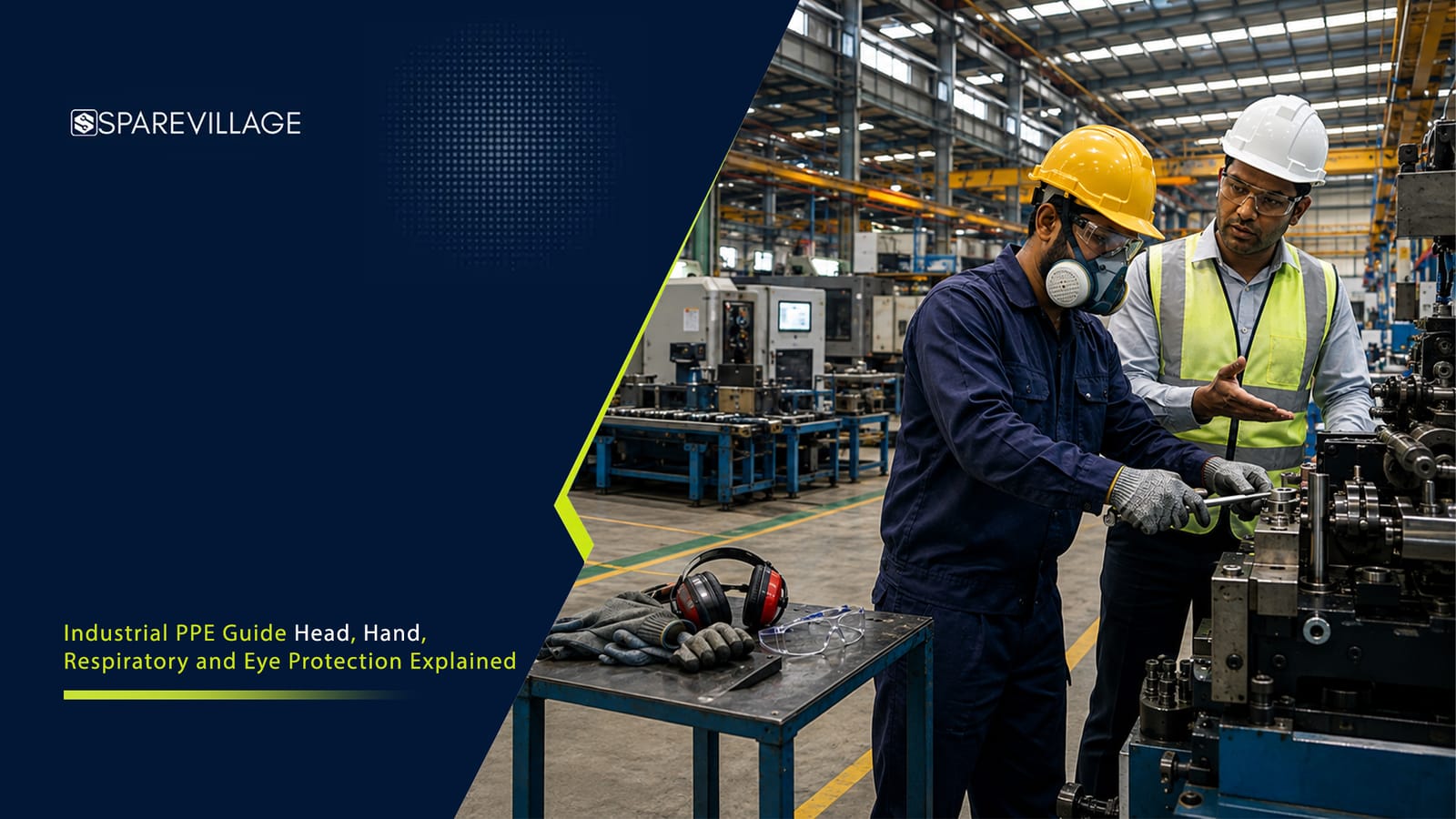
Industrial PPE Guide: Head, Hand, Respiratory and Eye Protection Explained
Industrial PPE Guide : helmets, gloves, respirators, goggles. IS codes, selection tips, and where to buy certified safety gear online.
Article Content
Intro
Industrial PPE is the equipment a worker wears to stay safe from hazards that can't be removed from the job. Think falling tools, flying metal chips, chemical fumes, dust, sparks, and sharp edges. No factory floor is 100% hazard-free. That's where personal protective equipment steps in, not as a replacement for safety systems, but as the last line of defence when everything else has already been done to reduce risk.
This guide covers the four PPE categories that protect a worker's most exposed body parts: head, hands, lungs, and eyes. You'll get straight answers on what each type does, when it's needed, which Indian safety standards apply, and how to choose the right gear for your workplace, without wading through generic checklists that don't match how Indian factories actually operate.
What Is Industrial PPE And Why It Matters
Industrial PPE is any protective gear, helmets, gloves, masks, goggles, footwear, or body suits, worn by a worker to reduce exposure to a workplace hazard. It's not optional gear for high-risk industries. It's a basic requirement wherever machines, chemicals, or heavy materials are part of daily work.
Every industrial workplace has a hazard profile. A fabrication unit deals with flying sparks and metal shards. A chemical plant deals with fumes and splashes. A warehouse deals with falling loads and forklift traffic. PPE is matched to that specific hazard profile, there's no single kit that fits every factory.
Why PPE is important in industrial safety comes down to one fact: most workplace injuries are preventable. Head injuries from falling tools, hand injuries from unguarded machinery, and respiratory issues from prolonged dust exposure account for a large share of factory incidents in India every year. The right PPE, worn correctly, cuts that risk sharply.
PPE also isn't a standalone fix. It works best alongside proper workwear and safety footwear, which is why most safety officers plan clothing and PPE together. Our Industrial Safety Footwear and Workwear: Complete Buyer's Guide covers how to get that base layer right before adding helmets, gloves, and masks on top.
There's also a common misconception worth clearing up early: PPE is not interchangeable across job roles. A helmet rated for impact protection won't help against electrical exposure. A glove built for grip won't stop a chemical burn. Personal protective equipment for workplace safety works only when each piece is matched to the hazard it's designed for, which is exactly why a head-to-toe understanding of PPE categories matters more than buying whatever's cheapest in bulk.
Types Of PPE Used In Industrial Workplaces
Industrial PPE for workplace safety generally splits into four core protection zones, plus body and foot protection layered separately:
Head protection : helmets and hard hats for impact and falling-object risk
Hand protection :gloves matched to cuts, heat, chemicals, or vibration
Respiratory protection : masks and respirators for dust, fumes, and particulates
Eye and face protection : goggles, glasses, and shields for debris, splash, and glare
Each category has its own IS (Indian Standard) code, its own selection logic, and its own failure points if bought wrong. The sections below break down each one in detail.
Head Protection: Industrial Safety Helmets
Direct answer: Industrial safety helmets protect workers from falling objects, overhead impacts, and, in insulated versions, electrical contact. They're mandatory on any site with overhead work, cranes, or scaffolding.
In India, industrial head protection is certified under IS 2925:1984, which sets requirements for shock absorption, penetration resistance, flammability, and heat resistance. A helmet with the ISI mark has passed these tests. That mark matters, uncertified helmets crack under impact instead of absorbing it.
Helmets come in a few practical variants:
Full-brim helmets : all-round protection from overhead and side impact, common on construction and mining sites
Half-brim (cap-style) helmets : lighter, preferred in manufacturing units with less overhead exposure
Electrical-rated helmets : insulated shells for workers near live electrical panels or wiring
Vented helmets : for hot environments where airflow matters as much as protection
How To Choose The Right Safety Helmet
Match the helmet to the actual hazard, not the cheapest option on the shelf. A warehouse with no overhead crane movement doesn't need the same helmet class as a steel fabrication yard. Check the chin strap, shell material, and ISI mark before ordering in bulk, a helmet that shifts on impact defeats its own purpose.
Hand Protection: Industrial Safety Gloves
Direct answer: Industrial safety gloves protect hands from cuts, heat, chemical contact, abrasion, and vibration injury. Hand injuries are among the most common in factories, largely because workers reach for the wrong glove, or no glove, for a five-minute task.
Glove selection in India is guided by IS 6994 (leather and cotton gloves) and IS 8807, the selection guide for hand and arm protection. Choosing gloves by application matters more than choosing by price:
Cut-resistant gloves : sheet metal handling, glass work, fabrication
Chemical-resistant gloves : handling solvents, acids, or industrial cleaning agents
Heat-resistant gloves : welding, foundry work, furnace handling
Anti-vibration gloves : workers operating grinders, drills, or jackhammers for extended hours
Electrical rubber gloves : insulated gloves under IS 4770 for live electrical work
General mechanical gloves : assembly line and machine-operator tasks needing grip and light protection
A glove that's rated for chemical resistance won't help against a cut, and a cut-resistant glove won't stop a chemical burn. Matching glove type to task is the single biggest factor in preventing hand injuries on the floor.
Respiratory Protection For Industrial Workers
Direct answer: Respiratory PPE protects the lungs from dust, fumes, and airborne particulates in environments like grinding, welding, foundries, and chemical handling units. Left unprotected, repeated exposure causes long-term respiratory damage that often shows up years after the exposure itself.
Respiratory protection in industrial environments is certified under IS 9473 for filtering half masks and IS 8522/8523 for cartridge and canister-type respirators. The right type depends on what's in the air:
Disposable dust masks : light dust environments like woodworking or general cleaning
Reusable half-face respirators : grinding, sanding, and moderate particulate exposure
Cartridge respirators : chemical vapours and fumes, with cartridges swapped based on the specific hazard
PAPR (powered air-purifying respirators) : high-exposure zones needing continuous filtered airflow
Fit matters as much as filter rating. A respirator that doesn't seal against the face leaks unfiltered air in from the sides, which defeats the entire purpose of wearing one.
Eye And Face Protection
Direct answer: Eye protection in industrial settings guards against flying debris, chemical splash, dust, and welding glare. Eye injuries happen fast, a single spark or metal chip is enough to cause permanent damage, which is why this category is non-negotiable on any cutting, grinding, or chemical-handling line.
Indian eye protection standards fall under IS 5983 for goggles. The choice between safety glasses, goggles, and face shields depends on the exposure type:
Safety glasses : general dust and light debris protection, worn all shift
Safety goggles : sealed protection for chemical splash and heavier dust environments
Face shields : grinding and cutting tasks where flying particles cover a wider area
Welding shields/helmets : glare and spark protection specific to welding operations
Impact-resistant lenses are standard for factory floors. Chemical-handling units need goggles with a full seal, not vented safety glasses that still let splash through the sides. A quick way to decide: if the hazard is airborne dust or debris, safety glasses usually suffice; if there's any risk of liquid splash or gas exposure, goggles are the safer default.
How To Select PPE Based On Workplace Hazards
Choosing PPE for workplace hazards starts with a hazard assessment, not a product catalogue. Walk the floor, list every task, and match each one to its risk: falling objects, sharp edges, chemical exposure, airborne particles, electrical contact, or noise. Only then does the PPE list make sense.
A few rules that hold across every industry:
Assess before you buy. PPE bought without a hazard assessment is usually the wrong PPE.
Check certification, not just price. ISI-marked gear under the relevant IS code is non-negotiable for factories and construction sites.
Fit is protection. Oversized gloves, loose helmets, and unsealed goggles fail exactly when they're needed most.
Train workers on use, not just supply. PPE handed out without training gets worn incorrectly or not at all.
Replace on schedule. Damaged, cracked, or worn PPE offers a fraction of its rated protection.
This selection discipline applies just as much to power tools as it does to protective gear, buying the wrong safety accessory for a tool is a common and costly mistake, one we've broken down in detail in Avoid These Mistakes When Buying Power Tools.
Common PPE Buying Mistakes To Avoid
Most PPE failures trace back to a buying decision, not a manufacturing defect. A few mistakes show up repeatedly across Indian factories and construction sites:
Buying by price alone. The cheapest helmet or glove on a listing is often uncertified, and the saving disappears the moment it fails during an audit or an incident.
Ordering one glove type for every task. A single "general purpose" glove across cutting, chemical handling, and welding stations leaves gaps in exactly the tasks that need specific protection.
Skipping size ranges. Bulk orders in one size mean workers wear PPE that's too loose or too tight, and loose PPE gets removed within the first hour of a shift.
Ignoring replacement cycles. Helmets, respirator cartridges, and gloves degrade with use. Treating PPE as a one-time purchase instead of a recurring one is how sites end up with expired protection in daily use.
Sourcing without documentation. A supplier who can't produce the IS code and test certificate on request isn't a supplier to build a safety program around.
Avoiding these five mistakes does more for worker safety than any single premium product upgrade.
PPE Compliance And BIS Standards In India
Industrial PPE safety requirements in India sit across a few overlapping laws. The Building and Other Construction Workers (BOCW) Act, 1996 requires PPE at no cost to construction workers. The Factories Act, 1948 governs manufacturing premises. The newer Occupational Safety, Health and Working Conditions Code, 2020 consolidates several of these older labour laws into one framework.
Across all three, the obligation is consistent: PPE has to match the actual hazard, and in practice, it has to carry BIS (ISI) certification against the relevant Indian Standard, IS 2925 for helmets, IS 6994 for gloves, IS 5983 for goggles, IS 9473 for respirators, and IS 15298 for safety footwear. For safety officers and procurement teams, this isn't paperwork for its own sake, it's what holds up during an audit or after an incident.
Factories and MSMEs sourcing PPE at scale need every batch traceable to these codes. That's a sourcing problem as much as a compliance one, and it shapes where teams should be buying from.
Where To Source Reliable Industrial PPE
Sourcing PPE for manufacturing workers reliably means working with suppliers who can show certification on every product, not just claim it in a product description. A single missing ISI mark on a bulk helmet order can stall a safety audit for weeks.
This is where a verified B2B marketplace makes a real difference over scattered local vendors. A structured B2B marketplace lets procurement teams compare certified PPE across categories, head, hand, eye, and respiratory, in one catalogue, with documentation attached to each listing instead of chased down after the order lands.
For teams building a broader safety kit rather than a single product, our Industrial Safety & PPE Supplies: The Complete Buyer's Guide for 2026 walks through sourcing an entire PPE program, from helmets to fall protection to fire safety gear, in one place.
Best PPE For Different Industries
The best industrial PPE for workers changes by sector, not by brand name:
Manufacturing plants : helmets, cut-resistant gloves, safety glasses, and hearing protection for machine-heavy floors
Construction sites : full-brim helmets, heavy-duty gloves, high-visibility workwear, and fall protection
Chemical and process units : chemical-resistant gloves, sealed goggles, and cartridge respirators
Warehousing and logistics : helmets near loading zones, gloves for material handling, and high-visibility vests
Labs and healthcare-adjacent facilities : disposable gloves, respiratory masks, and eye protection for contamination control
MSMEs often try to standardise on one PPE kit across departments to simplify purchasing. That works for general protection, but high-risk zones, welding bays, chemical stores, grinding stations, still need task-specific gear layered on top.
Budget also plays a role, and it's a fair concern for smaller operations. Bulk industrial PPE suppliers typically offer better per-unit pricing on helmets, gloves, and masks when ordered by department rather than one-off. For MSMEs running lean safety budgets, this is usually the difference between fully equipping a floor and leaving gaps in coverage. A supplier comparison across a few PPE suppliers in India, checking certification, pricing at volume, and delivery timelines together, is worth the hour it takes, especially before a large order goes out.
Buy Industrial PPE Online: Final Checklist Before You Order
Before you place a bulk PPE order, run through this checklist:
Confirm ISI certification and the specific IS code for each product category
Match glove, mask, and goggle type to the actual task, not a generic "safety kit"
Check sizing options, PPE that doesn't fit gets removed mid-shift
Ask for batch and lot traceability on bulk industrial PPE orders
Compare suppliers on a verified B2B marketplace rather than a single local vendor
Set a replacement schedule alongside the purchase, not after the first failure
Getting this right once saves repeat purchases, failed audits, and most importantly, avoidable injuries on the floor.
Workplace safety isn't a one-time purchase. It's an ongoing setup that needs the right gear, the right fit, and the right supplier behind it. If your team is still sourcing PPE piecemeal from scattered vendors, it's worth seeing what a dedicated industrial marketplace changes, our piece on Why Sparevillage Is More Than Just an Industrial Marketplace in India explains how sourcing, compliance documentation, and after-sales support come together in one place.
Buy safety equipment and tools for your workplace today, browse certified helmets, gloves, respirators, and eye protection from verified suppliers, all in one catalogue, and get your team properly equipped before the next shift starts.
Frequently Asked Questions
What is industrial PPE?
Industrial PPE is protective equipment worn to reduce exposure to workplace hazards like impact, chemicals, dust, and sharp edges. It includes helmets, gloves, respirators, and eye protection. It's the last line of defence after engineering and process controls.
What are the main types of PPE used in industrial workplaces?
The four core categories are head protection, hand protection, respiratory protection, and eye and face protection. Body protection and safety footwear are typically planned alongside these as a full safety kit.
Which IS code applies to industrial safety helmets?
Industrial safety helmets in India are certified under IS 2925:1984. This standard covers shock absorption, penetration resistance, flammability, and heat resistance. Always check for the ISI mark before bulk ordering.
How do I choose the right safety gloves for my workers?
Match the glove to the task, not a general category. Cut-resistant gloves suit fabrication, chemical-resistant gloves suit solvent handling, and heat-resistant gloves suit welding or foundry work. IS 8807 is the reference guide for hand protection selection.
When is respiratory protection required in a factory?
Respiratory PPE is needed wherever dust, fumes, or chemical vapours are present, grinding, welding, foundries, and chemical handling units. Disposable masks suit light dust; cartridge respirators suit chemical vapour exposure.
What's the difference between safety glasses and safety goggles?
Safety glasses protect against light dust and debris. Safety goggles provide a full seal, needed for chemical splash or heavier particulate exposure. Face shields add wider coverage for grinding and cutting tasks.
Is PPE legally required in Indian factories?
Yes. The Factories Act, 1948, the BOCW Act, 1996, and the Occupational Safety, Health and Working Conditions Code, 2020 all require employers to provide task-appropriate, certified PPE at no cost to workers.
How often should industrial PPE be replaced?
Replace PPE on visible damage, after impact, or per the manufacturer's rated lifespan, whichever comes first. Respirator cartridges and disposable masks have shorter cycles than helmets or gloves.
What does the ISI mark on PPE actually confirm?
It confirms the product has passed testing against the relevant Indian Standard, for example, IS 2925 for helmets or IS 5983 for goggles. It's the baseline check before any bulk purchase.
Can one PPE kit work across all departments in a factory?
A general kit covers baseline protection, but high-risk zones like welding bays or chemical stores need task-specific gear layered on top. Standardising everything to one kit usually leaves gaps.
What should I check before buying industrial PPE online?
Confirm the IS code and ISI certification, check sizing options, and ask for batch traceability on bulk orders. Comparing suppliers on a verified B2B marketplace reduces the risk of uncertified stock.
Are anti-vibration gloves necessary for all machine operators?
Only for workers using vibrating tools like grinders, drills, or jackhammers for extended periods. Short, occasional use doesn't usually require them, but daily prolonged use does.
What PPE is essential for chemical handling units?
Chemical-resistant gloves, sealed safety goggles, and cartridge respirators rated for the specific chemical in use. General-purpose PPE isn't sufficient for chemical exposure risk.
Do MSMEs need the same PPE compliance as large factories?
Yes. The Factories Act and OSH Code apply based on workplace type and worker count, not company size. MSMEs are equally expected to provide certified, task-matched PPE.
Where can I buy certified industrial PPE in bulk?
A verified B2B marketplace with documented certification per product is the safer route over scattered local vendors, especially for bulk orders that need to hold up during a safety audit.