How to Choose the Right Milking Machine for Dairy Farming?
Learn how to choose the right milking machine for dairy farming. Compare types, key specifications, animal compatibility, maintenance, and costs.
Article Content
Introduction
Dairy farming involves many routine activities, but milking has an important impact on the overall farm operation. How clean, consistent, and manageable the milking process is can directly affect daily farm operations, labour requirements, and milk handling. This is why, as the scale of a dairy farm increases, moving from manual milking towards a mechanical milking system can become a practical consideration.
However, buying a milking machine is not simply a matter of choosing a machine based on its price or capacity. Every dairy farm has different requirements. On some farms, the number of animals may be limited and the machine may only be required for occasional use, while larger dairy operations may place greater importance on regular milking, cleaning, workflow, and equipment reliability.
When choosing a suitable milking machine, factors such as animal type, herd size, milking frequency, available power supply, machine configuration, cleaning process, replacement parts, and after-sales support should all be evaluated together.
The purpose of this guide is not to recommend one particular machine, but to provide a practical framework that can help you identify the right milking machine for your dairy operation.
What Is a Milking Machine and Why Is It Used in Dairy Farming?
A milking machine is a mechanical system that uses vacuum and milking components to collect milk from an animal's udder. Compared with traditional hand milking, a machine-based system is designed to make the milking process more systematic.
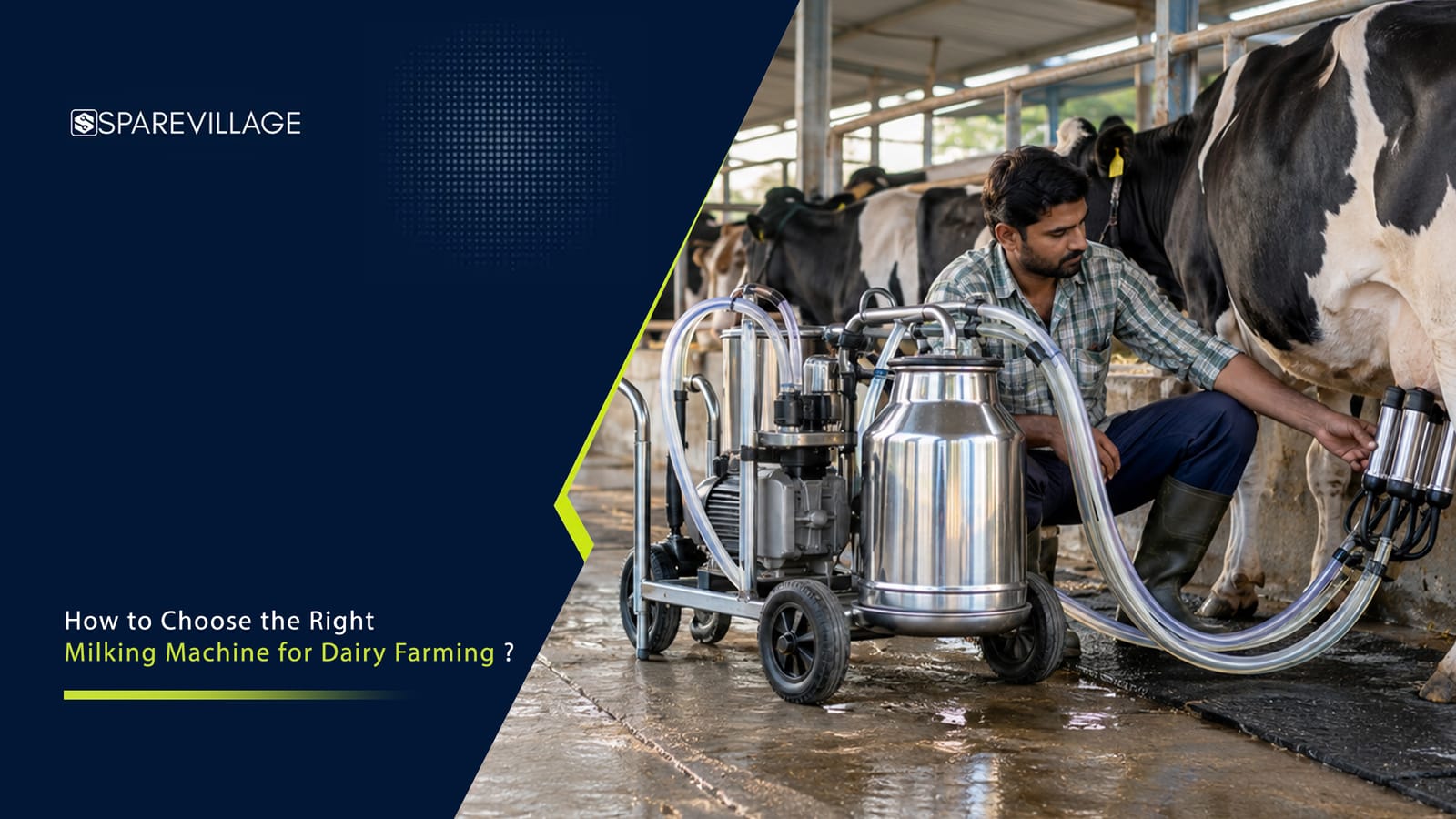
A typical milking setup may include a vacuum source, teat cups, milk tubes, a claw assembly, and a milk collection container. The exact configuration can vary depending on the design and model of the machine.
The working principle of a milking machine may appear simple, but correct operation is important. The vacuum system creates a controlled milking action through the teat cups, allowing milk to move into the collection container. In this process, equipment cleanliness, correct fitting, and following the manufacturer's operating instructions are particularly important.
Main Reasons Dairy Farms Consider Milking Machines
Consistent milking process: A mechanical system can help standardise the milking procedure, particularly when a regular milking schedule is maintained on the farm.
Labour management: Manual milking can require considerable physical labour and time. Mechanical equipment can make the workflow more manageable, although trained handling is still required to operate, monitor, and clean the machine.
Milk handling: A properly designed system can transfer milk into a collection container and reduce some of the manual handling involved in the process.
Adaptability to farm scale: Since different configurations are available, dairy operators can consider equipment according to their herd size and workflow.
However, using a milking machine does not automatically guarantee better milk quality. Milk hygiene largely depends on animal cleanliness, udder preparation, equipment sanitation, operator practices, storage, and overall milking management. Therefore, a machine should not be considered a replacement for a complete dairy hygiene system.
Define Your Requirements Before Buying a Milking Machine
Before making a purchase, it is useful to answer a few basic questions:
How many milking animals are on the farm?
How many animals will the machine be used for regularly?
How often does milking take place?
How much labour is available for milking?
Is the electricity supply reliable, or is an alternative power arrangement required?
Will the machine be used in a fixed location or moved between locations?
What existing setup is available for milk collection and cleaning?
Are replacement parts and servicing available locally or not?
The answers to these questions can considerably narrow down the suitable machine options.
Types of Milking Machines and the Differences Between Them
Milking machines can broadly be considered in different configurations based on their design, animal-handling arrangement, and ability to milk a certain number of animals at the same time. Each configuration can have a different use case.
Single-Animal Milking Machines
Single-animal systems can be a practical option for relatively small dairy operations where one animal is milked at a time. Their setup is generally simpler and can fit well into the workflow of smaller farms.
If the herd size is limited and the machine is primarily required to make labour more manageable, a single-animal configuration can be considered. Before purchasing, check the vacuum specifications, teat cup configuration, collection container, and cleaning requirements.
Multi-Animal Milking Systems
When a dairy operation has a larger herd and the milking workflow requires higher throughput, multi-animal systems may become relevant. These systems can provide an arrangement for handling multiple animals during the milking process.
The selection of a larger system should not be based simply on the principle that “more capacity is better.” The available farm space, animal movement, number of operators, cleaning process, and overall milking routine should be considered alongside the equipment's capacity.
Portable Milking Machines
Portable systems can be useful for farms where the machine needs to be moved between different locations. However, along with portability, factors such as weight, wheel arrangement, hose length, power source, and cleaning convenience should also be checked.
Whether a machine is genuinely portable should be verified through its specifications. It is not appropriate to assume portability based only on product photographs.
Electric Milking Machines
Electric models use powered vacuum systems and can be practical for regular farm operations, provided that a suitable electrical supply is available on the farm.
When choosing an electric machine, check the electrical requirements along with the motor specifications, operating environment, and manufacturer's instructions. If the power supply is inconsistent, the risk of downtime should also be considered as part of the purchase decision.
Animal Compatibility Is One of the Most Important Factors in Machine Selection
Animals such as cows and buffaloes can have different udder and teat characteristics. Therefore, it is important to check the manufacturer's compatibility information when selecting a machine.
The size of the teat cups, liner configuration, and suitability of the milking system should not be overlooked. If the equipment is not appropriately configured for the animal, achieving the expected performance from the machine can become difficult.
Which Specifications Should You Check When Buying a Milking Machine?
One of the most common mistakes when purchasing equipment online or offline is comparing only the price, motor power, or capacity. A better approach is to evaluate the milking machine as a complete system.
Vacuum System
The vacuum system is a central component of a milking machine. Vacuum-related specifications should be checked according to the manufacturer's documentation. Different systems can have different design requirements, so assuming that one generic number is ideal for every machine is not the correct approach.
Operators should follow the manufacturer's recommended operating settings and should not operate the machine at unnecessarily high vacuum levels.
Teat Cups and Liners
Teat cups come into direct contact with the animal's teats, making their construction, size, and liner compatibility important considerations.
Liners can be consumable components and may require replacement over time. When purchasing a machine, check whether replacement liners are easily available and what their replacement cost is.
Milk Collection Container
The capacity of the collection container should suit the farm's workflow. A very small container may require frequent emptying, while an unnecessarily large container may make handling more difficult.
The material is also important. For food-contact surfaces, verify the manufacturer's material information and applicable product specifications.
Motor and Power Requirements
Motor power should not be considered the only indicator of machine performance. It is better to evaluate the pump design, vacuum performance, system configuration, and intended application together.
If the machine operates on electricity, its voltage, frequency, and power requirements should be matched with the electrical supply available on the farm.
Cleaning and Maintenance
This is one of the most important parts of the purchase decision.
Milk-contact components need to be cleaned after use according to the appropriate cleaning procedure. If components such as tubing, liners, claw assemblies, or other milk-contact parts are difficult to clean properly, long-term hygiene management can become complicated.
Before purchasing, ask the supplier for clear information about the cleaning procedure, recommended cleaning agents, replacement intervals, and maintenance requirements.
Milking Machine Cost, Maintenance, and What to Check Before Buying
The actual cost of a milking machine is not limited to its purchase price. You should consider the total cost of ownership.
Along with the initial machine price, electricity consumption, replacement liners, hoses, seals, servicing, cleaning supplies, and possible repair costs can all become part of the long-term operating expense.
A Cheaper Machine Is Not Always More Economical
If an inexpensive machine has important spare parts that are difficult to source, limited servicing support, or consumable components that need frequent replacement, the initial saving may disappear through future operating costs.
Similarly, an expensive machine is not automatically the better choice. The machine's specifications should be evaluated against the actual requirements of your dairy farm.
Check Spare Parts Availability
Before purchasing, ask the supplier:
Are replacement liners available?
Can milk hoses and tubes be easily replaced?
Are spare parts for vacuum-related components available?
Where is service support available?
What does the warranty cover?
What is the repair process after the warranty period?
Clarifying these questions before buying a machine can help manage future downtime.
Verify Supplier and Product Information
When purchasing agricultural machinery, carefully read the technical information available on the product page. Verify the model number, specifications, included accessories, warranty information, and manufacturer or supplier details.
If a specification is unclear, it is better to seek clarification before purchasing rather than making assumptions.
When evaluating agricultural equipment on SpareVillage, buyers should also focus on comparing product specifications and application requirements. The objective is not simply to list products, but to provide buyers with relevant information that can help them make informed purchasing decisions.
A milking machine is not the only machinery requirement on a dairy farm. Chaff Cutter Machines can be relevant for feed preparation, different types of Agricultural Machinery can support field operations, and Waste Management Machinery can support farm hygiene and waste-handling requirements depending on the scale of the operation.
Animal comfort is also an important part of dairy management. Suitable Animal Mats can therefore be considered as part of overall dairy infrastructure planning.
How to Select the Right Milking Machine for Your Dairy Farm
There is no single answer for the right machine for every dairy farm. The best choice is the one that practically matches your animals, workload, infrastructure, and maintenance capabilities.
You can follow this sequence when making your decision.
Step 1: Identify Your Herd Size
First, determine how many animals the machine will be used for. Along with the current herd size, consider the expected operational requirement as well.
Step 2: Analyse Your Milking Workflow
Will the machine be used at a fixed location or moved closer to the animals? How many operators are available for milking? What is the process for cleaning the machine and handling the milk after collection?
These questions are important when deciding on the machine configuration.
Step 3: Verify Animal Compatibility
Check the machine manufacturer's recommended animal compatibility, teat cup configuration, and liner specifications. If you want to use the machine for both cows and buffaloes, explicitly confirm compatibility with the supplier.
Step 4: Make Cleaning a Purchase Criterion
Whether a machine is easy or complicated to clean can directly influence its long-term usability.
Milk-contact components should be accessible, and the manufacturer's recommended cleaning procedure should be practical to follow on the farm.
Step 5: Match the Power Requirements
For an electric machine, compare the electrical supply available on the farm with the product's requirements. For a portable setup, evaluate both the power arrangement and machine mobility.
Step 6: Calculate the Complete Ownership Cost
Consider consumables, spare parts, maintenance, and servicing along with the machine's purchase price. If two machines offer similar specifications, long-term maintenance support can influence the final decision.
Step 7: Evaluate Supplier Support
Support is also part of the purchase. Do not ignore warranty coverage, service network, replacement components, and supplier responsiveness.
Machinery Selection for Agriculture & Farming Is a Complete Ecosystem
Dairy farming should not be viewed from the perspective of a single machine. Farm operations involve multiple activities, including milking, feeding, fodder preparation, crop management, spraying, material handling, animal comfort, and waste management.
If you are evaluating farm machinery from a broader perspective, also read Power Weeder: How to Choose the Right Farm Machine. It explains the practical factors involved in evaluating machinery related to field preparation and weed management.
Similarly, when selecting equipment for crop protection, Agricultural Sprayer Buying Guide: Manual vs Battery vs Power Sprayers can be useful. This guide explains and compares different sprayer configurations based on their requirements.
What to Expect When Buying Agricultural Machinery from SpareVillage
When purchasing agricultural equipment, finding the right product is important, but access to reliable product information and suppliers is equally important.
SpareVillage's marketplace model is built with the objective of connecting businesses and industry buyers with different product categories and suppliers. When evaluating machinery and farm-use products in the Agriculture & Farming category, buyers should compare products according to their application, required specifications, and operating conditions.
Whether the requirement is for Milking Machines, Animal Mats, Chaff Cutter Machines, broader Agricultural Machinery, or Waste Management Machinery, the purchasing decision should be based on the actual use case of the product.
If you want to understand agricultural and industrial procurement from a broader supply-chain perspective, also read How SpareVillage Is Helping Businesses Build Stronger Supply Chains.
Final Takeaway
Choosing the right milking machine is not simply about selecting the “most powerful” or “most affordable” machine. You should evaluate the machine in the context of your herd size, animal compatibility, milking workflow, vacuum system, cleaning requirements, power availability, spare parts, and after-sales support.
A well-matched machine can support the existing workflow of a dairy farm, but its effectiveness also depends on correct installation, operation, cleaning, and regular maintenance.
Therefore, compare specifications before purchasing, ask the supplier important technical questions, and understand the total cost of ownership. When equipment is selected based on actual farm requirements and long-term usability rather than price alone, the purchasing decision becomes more practical and informed.
FAQs : 1. What is a milking machine? A milking machine is equipment that uses a controlled vacuum system to remove milk from an animal's udder and collect it in a container or milk-handling system. A typical milking unit includes teat cups with liners, a claw, milk tubing, pulsation components, and a vacuum source. The exact configuration depends on the type and design of the milking system. 2. How does a milking machine work? A milking machine uses vacuum and pulsation to create a controlled milking action. Teat cups are attached to the animal's teats, while the liners alternately collapse and open as part of the pulsation cycle. Milk is drawn through the milking unit and transferred through tubing into a collection container or milk-handling system. Correct settings and operation are important for animal comfort and effective milking. 3. Is a milking machine suitable for every dairy farm? A milking machine can be suitable for many dairy operations, but the appropriate system depends on factors such as herd size, number of animals milked, farm layout, labour availability, infrastructure, and maintenance capability. Penn State Extension notes that different milking systems may be appropriate depending on the number of cows milked and the operation's requirements. 4. How do I choose the right milking machine for my dairy farm? Start by assessing your herd size, animals being milked, daily milking routine, available labour, electricity, space, cleaning facilities, and expected future requirements. Then compare machines based on their configuration, vacuum system, teat cups and liners, collection capacity, cleaning requirements, spare-parts availability, and service support. The right machine is the one that fits your actual farm operation rather than simply having the highest capacity. 5. What should I check before buying a milking machine? Before purchasing, check the machine's intended animal compatibility, vacuum and pulsation specifications, teat cup and liner design, milk-contact materials, tubing, collection system, power requirements, cleaning procedure, spare-parts availability, warranty, and service support. Also confirm what components are included with the machine. These details can affect daily usability, maintenance, hygiene, and the long-term cost of operating the equipment. 6. How important is herd size when choosing a milking machine? Herd size is an important factor because it influences the required milking capacity and overall system design. A small dairy farm may have different equipment needs from a larger operation that milks many animals each day. However, herd size should not be considered alone. Farm layout, milking frequency, available labour, animal flow, and future expansion should also be considered before selecting equipment. 7. Can the same milking machine be used for cows and buffaloes? Not every machine or milking configuration should automatically be assumed suitable for both cows and buffaloes. Animal characteristics, including teat dimensions and udder configuration, can affect equipment suitability. Before purchasing, check the manufacturer's stated animal compatibility and confirm whether the teat cups, liners, and complete milking unit are appropriate for the animals on your farm. Avoid relying only on a general product description. 8. What vacuum level is best for a milking machine? There is no single vacuum setting that should be treated as universally correct for every milking machine. The appropriate operating vacuum depends on the equipment design, milking system, animal type, and manufacturer specifications. Incorrect vacuum or poor system performance can affect teat condition and milking effectiveness. Therefore, use the manufacturer's recommended settings and have the system checked when performance or teat-health problems occur. 9. Why are teat cups and liners important? Teat cups and liners are critical because the liner is the component that directly contacts the animal's teat during machine milking. Its condition, fit, and compatibility with the milking system can influence the milking process and teat condition. Liners should be inspected regularly and replaced according to manufacturer recommendations or when they become cracked, rough, damaged, or otherwise unsuitable for proper cleaning and operation. 10. How often should a milking machine be cleaned? Milk-contact parts of a milking machine should be thoroughly cleaned after every milking, followed by appropriate sanitization according to the applicable procedure. This includes teat cup liners and other components that come into contact with milk. Cleaning removes milk residues and helps control microorganisms. The exact cleaning chemicals, temperatures, concentrations, and procedures should follow the equipment manufacturer's instructions and applicable dairy hygiene requirements. 11. Does a milking machine improve milk quality? A milking machine alone does not guarantee better milk quality. Milk quality depends on the complete milking management process, including animal cleanliness, udder preparation, equipment condition, sanitation, correct milking technique, and proper milk handling. Clean, dry teats and properly maintained equipment are important parts of good milking practice. Equipment that is poorly cleaned or maintained can instead contribute to milk-quality problems. 12. What maintenance does a milking machine require? Milking equipment requires regular inspection and maintenance to remain clean and operate correctly. Check liners, tubing, gaskets, connections, and other components for cracks, wear, damage, or deposits. Vacuum and pulsation performance should also be monitored according to the manufacturer's recommendations. Worn rubber components should be replaced when required because cracks and deterioration can make cleaning more difficult and affect equipment performance. 13. What are the most important factors when comparing two milking machines? Compare the machines according to the same criteria rather than looking only at price. Check animal compatibility, system configuration, vacuum and pulsation specifications, number of milking units, collection arrangement, milk-contact components, cleaning requirements, power needs, spare-parts availability, warranty, and service support. The better option is the machine that meets your farm's operating requirements and can be maintained properly over its useful life. 14. Should I choose a portable or fixed milking machine? The choice depends on your farm layout and milking routine. A portable unit may be useful when the machine needs to be moved between animals or locations, while a fixed system can be more appropriate when the farm has a dedicated milking area and a suitable animal-flow arrangement. Consider movement, available space, electricity, cleaning facilities, drainage, and the number of animals milked before deciding. 15. Does a milking machine reduce labour requirements? A milking machine can change the way labour is used by mechanising part of the milk-removal process, but it does not eliminate the need for trained workers. Operators still need to prepare animals, attach and monitor milking units, identify problems, remove units appropriately, clean equipment, and maintain the system. Automated systems may require specialised maintenance and timely attention when malfunctions occur. 16. How important is after-sales service when buying a milking machine? After-sales service is an important consideration because milking equipment requires regular maintenance and replacement of wear components. Before buying, confirm the availability of spare liners, tubing, seals, and other required parts, along with warranty terms and technical support. A machine that is difficult to repair or maintain can create avoidable downtime, so service availability should be evaluated alongside the machine's purchase price and specifications. 17. How much does a milking machine cost? There is no single reliable price for all milking machines because cost varies according to machine type, capacity, configuration, automation level, materials, and included equipment. Instead of comparing only the purchase price, evaluate the total ownership cost, including consumables, replacement parts, electricity, cleaning requirements, servicing, and repairs. Obtain a product-specific quotation and verify exactly what is included before making a purchasing decision. 18. Can a milking machine be used without electricity? Some milking equipment may be designed for manual or alternative power arrangements, while many conventional systems rely on electrically powered vacuum pumps. Therefore, electricity requirements depend on the specific machine. Before purchasing, check the manufacturer's stated power requirements and determine whether your farm has a suitable electrical supply or needs another power arrangement. Do not assume that a machine is power-independent based only on its portability. 19. What should I consider about cleaning when buying a milking machine? Cleaning should be treated as a purchase criterion, not an afterthought. Check whether all milk-contact components can be properly accessed, rinsed, cleaned, sanitized, and dried according to the manufacturer's procedure. Complicated or inaccessible components can make routine cleaning harder. Pay particular attention to liners, tubing, gaskets, and other areas where milk residues can remain or damaged surfaces can become difficult to clean effectively. 20. Can a milking machine cause problems for animals? Improperly operated or poorly maintained milking equipment can contribute to teat or udder problems. FAO recommends using correct machine-milking techniques, attaching cups to clean and dry teats, avoiding unnecessary air entry, avoiding overmilking, and removing cups appropriately. Equipment condition and vacuum performance should also be monitored. If teat damage or abnormal milking behaviour occurs, the equipment and milking routine should be evaluated. 21. What is more important: machine price or machine quality? Neither price nor a general claim of quality should be used alone to select a milking machine. The better decision is based on how well the machine matches your farm's requirements and how reliably it can be operated, cleaned, maintained, and serviced. Compare specifications, animal compatibility, equipment design, spare-parts availability, warranty, and support alongside the purchase price before deciding. 22. Should I buy a milking machine for future herd expansion? If you have a realistic plan to expand your herd, future requirements can be considered during equipment selection. However, buying substantially more capacity than your current operation requires may increase the initial investment and maintenance requirements. The better approach is to compare your expected growth, available infrastructure, and milking workflow with the machine's capacity and determine whether the additional capacity is genuinely useful for your operation. 23. What makes a milking machine a good choice for dairy farming? A good milking machine is one that is appropriate for the animals and scale of the dairy operation, provides a suitable and controllable milking system, and can be properly cleaned and maintained. It should also have compatible replacement components and adequate technical support. Rather than relying on one specification, evaluate the complete system, including animal compatibility, workflow, hygiene, maintenance, infrastructure, and long-term operating requirements. 24. What should I ask a supplier before buying a milking machine? Ask the supplier about animal compatibility, machine configuration, vacuum and pulsation specifications, power requirements, included components, cleaning procedures, replacement liners and other spare parts, warranty coverage, servicing, and technical support. Also ask which components are consumable and how they should be maintained or replaced. Getting these details in writing can help you compare different machines more accurately and avoid making assumptions about the product.