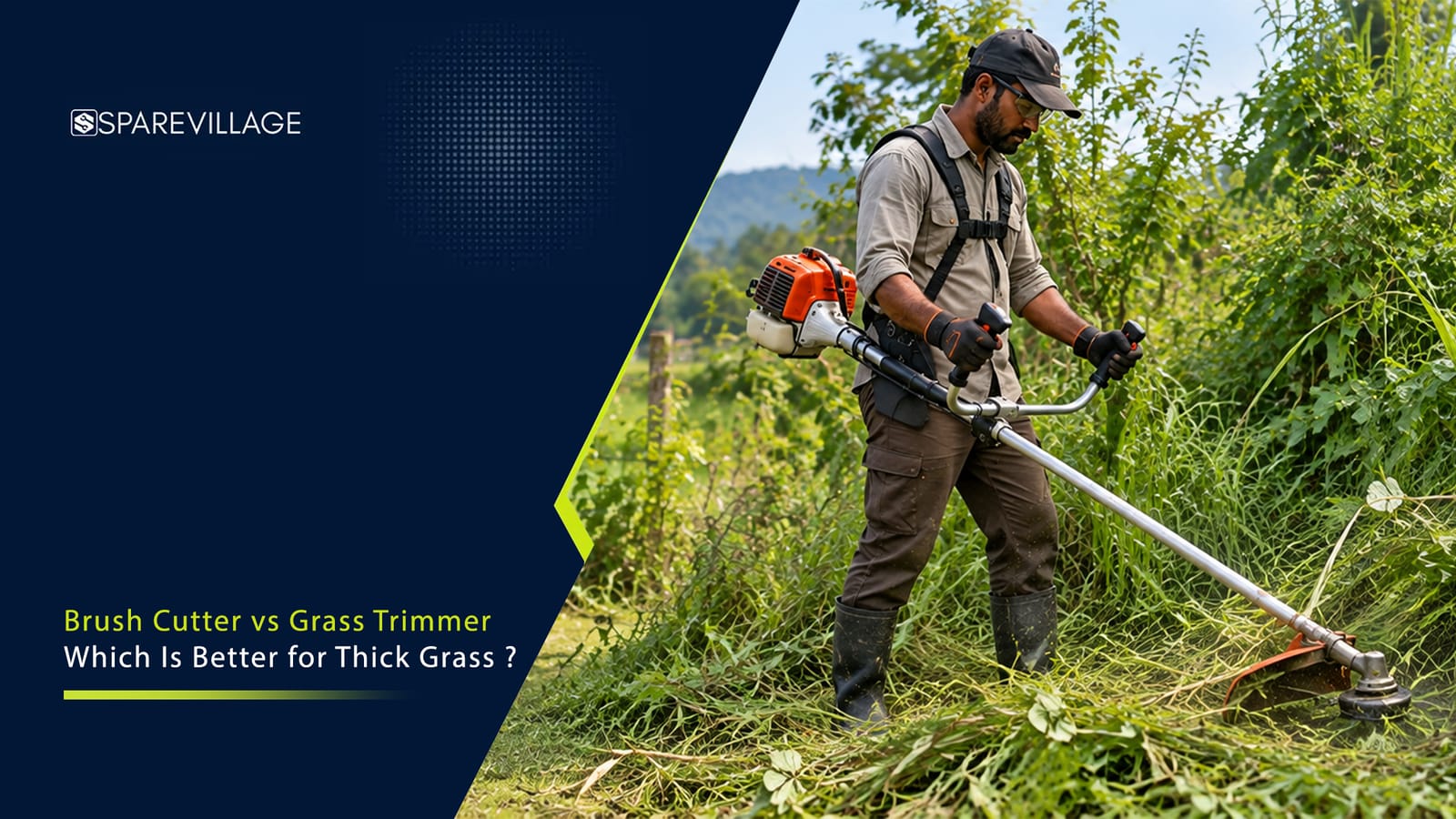
Brush Cutter vs Grass Trimmer: Which Is Better for Thick Grass?
Brush Cutter vs Grass Trimmer: learn which tool is better for thick grass, weeds, lawn edges and overgrown areas based on your cutting needs.
Article Content
Intro:
Brush cutters and grass trimmers are both used for cutting and maintaining grass and vegetation, but they are designed for different types of work.
The right choice depends on the type of vegetation, grass height, weed thickness, cutting area, cutting system, and machine specifications.
A grass trimmer can be suitable for light grass maintenance, lawn edges, and controlled trimming. A brush cutter is generally more relevant when the work involves tall grass, dense weeds, or tougher vegetation.
ISO 11806-1:2022 covers safety requirements for portable, hand-held powered brush-cutters and grass-trimmers. This makes the machine design, cutting attachment, guarding, and operating instructions important factors when selecting a machine.
Brush Cutter vs Grass Trimmer: What Is the Difference?
The main difference is the type of vegetation and cutting work each tool is intended to handle.
Brush Cutter
A brush cutter is designed for vegetation-clearing work where grass or weeds may be taller, denser, or tougher than normal lawn growth.
Depending on the model, a brush cutter may support manufacturer-approved nylon cutting systems or metal cutting blades.
This makes the category relevant for:
Tall grass
Dense grass
Tougher weeds
Overgrown areas
Vegetation-clearing work
The exact cutting attachment depends on the machine. Always check the manufacturer's specifications before selecting a blade, nylon line, or other cutting accessory.
Grass Trimmer
A grass trimmer is mainly used for trimming grass and maintaining areas where controlled cutting is required.
It is particularly useful around:
Lawn edges
Pathways
Walls
Garden boundaries
Areas that a lawn mower cannot easily reach
Grass trimmers commonly use flexible cutting line. The correct line type and diameter should be selected according to the manufacturer's instructions.
Which Tool Is Better for Thick Grass and Weeds?
For thick grass and dense weeds, the decision should not be based only on motor or engine power.
The vegetation and cutting attachment need to be considered together.
Thick Grass
Tall or dense grass can require more cutting capability than routine lawn maintenance.
A suitable brush cutter with an approved cutting attachment can be considered when grass has become too tall or dense for normal trimming.
Before buying, check:
Recommended cutting attachment
Supported blade or line type
Machine power
Machine weight
Handle configuration
Manufacturer's recommended application
A grass trimmer may handle some thicker grass depending on its design and specifications. However, it should not automatically be treated as a heavy vegetation-clearing machine.
Tough Weeds
The type of weed also matters.
Thin, soft weeds may be manageable with a suitable grass trimmer. Dense weed growth or tougher stems may require a brush cutter with a compatible cutting attachment.
The attachment must match the machine. A blade should never be selected simply because it physically fits the tool.
Cutting Attachment: The Part You Should Not Ignore
Many buyers focus on engine power, motor power, or battery capacity and overlook the cutting attachment.
That can result in choosing a machine that does not match the actual cutting requirement.
Nylon Cutting Line
Nylon line is commonly used for grass trimming.
Different machines support different line diameters and cutting systems. Using a line outside the manufacturer's recommended specification can affect machine operation.
HSE also warns that incorrect strimmer wire length can create imbalance and increase vibration.
Before buying replacement line, check the machine's manual and recommended specifications.
Metal Cutting Blades
Some brush cutters are designed to use metal cutting blades.
However, blade size, design, mounting system, and application must match the machine.
Before buying a blade, verify:
Compatible machine model
Approved blade diameter
Mounting system
Required guard
Manufacturer's recommended application
HSE advises users to follow the brush cutter manufacturer's guidance and warns about risks associated with non-standard metal cutting accessories.
How to Choose Between a Brush Cutter and Grass Trimmer
Instead of choosing a tool based only on its name, start with the work you actually need to perform.
Choose a Brush Cutter When You Need to Clear Thick Vegetation
A brush cutter can be considered when your regular work involves:
Tall Grass
If grass is allowed to grow tall before cutting, a brush cutter may be more suitable than a light-duty trimmer.
Dense Vegetation
Large areas with dense grass or weeds require equipment designed for more demanding vegetation-clearing work.
Tougher Weeds
Where weed stems are thicker or vegetation is dense, a suitable brush cutter attachment can provide a more appropriate cutting setup.
Overgrown Areas
For neglected plots, field boundaries, and similar vegetation-clearing applications, a brush cutter can be more relevant than a tool intended mainly for lawn trimming.
The exact machine should still be selected according to the manufacturer's stated application.
Choose a Grass Trimmer for Regular Grass Maintenance
A grass trimmer is more relevant when the job is mainly about maintenance and finishing.
Lawn Edges
Grass growing along pathways, walls, or garden boundaries can be difficult to reach with a lawn mower.
A grass trimmer can be used for this type of finishing work.
Light Grass
For regular trimming before vegetation becomes heavily overgrown, a grass trimmer can be a practical option.
Small Areas
If the work involves small lawn sections or limited trimming rather than vegetation clearing, a grass trimmer may be more appropriate.
Petrol, Battery or Electric: Which Power Source Should You Consider?
The power source should be selected according to where and how the machine will be used.
Petrol Models
Petrol-powered machines can be useful for outdoor work where access to mains electricity is limited.
However, buyers should also consider:
Machine weight
Fuel requirements
Maintenance
Noise
Vibration
Operating duration
Petrol power alone does not determine whether a machine is suitable for a particular type of vegetation.
Battery Models
Battery-powered brush cutters and grass trimmers can be convenient where cordless operation is important.
For battery models, check:
Battery voltage
Battery capacity
Claimed runtime
Charging time
Battery availability
Replacement battery cost
Do not assume that a particular battery capacity will provide the same runtime under every working condition. Actual runtime can change with workload and operating conditions.
Corded Electric Models
Corded electric trimmers can work well where a suitable power supply is available.
The main limitation is the need to manage the power cable during operation.
For a fixed garden or small maintenance area, this may not be a major issue. For remote outdoor work, another power source may be more practical.
Weight, Vibration and Operator Control
Cutting performance is only one part of the buying decision.
The operator also needs to control the machine safely during use.
HSE identifies brush cutters and strimmers among equipment that can expose users to hand-arm vibration.
Machine Weight
A heavier machine can become more demanding during longer working periods.
Compare the machine's weight with the type and duration of work you expect to perform.
Harness
For compatible brush cutter models, a suitable harness can help support the machine during operation.
The harness should be the type recommended for the machine rather than an incompatible replacement.
Vibration
Check the manufacturer's vibration information where available.
If the machine will be used frequently, vibration exposure should be considered during the purchasing and work-planning process.
Handle Design
Handle configuration affects how the operator controls the machine.
Before buying, consider whether the handle and operating position are appropriate for the work you plan to perform.
Do Not Choose Cutting Accessories Only by Price
Replacement accessories are an important part of machine ownership.
A cheaper blade or universal cutting head is not automatically a suitable option.
HSE has issued safety information regarding non-standard cutting attachments and the potential risks created when components fail at high rotational speed.
The UK Office for Product Safety and Standards has also published a product safety report concerning a universal trimmer head and identified serious injury risks associated with the product.
Before buying a replacement attachment, check:
Machine compatibility
Manufacturer approval
Correct dimensions
Mounting method
Guard compatibility
Recommended application
If you need replacement components for your machine, Brush Cutters Spare Parts can be considered when selecting compatible parts.
Brush Cutter vs Grass Trimmer: Buying Checklist
Before placing an order, evaluate your actual working conditions.
What Are You Cutting?
Identify whether you are cutting normal grass, tall grass, soft weeds, or dense vegetation.
How Large Is the Area?
A small garden and a large overgrown plot can require very different equipment.
How Often Will You Use It?
Occasional maintenance and regular professional use can have different requirements.
Which Cutting System Do You Need?
Check whether the machine supports the required nylon line, blade, or other approved attachment.
What Power Source Works for You?
Consider petrol, battery, or electric operation based on your work location.
How Long Will You Operate the Machine?
For longer work, weight, vibration, harness compatibility, and operator comfort become more important.
Are Spare Parts Available?
Check the availability of compatible cutting lines, blades, and other replacement components before purchasing.
If you are purchasing a brush cutter, the availability of Brush Cutters Spare Parts should also be considered for future maintenance.
Brush Cutter vs Grass Trimmer: Quick Decision Guide
This table is a practical application guide. Final product selection should always be based on the machine's exact specifications, compatible cutting attachment, and manufacturer's instructions.
Where to Buy Brush Cutters and Grass Trimmers
The right product should be selected based on the actual cutting requirement rather than price alone.
On SpareVillage, you can explore Brush Cutters and Grass Trimmers according to your application. If you need compatible replacement components for a brush cutter, you can also explore Brush Cutters Spare Parts.
For other garden-maintenance requirements, related categories include Hedge Trimmers, Hedge Shears, Pruning Secateur, and Lawn Mowers. You can also explore the broader Agriculture & Farming category for agriculture-related requirements and Gardening & Landscaping for garden and landscape maintenance products.
Conclusion
Brush Cutters and Grass Trimmers are not interchangeable choices for every cutting job.
A grass trimmer is more relevant for light grass maintenance, lawn edges, and controlled trimming.
A brush cutter is more relevant when the work involves tall grass, dense weeds, or tougher vegetation, provided the machine and cutting attachment are designed for that application.
Before buying, check the vegetation type, cutting area, power source, machine weight, vibration information, and compatible cutting attachments.
Most importantly, use only the cutting accessories and guards recommended for the machine. A physically compatible accessory is not necessarily a safe or approved accessory.
The right purchase is not simply the machine with the highest power. It is the machine whose cutting system, specifications, and operating design match the actual grass and weed conditions you need to manage.
Read This :
Chaff Cutter Machine: Types, Capacity & Buying Guide | Sparevillage
How to Choose the Right Milking Machine for Dairy Farming?
Agricultural Sprayer Buying Guide: Manual vs Battery vs Power Sprayers
FAQs :
1. “Will a strimmer clear brambles? Will a brush cutter do long grass?”
Answer: A strimmer can deal with light grass and some soft weeds, but brambles are a different type of vegetation. For established brambles, dense growth, or vegetation with tougher stems, a brush cutter designed for that application is generally the more suitable machine.
A brush cutter can also cut long grass when the machine and cutting attachment are rated for that application. The important point is not simply whether the machine is called a “brush cutter.” You need to check the manufacturer's recommended cutting system, blade or line type, and maximum supported attachment.
For long grass, use the attachment specified by the manufacturer for grass cutting. For tougher vegetation, use only the attachment approved for that machine and application.
Do not assume that a heavy-looking universal blade or head will make a strimmer suitable for brambles. Cutting accessories are part of the machine's operating system, and non-standard attachments can create serious safety risks. HSE specifically warns against non-standard cutting attachments on brush cutters.
2. “What is the difference between grass trimmer and cutter?”
Answer: The main difference is the type of cutting work they are designed to perform.
A grass trimmer is primarily used for grass maintenance and controlled trimming. It is useful for lawn edges, areas around walls and paths, garden boundaries, and grass that a lawn mower cannot easily reach.
A brush cutter is intended for more demanding vegetation-clearing applications. Depending on the machine, it may support nylon cutting line, metal blades, or other manufacturer-approved cutting systems.
The practical difference is therefore:
Grass trimmer: lawn maintenance, edges, light grass and controlled trimming.
Brush cutter: tall grass, dense vegetation, tougher weeds and vegetation-clearing work, when the machine is specified for those applications.
However, there is no universal rule that every brush cutter can cut every type of vegetation. The machine's specifications and approved cutting attachment still determine what it is designed to handle.
ISO 11806-1:2022 specifically covers portable, hand-held powered brush cutters and grass trimmers and addresses their design, cutting attachments, hazards and safe working information.
3. “Can a grass trimmer replace a brush cutter?”
Answer: Not in every situation.
A grass trimmer can replace a brush cutter when the work is limited to light grass maintenance, lawn edges, small areas, and similar trimming jobs.
It becomes a poor substitute when the work regularly involves:
Tall grass
Dense grass
Thick weeds
Brambles
Heavy overgrowth
Tough stems
Vegetation-clearing work
The important question is not whether a trimmer can physically cut some thicker grass. It may. The question is whether the machine is designed and specified for repeated work under those conditions.
For example, if you maintain a lawn every week, a grass trimmer may be sufficient. If you are clearing an overgrown plot where grass has become tall and dense, a brush cutter designed for that type of work is more appropriate to consider.
Also, do not assume that fitting a different blade or universal head turns a grass trimmer into a brush cutter. The cutting attachment, guard, drive system and machine specifications must work together. Manufacturers specify compatible cutting equipment for a reason.
4. “Which one will be better in terms of ease of use and power?”
Answer: It depends on the work you are doing.
For light grass trimming, a grass trimmer can be easier to manage because the job itself requires less aggressive cutting. For tall grass, dense weeds, or heavier vegetation, a suitably specified brush cutter can provide a more appropriate cutting setup.
But power should not be the only buying factor.
For a practical comparison, consider:
Type of vegetation
Area to be cleared
Cutting attachment
Machine weight
Handle design
Power source
Operating time
Vibration
Availability of replacement parts
For a small lawn, buying a large brush cutter simply because it has more power may not make practical sense.
For a large overgrown area, choosing a light-duty grass trimmer simply because it is easier to carry may result in slower work and a machine being used outside its intended application.
So the better approach is:
Choose the machine that has enough cutting capability for your vegetation without selecting more machine than your work actually requires.
5. “For using the blade on these for thicker tall grass, does it work well enough or should I spend more on another model?”
Answer: A blade can work well on tall or dense grass, but only when the machine is designed to use that blade and the blade is approved for that application.
Before spending more money on another model, check these points:
Is the machine designed for a metal cutting blade?
What blade diameter does the manufacturer specify?
What blade type is approved?
What vegetation does the manufacturer recommend it for?
Does the machine have the correct guard for that cutting system?
Is the machine's power and operating configuration suitable for the job?
If the machine is already designed for tall grass and supports the correct blade, upgrading may not be necessary.
But if you are repeatedly working through very dense vegetation and the existing machine is intended mainly for light trimming, buying a machine designed for heavier vegetation can be more sensible than trying to compensate with an unsuitable blade.
The key point is that the blade does not work independently of the machine.
A physically fitting blade is not automatically an approved blade. HSE warns that non-standard cutting attachments can create additional mechanical stresses and serious injury risks if components fail at high speed.
6. “What machine should I use to trim this type of grass?”
Answer: Choose the machine based on the grass height, density, area and frequency of cutting.
For short, regularly maintained lawn grass, a grass trimmer is usually the relevant category when you need to reach edges or areas a mower cannot easily access.
For tall but relatively soft grass, a suitable grass trimmer may work if its manufacturer specifies that application. If the grass is dense or heavily overgrown, a brush cutter designed for that work is more appropriate to consider.
For dense grass mixed with weeds or tougher vegetation, look at a brush cutter and select the cutting attachment specified for the vegetation.
For a large field, plot, roadside area, or neglected land, also consider:
Machine weight
Harness compatibility
Handle configuration
Power source
Cutting width
Blade or line system
Spare-part availability
Expected working duration
There is no single machine that is automatically correct for every type of grass. The correct choice comes from matching the machine specification to the actual vegetation.
7. “For mowing in thick vegetation, undergrowth and thick grass, what line would you recommend running and on what head?”
Answer: Do not choose the line and head only by looking at the vegetation. First check what the machine manufacturer allows.
Different brush cutters and trimmers are designed for different line diameters, head designs and cutting systems. The correct line should be within the manufacturer's specified range for that particular machine.
For thick grass and vegetation, check:
Maximum approved line diameter
Compatible cutting head
Recommended line material
Maximum line length
Machine power requirement
Manufacturer's application guidance
A thicker line is not automatically better. If the machine is not designed to operate with that line size, it can affect the cutting head, engine or motor load and machine balance.
HSE has also highlighted the importance of correct strimmer wire length because incorrect length can contribute to imbalance and increased vibration.
If the vegetation is beyond what the machine's nylon-line system is intended to handle, the answer may not be “use a thicker line.” It may mean using a brush cutter with the manufacturer-approved cutting system designed for that vegetation.
That distinction is important when buying accessories.
8. “I have 1 acre of hillside brush... Thick brush, tall grass, bush sized weeds and thorns and some small saplings... Is there a product that I can do this and possibly also have string trimmer option if I want?”
Answer: For this type of work, look beyond a basic grass trimmer.
You are describing several different types of vegetation:
Tall grass
Thick brush
Bush-sized weeds
Thorns
Small woody growth
Hillside terrain
A machine for this type of work should be selected based on its approved cutting attachments and intended application.
A brush cutter that supports both a suitable nylon cutting system and an approved metal blade can provide flexibility for different vegetation, provided the manufacturer specifically supports those attachments on that model.
For a one-acre hillside, also consider the physical demands of the work. Machine weight, harness support, handle configuration, vibration, balance and operating position become important because you may be carrying and controlling the machine for extended periods.
Do not select a machine only because the seller lists multiple attachments. Check whether each attachment is actually approved for that model.
For small saplings or woody vegetation, do not assume a standard grass-trimming head is suitable. Use only the cutting system specified by the manufacturer for the material being cut.
9. “I have very overgrown grass... Will I be able to make a dent in it with a standard brush cutter?”
Answer: A standard brush cutter may be able to handle very overgrown grass, but “standard brush cutter” is not enough information to determine whether it will be suitable.
Look at:
Engine or motor specification
Cutting attachment
Recommended cutting diameter
Blade compatibility
Manufacturer's intended application
Grass density
Presence of woody weeds or brush
Size of the area
If the area contains mainly tall grass, a brush cutter with the correct grass-cutting attachment may be suitable.
If the overgrowth also contains thick woody stems, brambles, bushes or other tougher vegetation, you need to check whether the specific machine and attachment are designed for those materials.
For very heavy overgrowth, work method also matters. Trying to force a light-duty machine through vegetation beyond its intended application can increase the load on the cutting system and make the machine harder to control.
So the practical answer is:
Yes, a suitable brush cutter can clear heavy grass, but choose the machine according to the actual vegetation rather than assuming every brush cutter is designed for extreme overgrowth.
10. “Can anyone recommend a brush cutter attachment head... Sometimes I cut really tall/thick grass, or overgrown weeds?”
Answer: Choose the attachment according to the brush cutter model and the vegetation you need to cut.
For tall or thick grass, a manufacturer-approved nylon cutting head may be appropriate if the machine specifies that system.
For tougher weeds or heavier vegetation, some brush cutters are designed to use approved metal cutting blades.
Before buying an attachment head, check:
Exact brush cutter model
Mounting/thread specification
Maximum approved attachment size
Compatible line diameter
Approved blade type
Required guard
Manufacturer's recommended application
Avoid choosing a “universal” head simply because the listing says it fits multiple machines.
This is particularly important with high-speed rotating attachments. HSE has warned about non-standard brush-cutter attachments that can fail and eject components at high speed. GOV.UK product-safety reports have also identified serious injury risks from certain non-standard chain-type trimmer heads.
For a brush cutter used regularly on different types of vegetation, it is better to have compatible, manufacturer-approved cutting systems for the specific jobs rather than trying to make one aftermarket head do everything.
11. Is SpareVillage a trusted place to buy industrial products online?
Answer:
SpareVillage is an online marketplace focused on industrial, business, and professional products. Buyers can find products from multiple categories and suppliers on one platform instead of contacting separate vendors for every requirement. SpareVillage also provides product ratings, specifications, pricing, and availability information on product listings, helping buyers evaluate an item before ordering.
For a product such as a brush cutter, the buyer should still check the complete product specifications, compatible attachments, warranty information, seller details, and other listing information before placing an order.
12. Can I compare different products and prices on SpareVillage before buying?
Answer:
Yes. SpareVillage is designed to help buyers discover and compare products, pricing, and availability before making a purchase. Its consumer app specifically lists product comparison, pricing, availability, and order tracking as part of the buying experience.
This is useful when choosing equipment such as a brush cutter or grass trimmer because the lowest price is not necessarily the only factor to consider.
Compare the power source, cutting capacity, compatible cutting system, machine weight, warranty, included accessories, and replacement-part availability along with the price.
For example, two brush cutters may have similar-looking prices but different engine specifications, cutting systems, or included accessories.
13. Can I buy products from verified vendors on SpareVillage?
Answer:
SpareVillage states that it connects buyers with verified and trusted vendors and positions the platform around business and industrial procurement. Its published information also highlights supplier discovery and reducing dependence on multiple vendor touchpoints.
For buyers, this can be useful when sourcing products that are normally purchased through multiple suppliers.
However, buyers should still check the product specifications, brand, warranty, seller information, and delivery details for the specific product they are purchasing. Vendor verification does not remove the need to check whether the particular product matches your requirement.
14. Can I get industrial and agricultural products from SpareVillage in one place?
Answer:
SpareVillage brings multiple business and industrial categories onto one marketplace, including Industrial Tools and Equipment, Agriculture & Farming, Electrical Tools & Equipment, Safety & PPE, Construction Materials, Automotive, Healthcare, Packaging, and Office Supplies.
This can be useful when a business needs different products for the same operation.
For example, a farming or landscaping requirement may involve a brush cutter, brush cutter spare parts, sprayer equipment, or other agricultural tools. Instead of searching for each requirement separately across unrelated websites, buyers can explore the relevant categories on SpareVillage.
15. What should I check before buying a product from SpareVillage?
Answer:
Start with the actual requirement, then compare the product specifications.
For a machine or tool, check:
Product specifications
Brand and model
Power rating
Intended application
Compatible accessories
Warranty
Seller/vendor information
Price
Availability
Delivery information
Replacement parts
For example, if you are buying a brush cutter, do not choose only by price. Check whether the machine is suitable for your grass or weed conditions, what cutting attachments it supports, and whether compatible spare parts are available.
SpareVillage provides product information, ratings, pricing, and availability on its marketplace, while its app also provides order tracking so buyers can stay informed about their purchase.