Chaff Cutter Machine: Types, Capacity & Buying Guide | Sparevillage
Chaff cutter machine types, capacity, uses and buying tips for dairy farms. Compare options and choose the right fodder cutter machine. Explore now.
Article Content
Intro:
Buying a chaff cutter machine is not simply about choosing the machine with the highest capacity.
A dairy farmer has to think about daily fodder requirement, available power, crop type, cutting size, labour, maintenance, and machine safety.
Choose too small a machine, and fodder preparation can take hours every day.
Choose an oversized machine, and you may pay for capacity your farm never needs.
A chaff cutter machine for dairy farm operations is designed to cut green and dry fodder into smaller, more uniform pieces. Agricultural engineering sources describe chaff cutters for processing materials such as green fodder, dry fodder and paddy straw. Different models use manual power, electric motors, engines, or tractor power.
This makes the buying decision very practical.
The right fodder cutting machine should match your actual workload.
It should also be safe to operate.
It should have adequate capacity.
And its important spare parts should be available when maintenance is required.
This guide explains the major chaff cutter types, their uses, capacity considerations, power options, safety requirements, and the factors that matter before buying one for a dairy farm.
What Is a Chaff Cutter Machine and Why Is It Used on Dairy Farms?
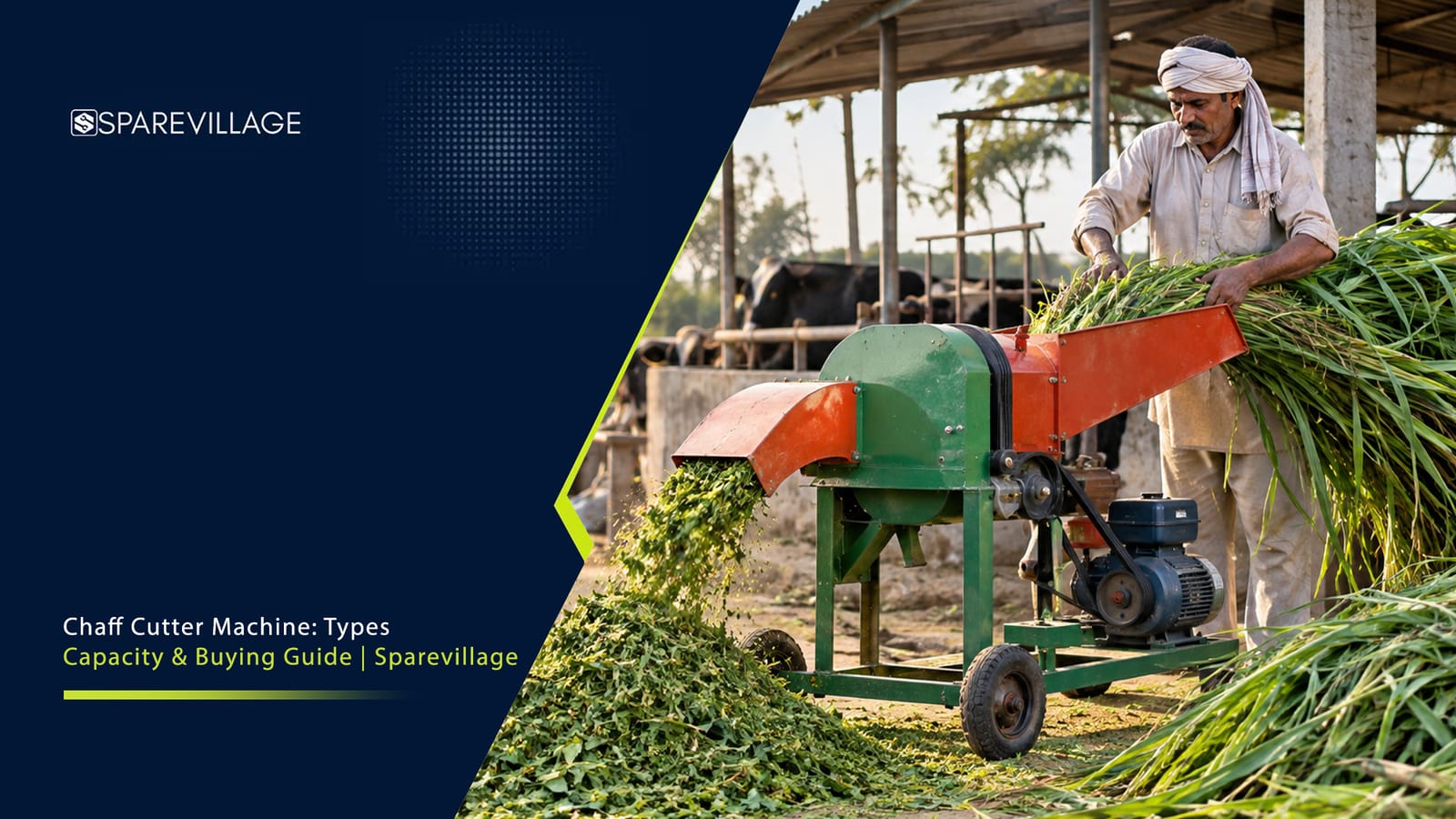
A chaff cutter machine is agricultural machinery used to cut fodder into smaller pieces before it is fed to livestock.
The machine can process different types of fodder depending on its design and specifications.
These can include green fodder, dry fodder, grass and crop residues such as paddy straw. TNAU's agricultural engineering resources specifically describe chaff cutters for cutting green fodder, dry fodder and paddy straw into uniform pieces.
The basic working process is straightforward.
Fodder is placed into the feeding section.
A feeding mechanism moves the material towards the cutting assembly.
Rotating blades then cut the material into shorter pieces.
The chopped fodder exits through the discharge section.
Many power-operated machines use rollers to feed the material towards the blades. A Reddit discussion from KisanKraft also describes this general arrangement, with rollers feeding fodder towards rotating knives.
The important point is that a chaff cutter does not replace the entire feeding process.
It is a fodder preparation machine.
The final feeding programme still depends on the animal, fodder quality, ration formulation, storage conditions, and the farmer's feeding practice.
Chaff Cutter Types: Which Type Is Suitable for Your Farm?
There is no single best chaff cutter machine for every dairy farm.
The correct choice depends mainly on workload and available power.
1. Manual Chaff Cutter
A manual chaff cutter uses human effort instead of an electric motor or engine.
It can be suitable for very small operations where the daily fodder requirement is limited.
TNAU documents a hand-and-pedal-operated chaff cutter with a reported capacity of about 300 kg of green fodder per hour. The machine is intended for green fodder, dry fodder and paddy straw.
The main advantage is simple operation.
There is no electricity consumption.
There is no engine fuel requirement.
However, labour becomes the limiting factor.
For a dairy farm processing large quantities of fodder every day, manual operation can become inefficient.
A manual machine therefore makes more sense when the workload is modest and labour is readily available.
2. Electric Chaff Cutter
An electric fodder cutter machine uses an electric motor to drive the cutting mechanism.
This is a common option for farms with reliable electricity.
TNAU lists different motor-operated configurations. One example uses a 1 HP motor with a stated capacity of 250 to 300 kg per hour. Another three-roller configuration uses a 1.5 HP motor with a stated capacity of 400 to 500 kg per hour. A heavy-duty 2 HP example is listed with a capacity of 1,000 to 1,500 kg per hour.
These figures demonstrate an important buying lesson.
Motor horsepower alone does not tell you the actual machine capacity.
Capacity depends on the complete machine design.
It can vary with the number of rollers, blade arrangement, fodder condition, feeding method, and manufacturer specifications.
Therefore, never select an electric chaff cutter only by reading the HP rating.
Check the manufacturer's stated throughput for the fodder you intend to process.
3. Engine-Operated Chaff Cutter
An engine-operated chaff cutter uses an internal-combustion engine instead of an electric motor.
This can be useful where electricity is unreliable or unavailable.
Petrol or diesel engine configurations can provide greater flexibility because the machine is not dependent on a fixed electrical connection.
However, fuel consumption becomes part of the operating cost.
Engine maintenance also becomes important.
Before buying, check the engine type, rated power, starting system, fuel requirement, service availability, and availability of replacement parts.
A machine that is powerful but difficult to service locally can become expensive over its working life.
4. Tractor-Operated Chaff Cutter
A tractor-operated chaff cutter uses tractor power.
This option becomes more relevant for larger farms or operations that already own a suitable tractor.
Agricultural machinery references identify manually operated, electric-operated and tractor-operated chaff cutters as different options for dairy farms.
The biggest advantage is that the farm does not necessarily need a separate motor for the cutter.
However, tractor compatibility matters.
The buyer should verify the required tractor power, PTO arrangement, attachment method, operating speed and transport requirements before purchase.
Do not assume that every tractor can safely operate every tractor-driven chaff cutter.
Chaff Cutter Capacity: How Much Capacity Does a Dairy Farm Need?
Chaff cutter capacity is normally expressed as kilograms per hour or tonnes per day.
This is one of the most important specifications to check before buying.
But capacity should not be treated as a simple number.
Manufacturers may state capacity under specific operating conditions.
Actual output can change with fodder type, moisture, feeding rate, cutting size, operator practice and machine condition.
For example, TNAU lists a 1.5 HP power-operated chaff cutter with three blades and a 25 mm chaff length at a capacity of 1.6 to 3.2 tonnes per day.
Another TNAU specification lists a 3 HP electric model with a stated capacity of 1,500 to 1,600 kg per hour.
These numbers should not be compared blindly.
They represent different machine configurations.
A better approach is to calculate your farm's approximate daily requirement first.
How to Match Capacity With Daily Fodder Workload
Suppose a farm needs approximately 600 kg of fodder prepared each day.
A machine rated for several tonnes per hour may be unnecessary.
The farm may finish its daily work much faster than required, but the additional capacity may increase purchase cost and power requirements.
Now consider a larger dairy operation that needs several tonnes of fodder every day.
A small machine could force workers to spend a large part of the day feeding fodder into the cutter.
That increases labour time.
It can also create unnecessary delays in feeding preparation.
The better approach is to select a machine that can complete the normal daily workload with practical operating time and some working margin.
Do not buy based on the maximum advertised capacity alone.
Ask how the capacity was measured.
Ask which fodder was used.
Ask what cutting size was selected.
Ask whether the figure represents continuous feeding or an ideal test condition.
That information makes the capacity specification much more useful.
What Can a Chaff Cutter Machine Cut?
A fodder cutter machine is mainly used for preparing livestock fodder.
Depending on the machine design, it may process:
Green fodder.
Dry fodder.
Grass.
Paddy straw.
Maize fodder.
Jowar or sorghum fodder.
Bajra fodder.
Barseem.
Sugarcane leaves.
Groundnut residues.
TNAU lists several green and dry fodder materials that can be processed by power-operated chaff cutters, including Bajra, Jowar, maize, Barseem, sugarcane, paddy, grass and groundnut material.
However, do not assume that every machine can safely process every material.
Always check the manufacturer's approved material list.
Very fibrous, excessively wet, contaminated, or unsuitable material can affect feeding and cutting performance.
How Does Cutting Size Affect the Buying Decision?
Cutting length is another specification that deserves attention.
A chaff cutter does not simply make fodder "small."
Different machines can produce different cut lengths.
TNAU examples list cutting lengths such as 3/8 to 1/2 inch and 1/2 to 5/8 inch for certain motor-operated models.
Other machines offer different settings.
The required cutting length should therefore be checked against the fodder and feeding system used on the farm.
Do not select a machine because it produces the smallest possible pieces.
Smaller is not automatically better.
The useful question is whether the machine produces the required size consistently.
Best Chaff Cutter Machine: What Should You Check Before Buying?
The best chaff cutter machine is the one that fits the farm's workload, power source, fodder type and service conditions.
Check these specifications before placing an order.
Daily Capacity
Calculate how much fodder your farm normally needs to prepare.
Then compare that requirement with the manufacturer's stated output.
Do not use the machine's maximum advertised capacity as your daily target.
Power Source
Decide whether the farm should use manual power, electricity, an engine or tractor power.
Reliable electricity can make an electric model practical.
Poor electricity availability may make an engine-powered machine more useful.
A tractor-operated model can make sense when a suitable tractor is already available.
Number of Rollers
Rollers help control the movement of fodder towards the cutting section.
Different machines use different roller configurations.
TNAU specifications include both two-roller and three-roller motor-operated machines.
Compare the complete feeding system rather than assuming that more rollers automatically mean better performance.
Blade Material and Design
Blades are working components.
They experience repeated contact with fodder.
Check the blade material.
Check whether replacement blades are available.
Also check how easily blades can be removed, sharpened or replaced.
TNAU examples include high-carbon-steel cutting blades in several machine specifications.
Cutting Adjustment
If the machine provides different cutting-length settings, understand how those settings work before buying.
A simple adjustment mechanism can be useful when the farm regularly processes different fodder.
Build Quality
Look at the frame.
Check the feeding tray.
Check the guards.
Check the drive system.
Check the bearings.
Check the belt and pulley arrangement where applicable.
A machine used every day needs more than a high-capacity label.
It needs a structure capable of handling repeated operation.
Maintenance and Spare Parts
Ask about replacement blades.
Ask about belts.
Ask about bearings.
Ask about rollers.
Ask about motor or engine service.
Ask about the availability of local technicians.
A machine that is easy to purchase but difficult to repair can create problems later.
Chaff Cutter Machine Safety: What Dairy Farmers Should Never Ignore
A chaff cutter contains moving parts and cutting blades.
Safety cannot be treated as an optional feature.
Research published on chaff cutter injuries in rural India found that workers feeding fodder into the chute were among those exposed to serious injury risk. The study also examined accidents involving children around the machines and developed safety interventions for chaff cutters.
The feeding area therefore deserves particular attention.
Never put hands near the cutting mechanism.
Use the machine's intended feeding arrangement.
Do not remove protective guards while the machine is operating.
Keep children away from the operating area.
Stop the machine before attempting cleaning, adjustment or maintenance.
Keep the blades properly maintained.
TNAU also specifies safety-related features such as covered belt wheels on certain chaff cutter designs and recommends keeping blades sharp and maintaining the specified blade-to-mouth-piece clearance.
Safety should be checked before purchase.
Do not wait until after installation.
Chaff Cutter vs Fodder Grinder: Are They the Same Machine?
No.
A chaff cutter and a fodder grinder perform different processing functions.
A chaff cutter is primarily used to cut fodder into smaller pieces.
A grinder performs a different type of size reduction.
This distinction matters when buying agricultural machinery.
If your requirement is simply to chop green or dry fodder into manageable pieces, a chaff cutter is the relevant machine category.
If your requirement involves grinding material into a much finer form, you may need a different machine.
Do not buy a machine simply because its product title contains the word "fodder."
Check the actual processing function.
How Reddit Discussions Reflect Real Dairy-Farm Buying Concerns
Online farming discussions are useful for understanding what users actually worry about after the technical specifications are published.
A dairy-farming discussion on Reddit lists a chaff cutter alongside other core dairy equipment such as fodder processing and milking equipment. The discussion also describes manual and powered chaff cutters and focuses on the practical process of feeding fodder into rollers and blades.
Other Reddit discussions show a different concern.
Users dealing with chopped forage often care about whether the machine can handle their specific material and workload.
One discussion about obtaining a chaff cutter for haylage highlights practical issues such as machine availability, cost, heavy use, and finding farmers who already have suitable equipment.
These discussions should not replace engineering specifications.
They do, however, highlight an important buying principle.
A machine that looks suitable on paper may still be unsuitable for your actual fodder and workload.
That is why capacity, material compatibility, maintenance and local service should all be checked before purchase.
About SpareVillage: Chaff Cutter Machines and Farming Equipment
SpareVillage places Chaff Cutter Machines under Agriculture & Farming → Farming Tools, Equipment and Machines.
This is relevant for buyers who are comparing chaff cutters with other equipment used around a modern farm.
The SpareVillage category currently includes chaff cutter listings with specifications such as machine capacity, phase, roller design, cutting components, dimensions and weight. For example, one listed Dhanlaxmi Chaff Cutter specifies a single-phase configuration, conveyor-belt feeding, self-adjusting rollers and high-carbon-steel blades.
This makes specification-based comparison more useful than choosing a machine only from its product name.
The broader Agriculture & Farming category covers equipment used for different farming requirements.
When comparing a chaff cutter machine for dairy farm operations, buyers can therefore evaluate the machine alongside other relevant agricultural machinery rather than treating the chaff cutter as an isolated purchase.
The wider farming equipment requirement may include Milking Machines, Agricultural Machinery, Petrol Engines, Animal Mats, and Waste Management Machinery, depending on the farm's operation.
The important point is to buy according to the actual job.
A milking machine solves a milking requirement.
A chaff cutter solves a fodder preparation requirement.
A waste management machine addresses farm waste handling.
These machines may work together as part of a larger farm operation, but they should not be substituted for one another.
Which Chaff Cutter Should You Buy?
Choose a manual chaff cutter when the daily workload is low and manual labour is available.
Choose an electric chaff cutter machine when reliable electricity is available and the farm needs regular fodder preparation.
Choose an engine-operated chaff cutter when electricity availability is a major limitation.
Choose a tractor-operated chaff cutter when the farm already has a suitable tractor and requires higher-volume processing.
For every option, compare capacity, fodder compatibility, cutting size, power requirement, safety guards, blade quality, maintenance requirements and spare-part availability.
The biggest machine is not automatically the best machine.
The right machine is the one that completes your normal fodder workload reliably without creating unnecessary operating cost.
Conclusion
A chaff cutter machine can become one of the most useful pieces of equipment on a dairy farm when it is correctly matched to the farm's workload.
The buying decision should start with daily fodder requirement.
Then evaluate power availability.
Then compare machine capacity.
After that, check cutting size, fodder compatibility, rollers, blades, safety guards and maintenance support.
Do not buy only because a machine has a high HP rating.
Do not buy only because a manufacturer claims high capacity.
And do not choose a machine without checking whether replacement parts and service are available.
For dairy farms, the practical objective is simple.
Prepare the required quantity of fodder consistently.
Reduce unnecessary manual work.
Maintain safe operation.
And keep the machine reliable enough for repeated daily use.
That is what makes a fodder cutting machine a useful investment rather than another piece of equipment sitting unused in the farm shed.
Explore More Agriculture & Farming Equipment
If you are building or upgrading a dairy or farming operation, these related categories can help you compare other equipment requirements:
Agriculture & Farming
Explore equipment used across different farming and agricultural operations.
Gardening Landscaping
Useful for equipment and tools used in gardens, nurseries, landscaping and outdoor maintenance.
Chaff Cutter Machines
Explore chaff cutters and compare machine specifications for fodder preparation.
Milking Machines
For farms looking to mechanise the milking process alongside fodder preparation.
Agricultural Machinery
A broader equipment category for different farm operations.
Petrol Engines
Relevant when an engine-powered machine requires a separate power source.
Animal Mats
Useful for improving animal housing and floor-management conditions.
Waste Management Machinery
Relevant for farms handling agricultural and livestock-related waste.
Recommended Reading
How to Choose the Right Milking Machine for Dairy Farming?
A practical guide for comparing milking-machine requirements, farm size, operation and machine selection.
Agricultural Sprayer Buying Guide: Manual vs Battery vs Power Sprayers
Compare different agricultural sprayer technologies and select the right option according to farm size and spraying requirements.
Power Weeder: How to Choose the Right Farm Machine
Understand power-weeder types, applications and the specifications that matter before buying.
FAQs:
1. What is a chaff cutter machine?
A chaff cutter machine is agricultural machinery used to cut green fodder, dry fodder, grass and crop residues into smaller pieces for livestock feeding. The cutting process produces more uniform fodder pieces and makes fodder easier to handle. TNAU specifically lists green fodder, dry fodder and paddy straw among materials suitable for chaff cutting.
2. Why is a chaff cutter machine used on a dairy farm?
A chaff cutter is used to prepare fodder before feeding livestock. It reduces long stalks and other fodder material into smaller pieces, which can make feeding and handling easier. The main practical benefit is faster fodder preparation and more consistent chopping. The machine can also reduce the manual effort required for cutting fodder.
3. Which chaff cutter machine is best for a dairy farm?
There is no single best chaff cutter machine for every dairy farm. The correct machine depends on daily fodder volume, number of animals, fodder type, available electricity, required cutting size and available labour. A small farm may need a low-capacity electric or manual machine, while a larger dairy operation may require a higher-capacity powered machine.
4. Which type of chaff cutter should I buy?
The main choice is between manual, electric, engine-operated and tractor or power-tiller-operated chaff cutters. Choose according to your power availability and workload. Manual machines suit low-volume work. Electric machines suit farms with reliable electricity. Engine-operated models are useful where grid electricity is unreliable. Tractor or power-tiller models are more relevant when compatible equipment is already available.
5. What are the different types of chaff cutter machines?
Common types include manual chaff cutters, electric motor-operated chaff cutters, engine-operated chaff cutters and tractor or power-tiller-operated chaff cutters. Machines can also differ in feeding arrangement, number of rollers, blade configuration, portability and capacity. The type should be selected according to the farm's workload and power source rather than only the machine's advertised horsepower.
6. How much chaff cutter capacity do I need?
Start with the amount of fodder your farm needs to process every day. Then compare that requirement with the manufacturer's rated hourly capacity. Do not choose capacity only from the number of animals because fodder requirements vary with animal type, ration and feeding system. Also check whether the stated capacity is for green fodder, dry fodder or a specific operating condition.
7. How much fodder can a chaff cutter cut per hour?
The output varies significantly between machines. For example, TNAU lists a manually operated model at about 300 kg of green fodder per hour, while an ICAR-CCARI horizontal chaff cutter reported approximately 396 kg/hour for green grass and 223 kg/hour for dry grass under its tested conditions. Manufacturer specifications can be much higher for heavy-duty machines.
Important: This is exactly why we should not write one universal capacity figure in the article.
8. Can a chaff cutter cut both green and dry fodder?
Yes, many chaff cutters are designed to process both green and dry fodder. However, the actual performance can differ between materials. ICAR-CCARI testing, for example, reported different output rates for green and dry grass using the same horizontal chaff cutter. Always check the manufacturer's specifications for the particular model you are considering.
9. What types of fodder can a chaff cutter machine process?
Depending on the machine design, chaff cutters can process materials such as green fodder, dry fodder, paddy straw, maize, jowar, bajra, berseem, sugarcane, grass and groundnut material. TNAU specifically lists several of these materials for power-operated chaff cutters. However, the permitted material should always be checked against the individual machine specification.
10. Does higher HP mean a better chaff cutter?
No. Higher horsepower does not automatically mean a better machine.
Horsepower should be considered together with cutting capacity, fodder type, feeding system, blade design, power supply and intended workload. A machine with excessive capacity can cost more than necessary, while an undersized machine may struggle with the farm's workload. Current buying guides also recommend matching motor power and capacity with the actual daily requirement.
11. Should I buy a 2 HP or 3 HP chaff cutter?
The answer depends on the material and workload rather than horsepower alone. A 3 HP machine can provide more available motor power than a 2 HP machine, but the actual advantage depends on the complete machine design and rated capacity. Compare the manufacturer's output, fodder compatibility, power supply, cutting mechanism and operating requirements before choosing between the two.
12. Can a chaff cutter run on single-phase electricity?
Yes, some chaff cutters are specifically designed for single-phase electricity. For example, ICAR-CCARI reports a horizontal chaff cutter using a 2 HP single-phase, 230 V motor. However, not every high-capacity machine uses the same electrical configuration. Check the required voltage, phase and motor rating before purchasing.
13. Should I buy an electric or engine-operated chaff cutter?
Choose an electric chaff cutter when the farm has a reliable electricity supply and the machine's capacity matches your workload. An engine-operated model can be more practical where reliable grid electricity is unavailable. The decision should include running cost, maintenance, fuel or electricity availability, service support and the machine's rated capacity.
14. What cutting size should a chaff cutter produce?
The required cutting size depends on the fodder and the farm's feeding practice. Chaff cutters are available with different cutting specifications. TNAU, for example, lists a power-operated machine with a 25 mm chaff length, while ICAR-CCARI reported approximately 18.5 to 21.5 mm cut pieces in testing for its horizontal chaff cutter. Therefore, compare the machine's available cutting size with your actual feeding requirement.
15. Is a chaff cutter machine safe to use?
A chaff cutter requires proper safety precautions because its feeding and cutting mechanisms contain moving and cutting components. Research on chaff-cutter injuries in rural India identified workers feeding fodder into the chute and children interacting with the machine as important injury situations. Protective interventions can be incorporated into new machines or retrofitted onto existing machines.
16. What should I check before buying a chaff cutter machine?
Check these specifications before purchasing:
Daily fodder requirement.
Rated cutting capacity.
Green and dry fodder compatibility.
Required cutting length.
Motor or engine power.
Single-phase or three-phase requirement.
Feeding rollers and feeding arrangement.
Blade material and replacement availability.
Safety guards.
Machine weight and portability.
Spare-parts availability.
Local service and maintenance support.
These factors are more useful than comparing machines only by price or horsepower.
17. How often does a chaff cutter need maintenance?
Maintenance requirements depend on the machine design and operating conditions. Regular cleaning, inspection of moving components, checking belts and fasteners, and maintaining the cutting mechanism are practical maintenance steps. Blades should be kept in suitable condition because cutting performance depends on the condition and alignment of the cutting system. Manufacturer maintenance instructions should take priority for the specific model.
18. Is a portable or fixed chaff cutter better?
A portable chaff cutter is useful when fodder is prepared at different locations or the machine needs to be moved around the farm. A fixed machine can be more suitable when the farm has a dedicated fodder-processing area. The choice depends on where fodder is stored, where it is processed and how often the machine needs to be moved.