Fall Protection Equipment for Industrial Use: The Complete Safety Guide
Explore fall protection equipment for industrial use, harnesses, hooks, lifelines, nets & safety kits. A complete guide for safer working at height.
Article Content
Intro:
Every year, thousands of industrial workers step onto a scaffold, a rooftop, a storage rack, or a platform several metres above solid ground, trusting that a single strap, hook, or rope will hold if something goes wrong. Falls from height remain one of the leading causes of serious injury in industrial and construction workplaces, and a surprising number of these accidents happen not because equipment didn't exist, but because the wrong equipment was used, worn incorrectly, or never inspected at all.
This guide breaks down what a plant manager, safety officer, or procurement team needs to know about fall protection equipment for industrial use, what it is, how the different categories work together, and how to choose a system that genuinely protects your workforce rather than just checking a compliance box. We'll cover safety harnesses, belts, hooks, nets, lifelines, fall arresters, rope access equipment, and complete safety kits, along with the selection and inspection practices that separate a real fall protection system from a collection of disconnected parts.
What Is Fall Protection Equipment and Why It Matters in Industrial Workplaces
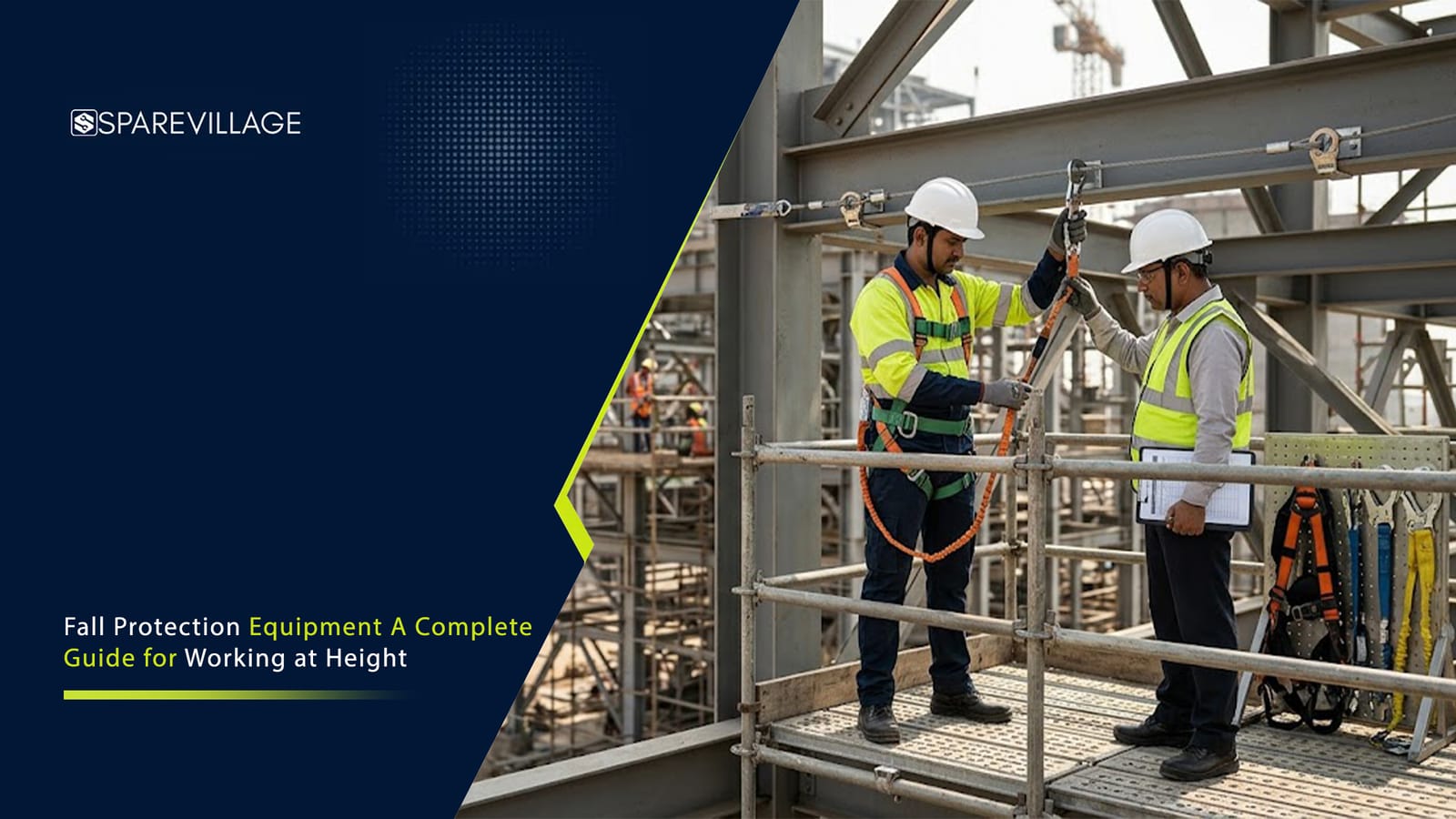
Fall protection equipment refers to the personal protective equipment (PPE) and structural systems designed to prevent a worker from falling, or to safely arrest a fall if one occurs, while working at height. In industrial settings, this typically means any work performed above ground level where a fall could cause injury, climbing ladders, working on elevated platforms, accessing storage racks, maintaining tanks and towers, or working near open edges and floor openings.
A complete fall protection system is rarely a single product. It's a combination of body support (harness or belt), a connecting device (lanyard, hook, or fall arrester), an anchorage point, and often an energy absorber that reduces the force transmitted to the body during a fall. Miss any one component, or mismatch the wrong parts together, and the entire system can fail even if each individual piece is certified and in good condition.
This is why working at height is treated as a distinct hazard category in industrial safety planning, separate from general PPE like gloves or eye protection, the consequences of a fall are immediate and often severe, which is why this equipment carries stricter selection, inspection, and training requirements than most other categories of workplace safety gear.
Fall Prevention vs Fall Protection: Understanding the Real Difference
These two terms are often used interchangeably, but they describe different approaches to the same hazard, and the distinction shapes how you should buy and deploy equipment.
Fall prevention refers to measures that stop a fall from happening in the first place, guardrails, floor opening covers, safe work platforms, and restraint systems that physically limit how far a worker can move toward an edge. Fall protection, in a narrower sense, includes fall arrest systems designed to safely stop a fall that has already begun, minimizing injury through controlled deceleration.
Most safety professionals treat fall prevention as the preferred first line of defence, since a fall that never happens is always safer than one that gets arrested mid-air. Fall arrest systems come into play when prevention alone isn't practical, for example, when a worker genuinely needs to move near an edge to complete a task.
Fall Restraint vs Fall Arrest: Which One Does Your Job Need
This is one of the most commonly confused pairs of terms in the industry, and getting it wrong can leave a worker with equipment that doesn't match the actual hazard.
A fall restraint system is configured so the worker physically cannot reach a fall hazard at all. Lanyard length and anchorage point are calculated so the worker runs out of reach before getting close enough to an edge to fall; there is no fall event in a properly configured restraint system.
A fall arrest system, on the other hand, assumes a fall is possible and is engineered to safely stop it. This requires a full body harness, a shock-absorbing lanyard or fall arrester, an adequately rated anchorage point, and enough fall clearance below the worker for the system to deploy without them hitting a lower level.
The choice between restraint and arrest depends on the task, the layout of the work area, and the available anchorage points. A competent person conducting a site risk assessment should determine which approach fits before any equipment is issued.
The Fall Protection Hierarchy: How Safety Professionals Think About Height Work
Experienced safety teams don't start by asking "which harness should we buy." They start with a hazard assessment of the task, then work down a hierarchy of controls:
Eliminate the need to work at height wherever possible.
Prevent falls through guardrails, covers, and physical barriers.
Restrain workers so they cannot reach the fall hazard.
Arrest falls safely when restraint isn't practical, using a full personal fall arrest system.
Minimize consequences through rescue planning, in case a fall does occur.
This hierarchy matters because it reframes fall protection equipment as the last layer of defence, not the first. Equipment selection should follow a genuine risk assessment for working at height, taking into account the specific job, the anchorage options available, and the fall clearance beneath the work area.
Types of Fall Protection Equipment Used in Industrial Settings
Industrial fall protection equipment falls into several distinct categories, each serving a different role within the overall system. Understanding what each one does, and doesn't do, is the foundation of making a safe, compliant purchase decision.
Industrial Safety Harness: The Core of Personal Fall Arrest Systems
A full body safety harness is the central body support component of any personal fall arrest system. Unlike a simple belt, a harness distributes the force of a fall across the shoulders, thighs, and pelvis, dramatically reducing the risk of internal injury during arrest.
A standard industrial safety harness includes shoulder straps, leg straps, a chest strap, and a dorsal (back) D-ring, sometimes supplemented with side D-rings for work positioning. Some designs also include a frontal attachment point for ladder climbing or rescue.
Common uses include construction and maintenance work at height, scaffolds and elevated platforms, tower and tank access, and any task requiring a fall arrest connection.
How to choose a safety harness comes down to the worker's body weight and size range, the type of work (general fall arrest vs. work positioning vs. confined space rescue), the number and placement of D-rings needed, and compatibility with the connecting device and anchorage system already in use.
How to wear a safety harness correctly matters as much as the harness itself. Straps should sit flat without twists, the chest strap should sit across the mid-chest (not the neck), leg straps snug but not restrictive, and the dorsal D-ring centered between the shoulder blades. A loose or twisted harness can fail to distribute fall forces properly even if it's fully certified.
Safety harness inspection should happen before every use, checking webbing for cuts, fraying, and UV or chemical damage; D-rings and buckles for cracks or corrosion; and stitching for pulled threads. Any harness that has arrested a fall should be removed from service immediately, regardless of how it looks.
Industrial Safety Belt: Work Positioning, Not a Harness Replacement
An industrial safety belt is often confused with a harness, but the two serve genuinely different purposes.
A safety belt is designed for work positioning, holding a worker in place at a fixed point while both hands are free for tasks like electrical line work or pole climbing. It is not designed to arrest a free fall. Because a belt only supports the waist, a fall arrested by a belt alone can cause severe internal injury, since the force isn't distributed across the body the way a full harness manages it.
This distinction matters for procurement teams especially, because a belt is sometimes purchased as a cheaper substitute for a harness. For any task with genuine fall arrest risk, a full body harness is the appropriate equipment. A belt only belongs in situations that are specifically work positioning, with a short restrained connection to an anchor point, where a free-fall scenario has been ruled out.
Safety Hooks and Connecting Devices
Safety hooks are the connecting hardware that link a harness to a lanyard, lifeline, or anchorage point, and they're an easily overlooked part of a fall protection safety kit, despite being a common point of failure when the wrong type is used.
Common types include snap hooks, double-locking safety hooks, scaffold hooks (with a wider throat opening for structural connections), and carabiner-style connectors. A locking safety hook is essential for fall arrest applications, since a non-locking hook can roll out under load or accidental contact, a failure mode known as rollout.
A double hook safety lanyard, often used in "100% tie-off" configurations, lets a worker stay connected to an anchor point at all times, even while moving between anchorages, by clipping one hook before releasing the other. Gate strength, locking mechanism, and compatibility with the connected D-ring and anchorage size all need to be verified when selecting hooks.
Lifelines, Anchorage and Energy Absorbers
An anchorage point is the fixed structural connection the entire fall arrest system relies on, and it needs to be rated to withstand the forces generated during a fall, far higher than most people assume. Anchorage selection is one of the most safety-critical decisions in the whole system, since even a perfect harness and lanyard combination is only as strong as the point it's connected to.
A lifeline extends the reach of a connection point along a horizontal or vertical path. A horizontal lifeline allows side-to-side movement along a structure, commonly used on rooftops or beams, while a vertical lifeline allows movement up and down, often paired with a fall arrester for ladder or tower access.
A shock absorber (or energy absorber) built into many lanyards reduces the peak force transmitted to the worker's body during a fall by extending the deceleration distance. This is where fall clearance becomes critical: if there isn't enough vertical space below the worker for the lanyard and absorber to deploy, they can strike a lower level before the system stops them. Swing fall, the pendulum effect when a worker falls at an angle from their anchor point rather than directly below it, is another factor to account for when planning anchorage positions.
Safety Nets: Collective Fall Protection
Unlike harnesses and lanyards, which are personal protective equipment worn by an individual, safety nets are a form of collective protection that safeguard multiple workers across a wider area without requiring each person to be tied off individually.
Industrial safety nets are typically installed as horizontal safety nets beneath elevated work areas, or vertical safety nets around a structure's perimeter, to catch a falling worker or falling objects before they reach the ground. They're common on large construction sites where continuous individual tie-off isn't always practical. Safety net installation requires attention to mesh size, net strength rating, and drop clearance, while safety net inspection should check for tears, UV degradation, and secure anchoring before each use period.
Fall Arresters: Self Retracting and Rope Type
A fall arrester is a device that automatically locks to stop a fall the moment it detects sudden movement, without requiring the worker to manually manage slack in a line.
A self-retracting fall arrester (often called an SRL) works similarly to a seatbelt, it allows free movement at normal walking speed but locks instantly if the line pays out too quickly, arresting the fall within a short distance. This makes it a preferred option over a fixed-length lanyard in many applications, since it reduces total fall distance and therefore the required fall clearance.
A vertical rope fall arrester, or rope grab, travels along a fixed vertical lifeline and locks automatically if the worker falls, commonly used for ladder access on towers, silos, and tank structures. Fall arrester inspection should check the locking mechanism, the housing for cracks or corrosion, and the cable or rope for fraying.
Rope Access Equipment: A Specialized Category Beyond Standard Fall Protection
Rope access equipment deserves its own category rather than being treated as just another type of fall protection gear, because it serves a different purpose: it's used for accessing and working at height using ropes as the primary means of support, rather than as a backup safety system.
Industrial rope access equipment typically includes a rope access harness (often with additional seat support compared to a standard fall arrest harness), ascending and descending devices, dedicated rope access ropes rated for worker support, backup fall arrest devices, and specialized connectors. This setup is used for tasks like tank inspection, tower maintenance, and facade work, where conventional platforms or scaffolding aren't practical.
What equipment is needed for rope access work generally comes down to a two-rope system: a working line the worker uses to move and position themselves, and a separate safety line with an independent fall arrester as backup, plus a harness rated specifically for rope access. Because rope access relies on the rope as the primary support during normal work, not just as a fall-arrest backup, the equipment, inspection frequency, and training requirements are more specialized than standard fall protection.
Fall Protection Safety Kits: Complete Solutions for Industrial Teams
For teams that need to equip workers quickly without sourcing every component individually, a fall protection safety kit bundles the essentials, typically a full body harness, a shock-absorbing lanyard with hooks, and sometimes an anchorage connector, into a single, pre-matched set.
The advantage of a working at height safety kit is compatibility: the components are designed to work together, reducing the risk of mismatched hardware that doesn't meet load or connection requirements. For procurement teams managing multiple sites, a complete fall protection kit also simplifies inventory, replacement planning, and training, since every worker is issued the same configuration. That said, a kit should still be matched to the task, one built for general fall arrest work isn't automatically suitable for rope access or confined space rescue.
How to Choose the Right Fall Protection Equipment for Your Workplace
Choosing fall protection equipment should start with the task, not the catalogue. A few practical questions help narrow the decision:
What is the nature of the work, general height access, work positioning, or rope access?
Is restraint sufficient, or does the task require a full fall arrest system?
What anchorage points are available, and are they rated for the required load?
Is there enough fall clearance for the chosen lanyard or arrester to deploy safely?
Are all components, harness, connector, lanyard, and anchorage, compatible with each other?
Does the equipment meet relevant certification and manufacturer specifications?
Mixing components from different systems without checking compatibility is one of the more common and preventable causes of fall protection failure. Manufacturer instructions typically specify which combinations of harness, lanyard, and connector have actually been tested together.
Inspection, Maintenance and Equipment Retirement: Keeping Workers Safe Every Day
Fall protection equipment is only as reliable as its last inspection. A pre-use PPE inspection should be part of every worker's routine before climbing, checking webbing, stitching, hardware, and locking mechanisms for any sign of wear or damage.
Beyond daily checks, a designated competent person should conduct a more thorough periodic inspection at intervals set by the manufacturer or workplace safety policy, and document the results. Equipment showing cuts, fraying, chemical damage, corrosion, or involved in an actual fall arrest event should be retired immediately rather than returned to service. Equipment retirement isn't a cost-saving decision, it's a safety one, and treating worn gear as "still usable" is one of the most common ways serious injuries happen despite the right equipment being on site.
Building a Complete Workplace Fall Protection Plan
Equipment alone doesn't create a safe working-at-height program. A genuine workplace fall protection plan combines the right gear with worker training on proper use, a documented hazard and risk assessment before height work begins, a rescue plan in case a fall does occur, and clear responsibility assigned to a competent person for inspections and equipment approval.
Rescue planning in particular is often overlooked. A worker suspended in a harness after a fall arrest can be at risk of suspension trauma if not rescued promptly, so having a plan, and the equipment, to bring a fallen worker down safely within a short window is a core part of any serious fall protection program, not an optional add-on.
If your team is also reviewing other categories of protective gear, it's worth reading our guide on Industrial PPE: Head, Hand, Respiratory and Eye Protection Explained, along with the Industrial Safety Footwear and Workwear: Complete Buyer's Guide, since a complete industrial safety program rarely stops at fall protection alone. For a broader view of how it all fits together, our Industrial Safety & PPE Supplies: The Complete Buyer's Guide for 2026 is a useful next read.
Where to Source Reliable Fall Protection Equipment
Sourcing fall protection equipment from a reliable industrial supplier matters just as much as choosing the right type of gear, since certification, build quality, and after-sales support all affect how equipment performs when it matters. SpareVillage, a B2B industrial marketplace built for procurement teams across India, brings together harnesses, lanyards, fall arresters, safety nets, and complete safety kits from trusted brands in one place, making it easier to standardize equipment across sites without compromising on quality.
If you're setting up or upgrading a working-at-height safety program, it's worth browsing the Safety and PPE Supplies collection to compare harnesses, hooks, lifelines, and kits side by side and find equipment that matches both your risk assessment and your budget.
Fall protection isn't a single product decision, it's a system built from the right body support, the right connecting devices, the right anchorage, and the right habits around inspection and training. Get each of those pieces right, and working at height stops being a daily risk your team has to accept, and becomes a task they can complete safely, every single time.
Conclusion
Fall protection equipment for industrial use is never about buying one product, it's about building a complete, compatible system around the actual hazard your workers face. In this guide, we looked at how fall prevention differs from fall protection, and how fall restraint differs from fall arrest, along with the fall protection hierarchy that safety professionals follow before any equipment gets issued. We covered the core equipment categories that make up an industrial fall protection system: full body safety harnesses and how they differ from work-positioning safety belts, connecting hardware like safety hooks and lanyards, anchorage points, lifelines, and energy absorbers, collective protection through safety nets, and fall arresters including self-retracting and rope-type devices. We also looked at rope access equipment as its own specialized category, and how a fall protection safety kit can simplify sourcing without sacrificing compatibility. Finally, we walked through how to choose the right equipment for a given task, why regular inspection and timely equipment retirement matter as much as the gear itself, and what a genuine workplace fall protection plan looks like once training and rescue planning are added in. Put together, these pieces are what turn "wearing a harness" into an actual system that keeps industrial workers safe every time they work at height.
Frequently Asked Questions
What is fall protection equipment?
Fall protection equipment is PPE and structural systems that prevent workers from falling or safely arrest a fall while working at height, including harnesses, lanyards, anchorage points, lifelines, and safety nets.
What is the difference between fall arrest and fall restraint?
Fall restraint stops a worker from reaching a fall hazard entirely, so no fall occurs. Fall arrest allows movement near the hazard but safely stops a fall in progress using a harness and lanyard.
Safety harness vs safety belt: which one should I use for working at height?
A full body harness distributes fall forces safely and is required for fall arrest. A safety belt only supports the waist and should be used only for work positioning, not fall arrest.
What is the difference between fall prevention and fall protection?
Fall prevention uses guardrails and barriers to stop falls from happening. Fall protection, particularly fall arrest systems, safely stops a fall that has already begun through controlled deceleration.
How do I choose the right fall protection equipment for industrial work?
Match equipment to the task by assessing anchorage strength, required fall clearance, restraint versus arrest needs, and compatibility between the harness, lanyard, and connector before purchasing.
How does a fall arrest system work?
A harness connects through a shock-absorbing lanyard or fall arrester to a rated anchorage point. If a fall occurs, the system locks and absorbs energy to reduce impact force on the body.
How often should fall protection equipment be inspected?
Workers should inspect equipment before every use for wear or damage. A competent person should also conduct periodic formal inspections at intervals set by the manufacturer or safety policy.
What equipment is needed for rope access work?
Rope access requires a rated harness, a working line for movement, a separate safety line with an independent fall arrester, and specialized ascending and descending devices.
What is included in a fall protection safety kit?
A standard kit typically includes a full body harness, a shock-absorbing lanyard with connecting hooks, and sometimes an anchorage connector, pre-matched for compatibility and ease of use.
How should a safety harness be worn correctly?
Straps should lie flat without twists, the chest strap should sit at mid-chest, leg straps should be snug, and the dorsal D-ring should be centered between the shoulder blades.